
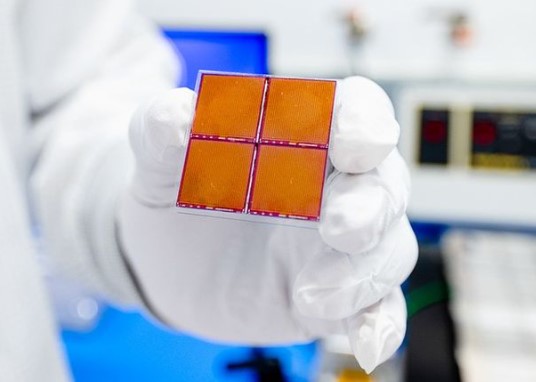
On 11th June, NASA introduced a new gamma-ray sensor named AstroPix. The device will participate in a robotic arm demonstration as part of the Fly Foundational Robots mission, planned for launch in late 2027.
AstroPix is designed to detect gamma rays in a specific energy range, from 20,000 to 700,000 electron volts. By comparison, ordinary visible light carries energy around 2 to 3 electron volts. NASA notes that existing missions like the Fermi Gamma-ray Space Telescope and the Neil Gehrels Swift Observatory already study gamma rays, including higher-energy photons.
Gamma rays represent the most energetic form of light. They originate from events such as lightning in Earth’s atmosphere, powerful solar flares, and violent processes in distant galaxies. A gap exists in detectors with a sensitivity for gamma rays with energies between 500,000 and 1,000,000 electron volts. This band is where gamma-ray bursts—some of the universe’s most intense explosions—shine brightest. It is also where astronomers expect to see strong emissions from active galaxies powered by black holes. The AstroPix team envisions stacking multiple detectors to fill this sensitivity gap in future missions, potentially improving observations of these cosmic phenomena and helping scientists understand the mechanisms behind them.
“The Fly Foundational Robots spacecraft is also a technology demonstration, so the projects were a good fit for each other,” stated Dan Violette, a member of the AstroPix team and a post-doctoral fellow at NASA’s Goddard Space Flight Center. He added that thorough testing is needed before AstroPix can be deployed on future science missions. He noted that similar technologies have flown on scientific balloons, and the current prototype will eventually be part of a sounding-rocket payload. However, many flight opportunities only reach near space, and demonstrations like this are not common for orbital launches.
The AstroPix team aims to deliver the hardware in September. It will be integrated into the Fly Foundational Robots payload and then attached to the spacecraft. The Orbital Replacement Unit will house the chips and all necessary electronics for power, data collection, and transmission during flight. Fitting the hardware into the Orbital Replacement Unit was an opportunity that came about due to the Fly Foundational Robots team realizing that there was empty space inside the unit that could be put to good use.
“The unit already had the volume, power, and data needed to support the AstroPix team’s design,” says Bo Naasz, senior technical lead, In-space Servicing, Assembly, and Manufacturing in the Space Technology Mission Directorate at NASA Headquarters in Washington. “One of our major goals with Fly Foundational Robots is to demonstrate robotic changeout of payloads in orbit, enabling upgrades or improvements to satellites and space instruments at a fraction of the cost of a full mission. Allowing AstroPix to complete its own technology demonstration in orbit is a bonus.”
NASA’s Fly Foundational Robots mission is funded by the Space Technology Mission Directorate’s ISAM portfolio at Goddard. Rocket Lab Robotics will provide the mission’s robotic arm system under a NASA SBIR Phase III award. Astro Digital will host the arm’s orbital flight test through NASA’s Flight Opportunities program at the Armstrong Flight Research Center in Edwards, California. The AstroPix project is supported by NASA’s Astrophysics Division and funded through the Nancy Grace Roman Technology Fellowship.
 Published by James Hydzik
James Hydzik is a technology geek focused on the junction of engineering, writing, and coffee. He joined Orbital Today in 2020 to help make sense of the Johnson government’s decision to buy OneWeb. Since then, he has taken on interviewing and editor-in-chief roles. James learned the ropes of editing and writing with Financial Times magazines, The World Bank, PwC, and Ericsson. Thus far, interviewing New Space movers has put the biggest smile on his workaday face. The son of an Electrical Engineer, James understands the value of putting complex topics into clear language for those with a lay person’s understanding of the subject. James is a European transplant from the United States, and as ex-KA3LLL, he now holds European amateur radio licenses. His next radio project is a portable 10GHz EME (moonbounce) station, as it combines his childhood interests in antennas and space.