
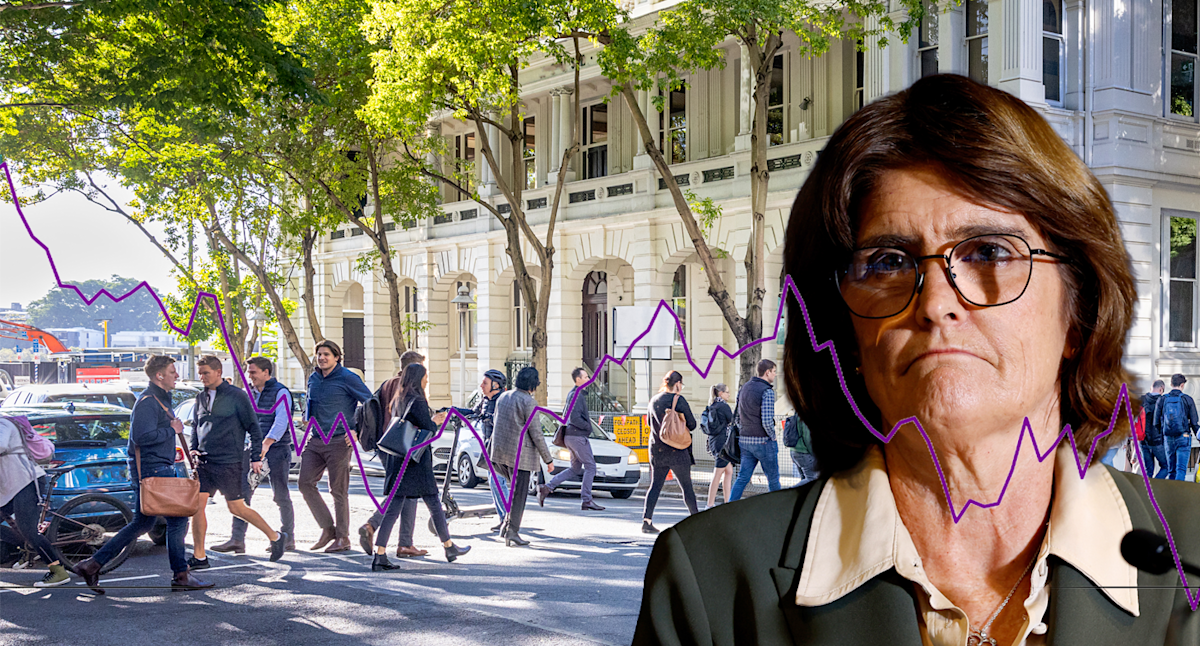
 RBA governor Michelle Bullock has continually lamented the problem embedded in our economy. · Getty
There are mounting concerns inflation is here for longer thanks to the ongoing conflict in the Middle East. Central banks around the world are on alert for any signs of inflation expectations becoming entrenched as they seek to prevent a re-run of the energy price driven inflationary shocks of the 1970s and 1980s.
For Australia, the inflationary impulse from Trump’s war is particularly concerning, with RBA Governor Michele Bullock expressing the view that domestically driven price pressures were already uncomfortably hot even before the US attacked.
Part of that puzzle – and a big part of the concern – is Australia’s weak rate of productivity growth.
RELATED
While there are a number of different ways to measure productivity growth, one of the most common is labour productivity, which is simply the rate at which the level of inflation adjusted GDP per hour worked grows.
The importance of which was summed up by Governor Bullock appearing before the lower house Parliamentary Economics Committee back in February, prior to the war:
“Faster productivity growth allows for stronger growth in incomes and spending without the emergence of inflationary pressures,” she said. That’s what she desperately wants to see.
The problem for Australia is that the economy’s productivity growth has been going more or less nowhere for the best part of a decade, with the exception of a short period during the pandemic which was driven by reversing levels of net overseas migration, pandemic constraints on labour and high levels of government stimulus.
Between the June quarter of 2016 and the latest national accounts figures from earlier this month, productivity has grown by just 0.9 per cent.
 We need to lift our productivity growth to avoid domestic inflationary pressures. · ABS The long view
While there have been other periods in the past during which productivity growth has stagnated, the data reveals that in the past the trend was generally more favourable.
Using a metric which assesses the 5-year annual average rate of compounding growth in order to smooth volatility in the data, the peak in the current ABS data set occurred in the June quarter of 2000 at a figure of 2.9 per cent per year.
As of the latest reading on this metric, productivity is currently contracting at a rate of 0.7 per cent per year.
The trend is not our friend. · ABS International comparisons
When it comes to our Anglosphere peers, productivity growth varies dramatically, with some nations such as the United States streaking ahead, while others such as Canada, Britain and New Zealand have seen their performance be less than stellar.
Story continues
In an attempt to smooth out the impact of the pandemic and its aftermath over time, productivity growth will be assessed from the final quarter of 2019 onwards.
The strongest performer on this basis is the United States, where productivity has risen by 13.8 per cent.
At the other end of the spectrum Australia has seen productivity fall by 0.2 per cent across the same period.
The rest of the Anglosphere has well and truly outperformed by the United States, but is still ahead of Australia, if only relatively marginally.
Australia’s economy is backed into a corner
The are plenty of reasons economists point to when lamenting Australia’s poor productivity growth. Issues such as high, poorly targeted migration, the growing role of government in the economy and the rise of employment in majority taxpayer funded industries are all challenges to confront.
Any major shift is likely to face opposition and carry risks of downside to headline GDP growth and the labour market.
But as the figures from the ABS reveal, the current course of doing little to alter the path the economy also carries risks, largely of potential economic stagnation and higher inflation.
Whether the current government will be willing to embark on that reform, particularly after the Albanese government’s recent budget was so poorly received remains an open question.
Much needed reform to boost productivity growth and the “speed limit” at which the economy and wages can grow without being inflationary is a vital element in returning Australia to a more prosperous path. But it doesn’t appear to be imminent.
The Productivity Commission’s quarterly bulletin released this week reinforced the scale of the challenge.
Breaking down Australian Bureau of Statistics data, the report showed labour productivity fell by 0.6 per cent in the March quarter while hours worked grew by 0.9 per cent. In the year to the end of March, labour productivity was up a paltry 0.3 per cent compared with 2.2 per cent growth in hours worked.
“Australia’s labour productivity growth is going from bad to worse,” commission deputy chair Alex Robson said.
Get the latest Yahoo Finance news – follow us on Facebook, LinkedIn and Instagram.