
JUSTINA: How long would I last in space without a helmet? Should I get a micro fringe? What’s the meaning of life?
AI: 42.
JUSTINA: Cool! How did you know that?
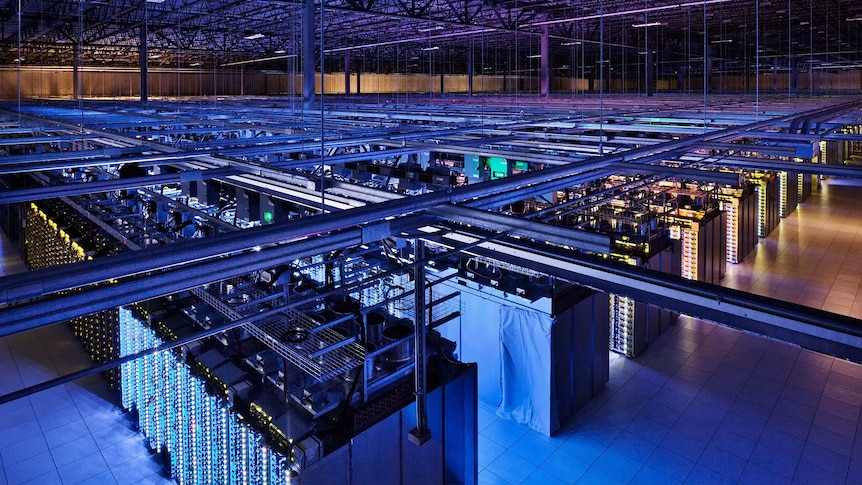
AI: The process happens inside a data centre where billions of electrical signals flow through specialised computer chips called GPUs.
Behind every intelligent question you ask an AI model is a place like this. This is a data centre. They are buildings that run all day, every day to process, store and manage our digital data. And as AI becomes more popular, we’re gonna need a lot of them. In fact, some reckon by 2030, AI companies will need to build around $7 trillion worth of data centres to keep up with demand.
JUSTINA: How much is $7 trillion?
AI: $7 trillion is a seven followed by 12 zeros.
JUSTINA: That’s a lot.
And some of the zeros are being spent right here.
TIKTOK: Here this afternoon in Gore Hill…
TIKTOK: A 123-hectare data centre is coming to Morwell.
TIKTOK: They’re trying to put the 350-hectare AI hub of Victoria there.
Yeah. When it comes to data centres, Australia is pretty hot property, and for good reasons. Our government is pretty stable and so is our land. There’s also a lot of land and other stuff you need to make data centres go. Like power. And these places need a lot of it. Just one large data centre can consume the same amount of energy as 50,000 homes, which is about a Ballarat. It can also need millions of litres of water to cool its systems, and some people aren’t too happy about it.
PROTESTERS: What do we need? ALL: Regulations. What do we need it? ALL: Now.
RUBY: We’re hoping it will get more attention and also put more pressure on our leaders to implement change.
This is Ruby, she’s just taken part in a protest on the Sunshine Coast against a new data centre that’s being built.
RUBY: There’s not really any regulation on how much water they can use or energy they can use or carbon they can produce.
She says this one is more environmentally friendly than some that are being built overseas. In fact, the Australian government says new data centres will be expected to use water efficiently and invest in renewable energy. But some are still worried about the impact of data centres and from AI in general.
ERIC SCHMIDT, FORMER GOOGLE CEO: The question is not whether AI will shape the world, it will. The question is whether you will help shape artificial intelligence.
Right around the world, there have been protests against AI today.
JENNIFER KRILL, PROTESTER: Today, data centres are spreading like cancer all over the landscape.
Studies have shown that young people in particular are worried about how it can impact jobs, privacy, mental health and our societies.
RUBY: There’s an inability for these regulations and laws to catch up with the, um, rate that it’s being implemented into our society, and then also with our understanding of it.
There are also worries about how much Australia will benefit financially from data centres that use our resources.
DAVID POCOCK INDEPENDENT SENATOR: If multinational tech giants are going to use Australian land, Australian energy, Australian water and Australian workers to build the infrastructure that powers AI, then Australians deserve a fair return.
But others say it’s a huge opportunity for Australia. They say AI is going to provide jobs, boost the economy, and by hosting data centres, Australia has a bigger chance of being a part of that.
AI BOT: Data centres boost Australia’s economy and speed up local digital services, while ensuring strict domestic data security and drive new investments into renewable energy infrastructure.
JUSTINA: Cool. How are socks made?
AI: The process of making socks is quite fascinating and involves several intricate steps to ensure…