
The Stanley Cup has been lifted, summer weather is here, and the NHL offseason has officially begun.
With the hockey all settled, the business side of the game should pick up almost immediately. The first buyout window will open this week, as teams around the league go about filling out their coaching staffs. Then, in quick succession, the NHL’s 32 clubs will draft, work through the qualifying offer deadline and then the annual free agent frenzy.
For the rebuilding Vancouver Canucks, under new management following the shocking 32nd-place campaign the team just endured, this offseason offers an opportunity to begin laying a new foundation.
The offseason for a disciplined rebuilding team takes on something of a paradoxical bent. Rebuilding GMs are typically judged not on what they were able to add to their lineup, but on what they managed to subtract. That’s why a team like the Canucks enters the summer with both significant roster needs and no specific pressure to fill them.
For those of you who haven’t been keeping up with the offseason minutiae around the draft and the team to this point in the offseason, let’s get caught up ahead of the traditional silly season. Here’s your Canucks 2026 offseason primer.
Unrestricted free agent questions
This is far and away the least hyped pre-free agency period in recent Canucks history. None of Vancouver’s pending unrestricted free agents is a key figure in a big-picture rebuilding puzzle.
It’s impossible to imagine that Evander Kane, 34, will return.
Teddy Blueger, 31, has been an excellent teammate and penalty killer throughout his Canucks tenure. Younger teammates and fellow veterans alike were quick to credit Blueger’s leadership down the stretch run last season, when a younger Canucks team — just playing out the string — at least began to compete hard and stand up for one another.
Returning Blueger wouldn’t be indefensible if the price is right. He’s a useful player, and probably a sharp value target for a contender in need of reliable centre depth in free agency.
His skill set, however, is better suited to being a finishing fourth-line depth piece. Blueger has demonstrated the ability to move up the lineup in a pinch on a team with serious competitive aspirations, but his value would surely be higher in a team environment where that mattered. In Vancouver, Blueger would mostly just be blocking younger players during a rebuild, not to mention that his player archetype, a left-handed fourth-line centre, has proven increasingly difficult to monetize on the trade market over the past 24 months.
Given the lack of centre options and Blueger’s quality as a teammate and player, if Vancouver were to extend him with an affordable short-term contract, it would be tough to get fussed about it. Provided, of course, the next Canucks head coach proves able to resist the temptation of deploying Blueger more frequently at five-on-five than Marco Rossi.
Derek Forbort sustained a significant injury last season, and you just hope that he’s able to continue his playing career. Vancouver could certainly use another physical lefty with high defensive IQ, given the youthful composition of its blue-line group.
Group VI unrestricted free agent Curtis Douglas is the pending unrestricted free agent player whom Vancouver would be wisest to extend. He brings the sort of toughness and team character that this team will require during a rebuild. Douglas, 26, is a willing pugilist and has the sort of affable good nature that rebuilding organizations generally find helpful to keep around. Even if Vancouver were to extend Douglas, however, it would still need some other players of Douglas’ ilk capable of filling a role higher up the lineup.
On the open market, there’s very little of significance bound for July 1. Presumably, the pending UFA ranks will only thin out over the next two weeks, as teams really start to consider their options.
It will be a challenging market. Most teams will have more cap space than they can find good ways to spend it on free agents.
Can the Canucks still find a way to make free agency work for them? There are certainly radical approaches that Vancouver could consider taking, with appropriate resources, to smartly invest in expediting its efforts to accumulate future assets.
There’s also a reasonably large handful of hardworking, high-character veteran players with local ties — Colton Sissons, Beck Malenstyn and Troy Stecher among them — that would be suitable free agent targets for a rebuilding team to consider. There are several more players with some ability to play a top-nine role and build up their value. Players like winger A.J. Greer, right-handed centre Kevin Stenlund, winger Jeffrey Viel and defender Ville Heinola might be worth speculating on if the price is right.
Identifying needs
Vancouver’s needs, in short, are everything.
This is a team short on top-line talent and short on depth. Short on quality centres, scoring wingers and reliable, veteran defenders who can reasonably log top-four minutes, too.
This is a team that needs to rebuild its star-level core from scratch, which means that the Canucks’ biggest needs have nothing to do with the lineup.
Vancouver is already reasonably well-positioned from a draft capital perspective, both in 2026 and over the medium term. There is still significant work to be done in adding top-round draft selections over the next two to three years, but Vancouver’s position is already appropriate for a rebuilding team.
Currently, the Canucks have 36 picks through the 2029 NHL Draft, a total that closely matches the number of picks made by Montreal (39), Anaheim (36) and San Jose (36) during their rebuilding stints over the previous four drafts.
The Sharks, however, have picked seven times in the first round across the past four drafts, and will do so two more times in June, including at No. 2. The Ducks have made six first-round selections over the previous four years, in constructing their own promising young core.
Vancouver has made a good start in accumulating futures, but this is a team that should be hunting for additional first-round picks, ideally conditional picks that could convey at higher value in future seasons.
Cap and roster space
Vancouver will enter this offseason flush with significant salary cap flexibility, but that doesn’t mean what it used to mean in an era of cap growth.
The Canucks will also enter this offseason with a roster that’s effectively full.
Let’s model this out over at PuckPedia by projecting a full and surprisingly credible 23-man roster, including 13 forwards, seven defenders and three goaltenders:
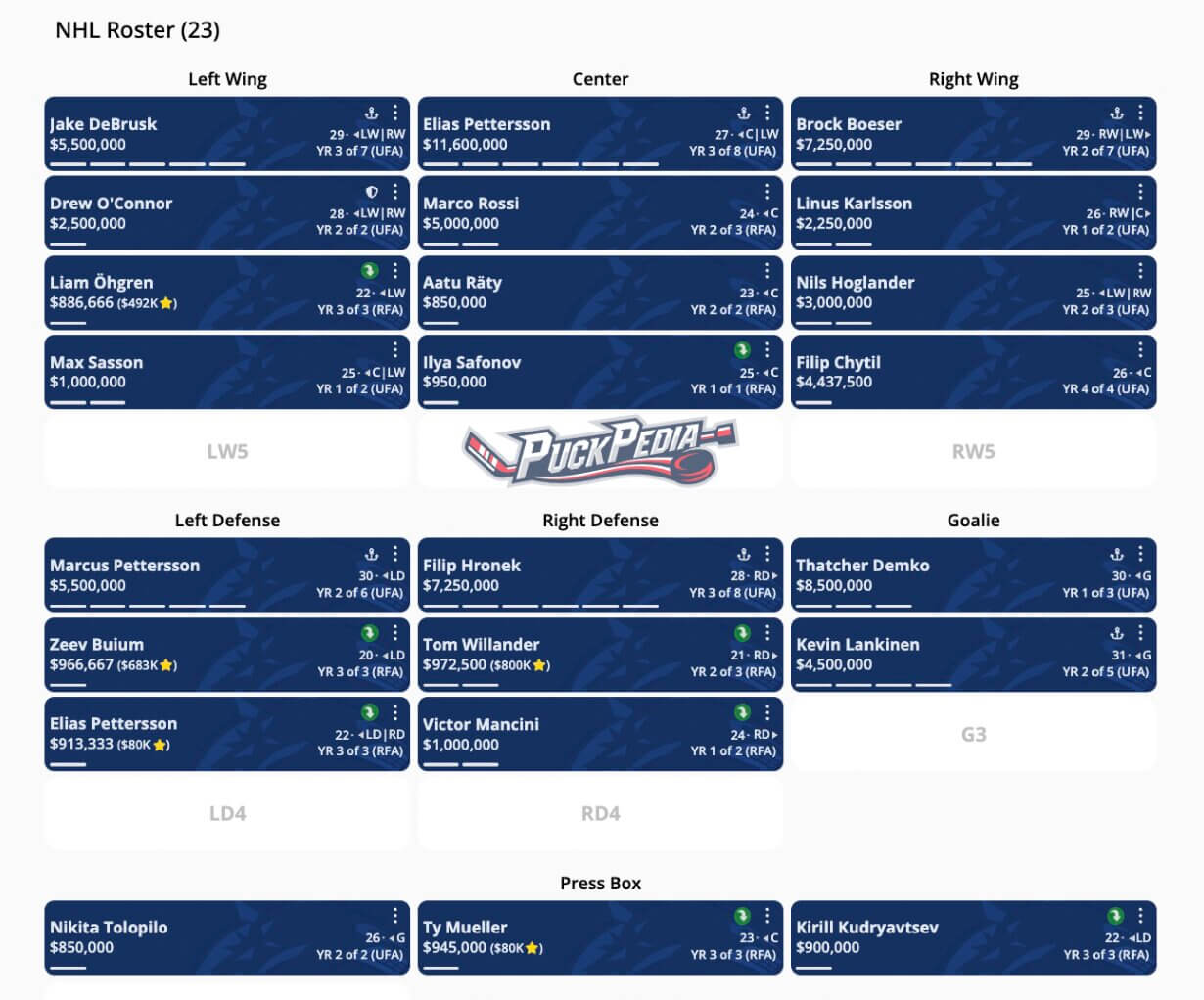
(Courtesy of PuckPedia)
With that roster intact, Vancouver is poised to enter the offseason with well over $20 million in cap space. It’s a healthy sum, especially when you consider that the Canucks are still carrying over $6 million in dead money cap hits due to the Oliver Ekman-Larsson buyout and the money Vancouver agreed to retain in trading Tyler Myers to Dallas.
It’s the roster number crunch that Vancouver will have to be careful about navigating, more than any salary cap considerations.
It’s really at the point where the Canucks will probably need to shed player volume first in order to speculate on veteran reclamation projects in free agency and on the trade market.
Trade chips
Given Vancouver’s roster position, it seems only sensible to expect that the new Canucks brain trust will be motivated to continue the deconstruction of this roster. It’s probably the primary question of Vancouver’s offseason: “How aggressive will Ryan Johnson and company look to be in shedding long-term cap and salary liabilities to create the space required to build something fresh?”
Here are the key trade assets that we’ll be focused on as this offseason unfolds:
Filip Hronek: The soon-to-be 29-year-old right-handed defender is the last remaining veteran player who is also a premium trade asset. Hronek has total sway over the decision for another two seasons and appears settled in Vancouver, but these things tend to be negotiable. The Canucks will have to weigh the wisdom and risks of carrying a depreciating asset of Hronek’s value and calibre during the depths of their rebuild.
Jake DeBrusk: DeBrusk is widely viewed around the industry as the most likely of Vancouver’s veterans to be dealt this summer. The veteran winger has a full no-move clause through the 2026-27 league year, and is a consistent — if streaky — 20-goal scorer and net-front power play ace, who’s also a high-end skater. That should carry some measure of value, although the term remaining on DeBrusk’s deal will probably limit his trade value somewhat.
Elias Pettersson, the centre: A one-time top-line centre who has performed at the level of a 3C for two and a half years now, Pettersson still has six years remaining on his $11.6 million per season contract, which also carries a full no-movement clause. The structure of Pettersson’s deal will make him more valuable in the future than he is today, even if he never recovers the dynamic form that first earned him this contract. On the other hand, given the organization’s constant commentary about his habits and preparation, it’s certainly fair to wonder if he’s the right presence for the organization to keep around through the early stages of a forthcoming youth movement?
Nils Höglander: With two years remaining on a three-year, $3 million per season deal that Höglander signed before the start of the 2024-25 campaign, Höglander is relatively expensive for a winger who has never been able to earn the trust of three separate coaches required to contribute regularly in an everyday top-nine role. There’s no questioning Höglander’s work ethic, motor or skill level, but he’s yet to put it all together. If the club were to make Höglander available, he would probably still have some measure of cachet with some NHL teams.
Drew O’Connor: O’Connor is coming off a very good season in which he converted shots into goals at an elevated percentage, worked hard consistently, carried himself like a consummate professional and contributed helpfully in a variety of phases of the game. The veteran winger is entering the final year of his deal, and seems likely to be sold eventually, whether it’s this summer or at the trade deadline. Will the Canucks be tempted to get out ahead of it, given their overall roster crunch entering this offseason?
Draft considerations
The Canucks will select third at the NHL Draft, and the general industry consensus has strongly linked them to OHL centre Caleb Malhotra ever since the draft lottery. The Athletic has heard throughout this process that Chase Reid has been in the mix for Vancouver near the top of their draft board.
Of course, there’s also the possibility that San Jose opts to draft a defender with the second pick. Would Vancouver really pass on a potential NHL-ready star winger like Ivar Stenberg if he were still available at No. 3?
At the NHL Scouting Combine in Buffalo, N.Y., earlier this month, Vancouver cast a wide net when interviewing prospects that may be considered with the Canucks’ pick at No. 24, which was acquired from the Minnesota Wild in the Quinn Hughes trade. Casey Mutryn and Preston Mathis are among those names we’ve heard linked to Vancouver.
All told, the Canucks own four selections in the top 50 and are slated to make 10 picks overall. The draft is by far the most important date on the NHL calendar for Vancouver in its current state.