
It sought. It located. It exterminated.
Ukraine has revealed the first known case of an entirely AI-controlled weapon targeting – and killing – human beings.
“We tried it. It’s a test,” Ukrainian drone manufacturer Alexander Kokhanovskyy told New Scientist.
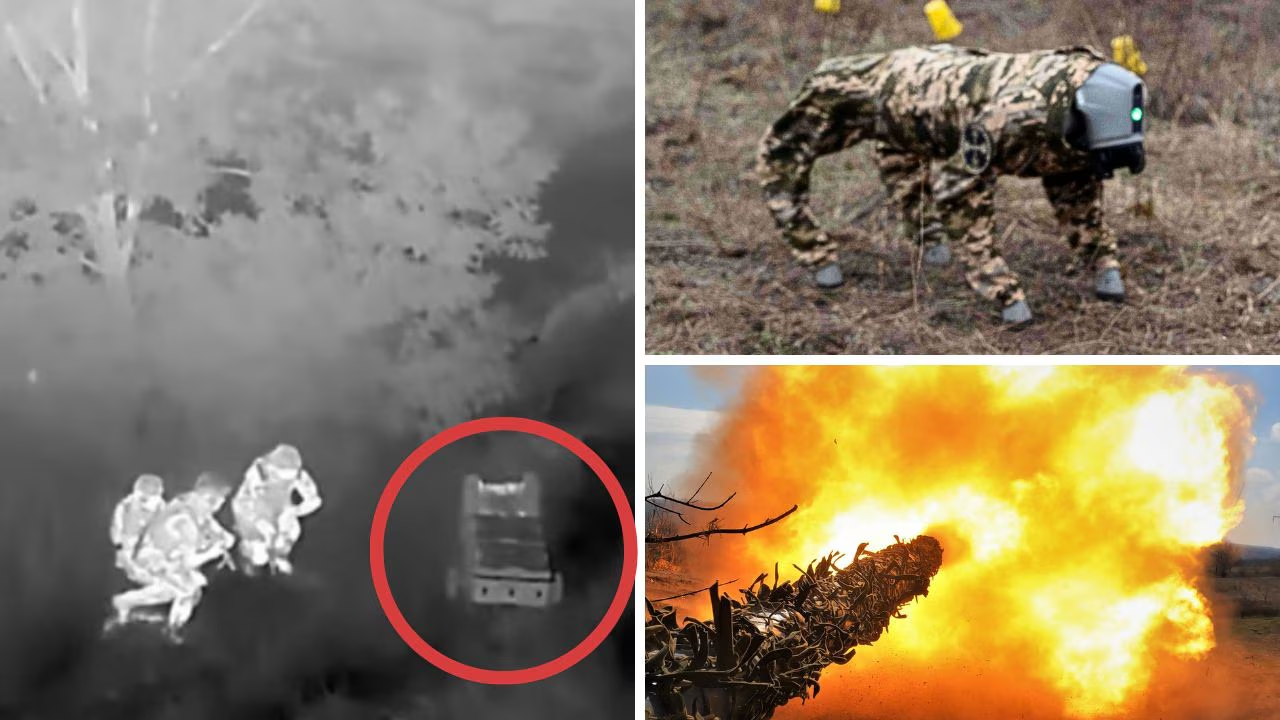
The successful hunter-killer quadcopter drone reportedly took to the skies two years ago. It was fully autonomous. It had no communications links. It flew 5km to a designated patrol area. There, its on-board artificial intelligence detected and identified two Russian soldiers.
Then it killed them.
Kokhanovskyy, speaking at an embassy event earlier this month, said a human-operated surveillance drone confirmed the AI had detonated above a “couple” of Russian soldiers beside a truck.

The attack reportedly took place near the cities of Bakhmut and Chasiv Yar in eastern Ukraine’s Donetsk Oblast.
“We never implemented it [more widely],” Kokhanovskyy added.
Currently, Ukraine insists a human must be involved in the final “trigger” phase of any autonomous attack. But it is reportedly considering removing this requirement.
“AI will form a new paradigm of warfare. It’s already actively doing so,” Danylo Tsvok, Ukraine’s Defence Ministry chief of AI operations, told media at the weekend.
He wants quadcopters, wheeled and tracked vehicles and robot dogs integrated as “one single living organism that can operate in a co-ordinated manner”.
What could possibly go wrong?
‘Oppenheimer moment’
Ukraine’s “A1” Defence AI Centre was created last year to standardise and unify Ukraine’s autonomous defences into a single system. This is to further accelerate the “kill chain” – locating, identifying, analysing and acting – process of combat operations.
“The system that possesses more data and better understands that data, proposes solutions — that system will gain the advantage over the other,” he said.
“Then the question arises: how do we keep up with making decisions that autonomous systems propose?”
Humans are already considered the AI kill-chain’s weakest link.
They take seconds to think. Not nanoseconds.
And hesitation can cost lives.
Or save them.
Giving the power of life or death to such software has unsettled British House of Lords peer Baroness Arminka Helic.
“A phrase increasingly heard in defence and arms-control circles is the ‘Oppenheimer moment’,” Helic told a debate last week.
Once unleashed, can the proliferation of killer robots be contained? Can they be controlled?
“Autonomous weapons may represent a technological threshold comparable in significance with the advent of nuclear weapons,” the conservative peer warns.
“Unlike nuclear weapons, however, autonomous systems are comparatively cheap, scalable and accessible. The barriers to proliferation are low while the potential for misuse is considerable.”
‘Off-the-shelf’ killers
“On the battlefield I did not see a single Ukrainian soldier. Only drones,” the Centre for Strategic and International Studies (CSIS) quotes a captured Russian soldier as saying.
“I saw them [Ukrainian soldiers] only when I surrendered. Only drones, and there are lots and lots of them. Guys, don’t come. It’s a drone war.”
It could soon become a clash of terminators.
“We just launch it and we know everything will be dead – everything that will be found there in this particular area will be dead,” Kokhanovskyy said, describing the effect of AI-brained hunter-killer quadcopters.
“There is no connection to the drone at all, you cannot see the video, nothing … Everything it sees will be killed.”
Guided missiles have long been autonomous. They are fired at a human designated target (a building, bunker, ship or aircraft). They fly to the target. They detonate.
Now, AI can choose a target by itself.
“AI significantly enhances specific functions, such as drone footage analysis and target recognition, target tracking, and autonomous navigation, including last-mile navigation and sound and text analysis for intelligence extraction,” CSIS analyst Kateryna Bondar writes in a recent report.
Quadcopters are the obvious first step.
Modular components are already being built to repurpose commercial drones into weapons with specific tasks. Now it’s developing bolt-on, modular AI.
“Ukraine’s defence industry is developing stand-alone AI-driven software that can be integrated across various platforms to expand battlefield autonomy,” Bondar states.
“It comes in stand-alone modules, consisting of compact chips with embedded software and sometimes cameras. These modules can be integrated into a range of platforms, from small FPV drones and long-range-strike drones to turrets mounted on unmanned ground vehicles.”
March of the machines
The world’s first ever robot-only attack was conducted by Ukraine in 2024. A small unit of co-operating, semi-autonomous drones and quad bike-sized ground vehicles successfully attacked and seized a Russian emplacement. Two of the ground robots got stuck. Despite having humans on ‘overwatch’.
But Ukraine has learned a lot since then.
It’s betting big on a new, mass-produced, multi-mission ground vehicle system dubbed Legit.
Costs are being kept to between $A16,000 to $A30,000 each (depending on size) by using commercial components used in toys and recreational vehicles. These can be fitted with machine guns, rockets, stretchers or cargo modules.
Ukraine says it hopes to replace one-third of its soldiers fighting on the front lines with similar uncrewed vehicles within a few years.
And the Legit could operate in “terminator mode”, without human control. Or frailty.
“By removing the need for constant manual control and stable communications – both of which are vulnerable to electronic warfare and lack of operator skills – drones enabled with autonomous navigation raise the target engagement success rate from around 10 to 20 per cent to around 70 to 80 per cent,” CSIS’s Bondar explains.
It’s a degree of efficiency Kokhanovskyy yearns for. His firm manufactures interceptor drones – small, fast machines designed to destroy incoming kamikaze drones before they reach their target.
“Every step of this one can be either manual or automatic. We’re not allowed to do the final stage automatically,” he told New Scientist.
“I would love to.”
Jamie Seidel is a freelance writer