
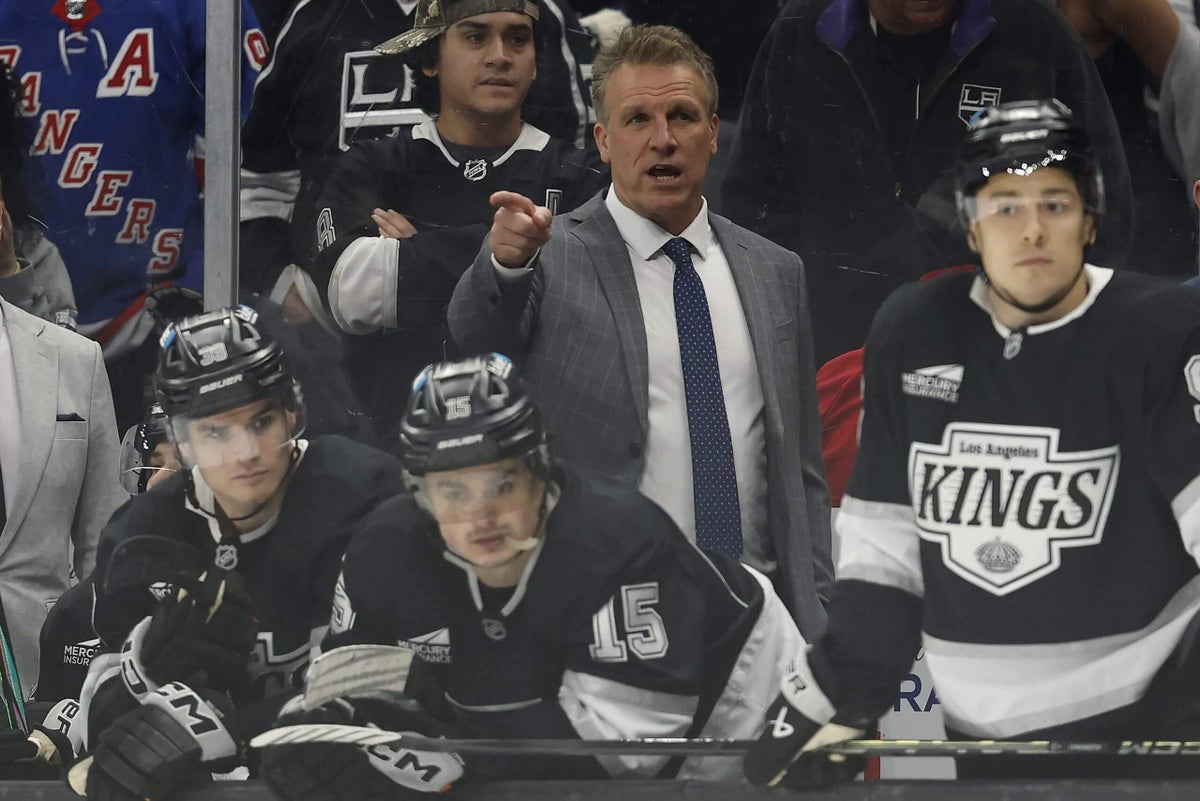
You have to hand it to new Toronto Maple Leafs general manager John Chayka in terms of whom he really had in mind to coach the Leafs. Who had Jim Hiller as a candidate? Who had someone who flamed out with the Los Angeles Kings just 3 1/2 months ago?
Hiller is getting a second go as an NHL head coach, and it’s a franchise he is familiar with, having spent four years as a Leafs assistant under Mike Babcock. As he hits the ground running, the 57-year-old can certainly lean on relationships he forged with Auston Matthews, William Nylander, John Tavares and Morgan Rielly — provided that Rielly, a potential trade candidate, remains with the club.
What can Hiller bring to the Leafs from his L.A. experience as he returns to The Center of the Hockey Universe? The narrative that he gifted his last playoff series to the Edmonton Oilers with botched decisions still has legs, and without question, it proved to be the turning point in his time coaching the Kings. But what gets shoved into the background is that the Kings found success with him in charge — at least until pivotal moments.
When the Kings ran aground in 2024 in a terrible January that got Todd McLellan fired after a 16-4-4 start (which included 11 straight road wins to open that season), Hiller was tabbed to handle the coaching duties on an interim basis. His mission was simple: Get the Kings in the postseason. It was a logical ask given Los Angeles had been a playoff team the previous two seasons and was very much on a win-now track.
Is Viggo Bjorck the best center in the NHL Draft?
Corey Pronman, Scott Wheeler and more
Hiller got the Kings back on the rails with a 21-12-1 stretch run after the All-Star break that resulted in the team removing the interim tag, rewarding him with a three-year contract. Influential players backed him. One of the strong statements of support came from Drew Doughty, who said he wanted him to be the coach. “And I knew that right from the first time he took over,” Doughty said. “I was asking for it.”
“They could have went in a bunch of different directions,” Hiller told The Athletic in a 2025 interview. “I can say this with full confidence. I felt that I was the best person for the job at the moment. I really did. And I thought if they don’t see that, then they don’t see that. I just felt that.”
One of Hiller’s strengths is interpersonal communication, and he leaned on that, perhaps offering himself as a respite from the direct and blunt McLellan. He connected with the Kings’ top players, and that ability should help as he re-engages with the Leafs’ stars. It didn’t always work — he couldn’t get the enigmatic Pierre-Luc Dubois to have a big impact, just as McLellan couldn’t — but Hiller managed to get the mercurial Kevin Fiala to play more responsibly while still allowing the talented left wing to produce offensively.
Hiller’s relationship with Fiala held up well even after the winger was benched for taking a bad penalty or committing an unforced turnover. Or, in one instance, a healthy scratch when he overslept and missed a team bus, causing him to be late for the team’s usual game-day meeting. Veteran players bought in, and that was necessary with the Kings built to win with depth instead of being carried by a starry Core Four.
Their defense-first, collective approach and Hiller’s maneuvers coalesced in a 2024-25 season that put them in position to finally break the Oilers’ stranglehold on them in playoff meetings and advance in the postseason for the first time since the 2014 Stanley Cup victory. In the fourth straight matchup, the Kings finally gained home-ice advantage after finishing second in the Pacific Division. Team records they either set (105 points) or tied (48 wins) made for one of the franchise’s best regular seasons.
Everything, of course, turned for Hiller when that 2025 series shifted to Edmonton after the Kings grabbed a 2-0 lead. His disastrous Game 3 challenge, which sparked the Oilers’ third-period comeback, was rightly lambasted and helped turn the series, but his player deployment as it went on was the greater misstep. After another blown lead late in Game 4, the Kings’ Game 5 at Crypto.com Arena was one of the worst a playoff team could play and was another poor reflection on their coach.
Through input from leading players eager for change, Hiller tried to move the Kings beyond the 1-3-1 neutral zone trap, but he still had the Kings playing with a conservative bent, particularly when they led. A forward in his playing days and someone who ran power plays while as an NHL assistant — including his time with the Kings — Hiller’s L.A. teams still didn’t move the needle offensively. Over 175 games, the Kings were tied for 24th in scoring and converted just 18.7 percent of their man-advantage situations.
Was that Hiller adhering to an organizational philosophy? Was it him being unable to maximize what his best offensive players could do? We’ll see what he does with the Leafs, who, with a healthier Matthews and the gifted Nylander, possess top-of-the-league types the Kings didn’t have.
Hiller initially showed he could adapt. While Doughty was sidelined for the first half of 2024-25 with a broken ankle, Hiller often went to an 11-forward, seven-defenseman lineup. Vladislav Gavrikov emerged as a versatile shutdown force with Mikey Anderson. Brandt Clarke took the necessary developmental strides. Joel Edmundson came in and was better than expected. The Kings gave up the fewest five-on-five goals across Hiller’s three seasons. They routinely put up strong possession metrics and defensive stats, something Hiller has always liked and you figure appealed to the analytically minded Chayka.
And Hiller was quicker than McLellan to move his forward personnel around when things didn’t work. He pushed the right buttons throughout 2024-25 until the playoffs. But it’s also fair to question whether that season was also propped up by Darcy Kuemper’s Vezina-finalist performance and other career-best efforts, such as that of the since-traded Warren Foegele.
Hiller’s work with younger players will be scrutinized, as it was in L.A. The results with the Kings were mixed at best. Alex Laferriere has shown steady growth into an important piece. Quinton Byfield transitioned back to his natural center position but eventually stalled under the coach. Clarke got more ice time and performed the best out of all Kings defenders this past season, but he still was never trusted with the toughest minutes. Alex Turcotte, the No. 5 pick in 2019, has yet to find a fixed spot. Let’s not forget how Jordan Spence was essentially ushered out of town after being turned into a bit player against Edmonton.
It is in the biggest moments Hiller dropped the ball. His generally passive demeanor behind the bench didn’t help, particularly when the Kings lost the identity they had in an underwhelming 2025-26 marked by rampant inconsistency. It increasingly looked as if he was out of answers. Former assistant D.J. Smith was recruited to light their fire in the role Hiller once had and used to his benefit.
But when things are going right, Hiller can be an effective coach who can relate to players and get them on board.
“He’s a very intense guy,” said Kopitar, whose Hall of Fame-worthy career ended with the Kings’ playoff loss to the Colorado Avalanche. “He’ll let you know if things are going right or if things are going wrong. That’s obviously accountability. He is a straight shooter. Calls it the way he sees it.
“That’s good. You want to know where you stand. He lets you know. The good or the bad.”
During Hiller’s most successful season, Edmundson drew what is now an ironic comparison between Hiller and the coach he is replacing in Toronto. Craig Berube was fired by the Leafs last month after two seasons.
“They’re both guys that you want to play for,” said Edmundson, who won the Stanley Cup with Berube in St. Louis. “They bring the best out of every player. Very intense but they also joke around and have a fun side at the same time. Someone you want to go to war for.”
Even when his final Kings season collapsed around him, Hiller maintained a professional, even congenial, relationship with media members, and that can serve him well in the cauldron that is Toronto. More power to him if he can do that in hockey’s most relentless market, as his decisions will be debated daily, well beyond the scrutiny he faced in Los Angeles.
Times when things aren’t going Hiller’s way will show how much growth he’s made since his firing. Whether he can make the right calls in crunch time. Whether he can bring out the best in Toronto’s younger talents. Whether he can inspire a Leafs club that is in transition.
Knowing the market as he does and heading into a situation where expectations should be scaled back as he takes over a last-place team, Hiller could shine if he can turn the Leafs in the right direction. In that minefield of an Atlantic Division, it won’t be easy. It could reveal someone who does better the second time around, as many other NHL head coaches have done.
Or it could reveal someone whose best work is when he’s not the one in charge.