
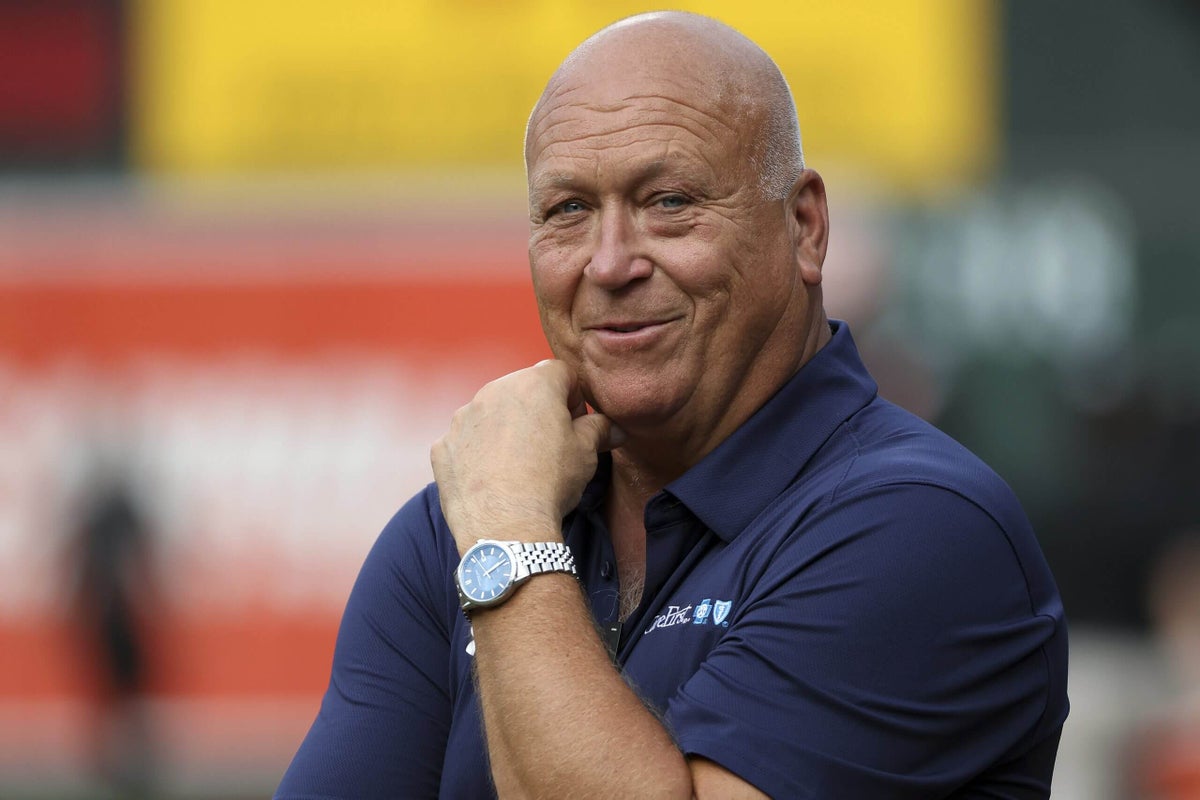
Cal Ripken Jr. sits in his front-row seat at Camden Yards and watches Baltimore Orioles players make correctable mistakes nightly. Surely, it grates him.
A long time ago, in a baseball galaxy far, far away, the Orioles followed a guiding set of principles known as “The Oriole Way.” Originating in the 1950s by legendary executive Paul Richards, catcher Elrod Hendricks once described “The Oriole Way” as “never beat yourself.”
Ripken, meticulous in his efforts to master every nuance of the game, came to embody the philosophy during his Hall of Fame career.
Now, as a part-owner of the Orioles, he’s contributing to an effort to revive the organization’s emphasis on fundamentals. Ripken, 65, is taking a more active role in player development, according to people briefed on his involvement but granted anonymity to discuss it. This is the first time Ripken, who retired as a player in 2001, has taken such a hands-on approach within the organization.
Ripken’s involvement follows the hiring last November of former big-league manager Mike Shildt, who became the organization’s coordinator of instruction in the minor leagues, a newly-created position emphasizing fundamentals.
Orioles president of baseball operations Mike Elias sought out the expertise of both Shildt and Ripken on player development and over time has leaned more heavily on Ripken’s baseball acumen, according to people briefed on the situation.
Ripken and Shildt enjoy a relationship dating back to 1980, when Ripken was at Double-A Charlotte and Shildt worked in the team’s clubhouse. Both share an affinity for the importance of cutoffs, relays and bunt plays, fundamentals the Orioles are actively trying to incorporate in development.
The shift toward emphasizing small details isn’t just in the minor leagues. First-year manager Craig Albernaz, another agent of change, recently invited public scrutiny when he declined to start star rookie Samuel Basallo from June 8-10. Albernaz, according to people briefed on his reasoning, was trying to send Basallo, 21, a message about playing through minor ailments and what it takes to succeed as a major-league catcher.
Albernaz, Elias and Ripken all declined comment for this story.
Albernaz, who previously worked for Tampa Bay and Cleveland, two lower-revenue organizations that generally get the most out of their talent, seemingly viewed the Basallo matter as an important step toward instilling a new culture — one that will include crisper play.
“The issues we’re trying to address are the small, stupid little mistakes that younger teams make,” said injured pitcher Chris Bassitt, 37, who signed with the Orioles this winter and acknowledged his 5.27 ERA as a factor in the team’s sluggish performance. “We’re a team that tends to give away outs. We’re a team that tends to give the other team extra outs with errors or mental mistakes. We need to clean up the way we’re playing the game.”
The Orioles often were a strong fundamental team under Buck Showalter, who managed the club to three playoff appearances between 2010-18. They also succeeded on the margins under Brandon Hyde between 2022 and 2024, when they tied the New York Yankees for the second-most wins in the American League.
But if a metric existed for teams that routinely beat themselves — call it Botched Plays Above Average — the more recent versions of the Orioles probably would be among the league leaders. The current group, 35-40, is 11.5 games back in the AL East and two games back in the wild-card race. And the pressure on Elias only will increase if the team is again unable to take a step forward.
Elias, upon taking over in November 2018, aggressively modernized the Orioles in a way they sorely needed by embracing new technology and analytics. The perception, both inside and outside the organization, is that offense moved to the forefront of their position-player development, in part because of increasingly available swing data. Fundamentals were not ignored. But they weren’t emphasized, either.
The Orioles, after years of tanking to secure high draft picks, rebuilt around young position players. Not all succeeded, but catcher Adley Rutschman finished second for AL Rookie of the Year in 2022, shortstop Gunnar Henderson won the award in 2023 and outfielder Colton Cowser finished second in 2024. The team made the postseason in the latter two seasons, yet failed to win a game.
Elias eventually recognized that the Orioles fell behind in teaching basic fundamentals, leading to his desire to incorporate the expertise of Shildt and Ripken. People briefed on Ripken’s involvement say that in addition to becoming more visible at spring training, he is in regular contact with Elias and talking to minor-league coaches and instructors as well. He even participated last fall in manager interviews, including Albernaz’s.
The Orioles rate as average or worse in many defensive and baserunning metrics. Poor fundamentals, however, are an industry-wide problem, borne in part out of the increased focus teams place on hitting and pitching metrics, starting in the minor leagues.
“We’re covering things I don’t think had to be covered as much 20 years ago,” said Philadelphia Phillies infield coach Bobby Dickerson, a former Orioles instructor. “Talking to friends of mine in the league, the things you used to be able to assume, you don’t assume ’em anymore.”
First baseman Pete Alonso, who joined the Orioles this season on a five-year, $155 million free-agent contract, said minor-leaguers are less prepared for the majors than in the past, in part because of schedule changes Major League Baseball instituted in 2021.
Starting that season, minor-league teams began playing six-game series to reduce their travel, with days off every Monday. Many organizations also give position players an additional day off during the week.
“The setup of the minor leagues now, I think it’s probably the most comfortable it’s ever been,” Alonso said.
Alonso also believes minor leaguers are simply not being taught to play the game way they once were.
“The gamesmanship in a level of higher play, I feel like that is missing for sure, and that’s just the system,” Alonso said. “Now guys have to learn at the highest level, which is really, really damn hard.”
By virtually all accounts, Basallo is not only talented, but also hardworking and intelligent. A native of the Dominican Republic, Basallo is bilingual and capable of navigating a game plan behind the plate. Last August, just five days into his big-league career, the Orioles signed him to an eight-year, $67 million extension.
By no means, though, is Basallo a finished product. The accelerated development process for top prospects in today’s game often results in them arriving as raw gems, requiring further polish.
Basallo reached the majors quickly, making his debut just after turning 21, a particularly young age for a catcher. Atlanta Braves catcher Drake Baldwin, when he won National League Rookie of the Year last season, was 24.
Basallo played only 97 games at Triple A. He has played only 93 in the majors. He is trying to master the game’s most demanding position. And he can be emotional, sometimes to the point of crying out of frustration in the dugout during games, according to multiple sources.
When Albernaz held Basallo out of the lineup for three straight games, it created a public stir. The benching came after the catcher — who has a .788 OPS — left two of the previous three games prematurely, the first with right abdominal discomfort, the second with left wrist discomfort. Basallo also was scratched on May 11 with left knee discomfort.
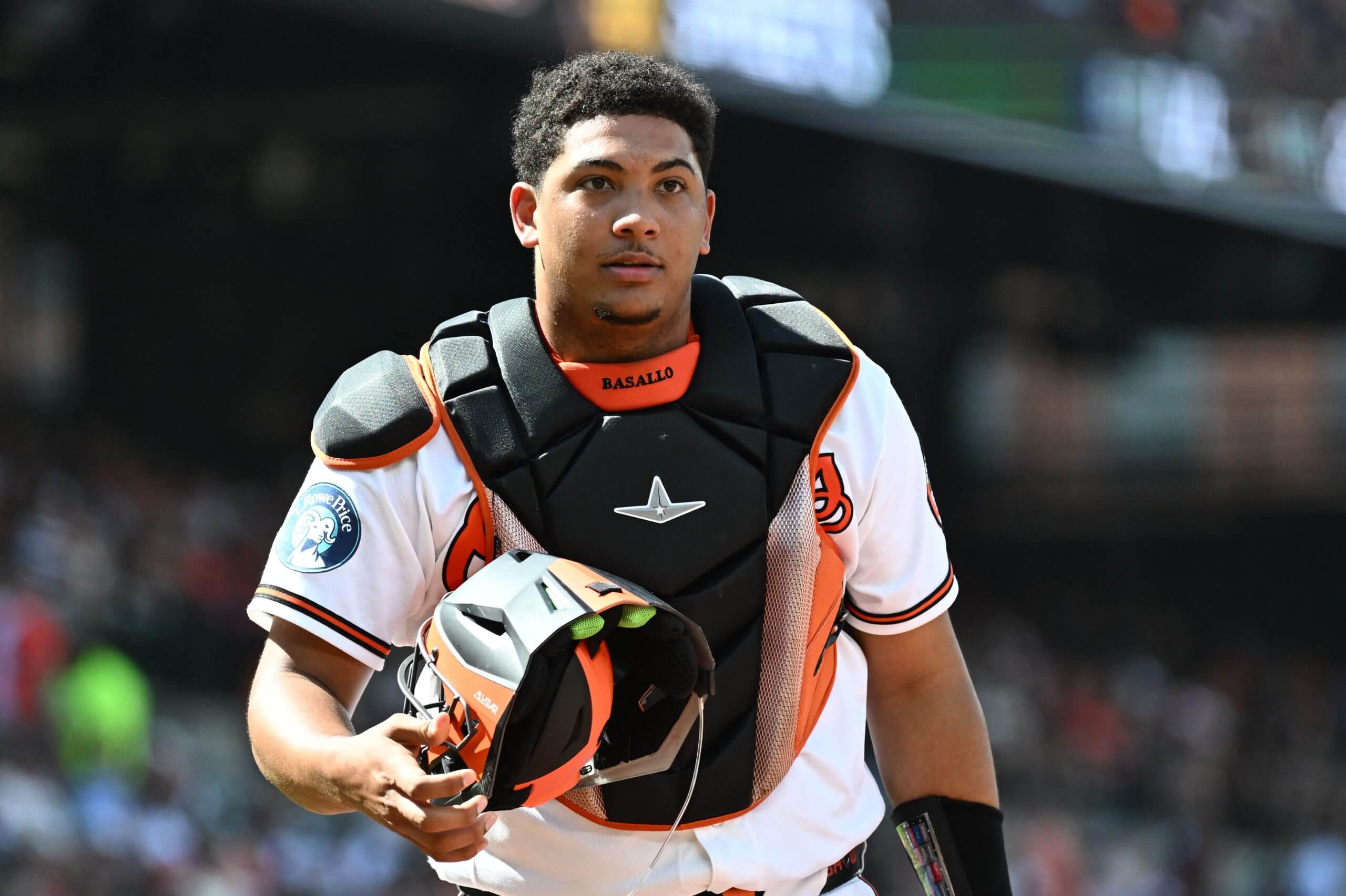
Samuel Basallo signed an eight-year extension with the Orioles last August, just five days after his major-league debut and nine days after turning 21. (James A. Pittman-Imagn Images)
Albernaz told local reporters Basallo is “learning a lot how to play through being nicked up when everything is checked out and everything is fine.” He later revealed a bony growth in Basallo’s wrist as another minor ailment the catcher would need to endure.
Behind the scenes, according to people briefed on the situation, Albernaz and his staff had other concerns as well.
They wanted Basallo to engage more with teammates, better connect with pitchers, and acknowledge those who were trying to help him. Small things, in the Orioles’ estimation. But things that needed to be addressed before they developed into larger problems.
“I don’t want to get into it, but we talked,” Basallo told The Athletic.
He and Albernaz?
“Yes, we talked about it. I don’t want to get into more.”
Albernaz, a former catcher in the Rays’ minor-league system and catching instructor with the San Francisco Giants from 2020 to ‘23, came under public fire from fans. Hall of Fame broadcaster Jim Palmer openly questioned on-air if the Orioles, amid a four-game losing streak, should be trying to teach a lesson to one of their best hitters.
But Albernaz, who was bench coach for the defensive-minded Guardians the past two seasons, is trying to instill a new culture. A culture in which Basallo, armed with a long-term contract, figures to play a major part.
Since sitting entirely on June 10, Basallo has played in six complete games entering Thursday. One Orioles person compared his flareup to a pebble in Basallo’s career, not a boulder. Another said Basallo already is taking steps to becoming a better teammate.
“He’s a super-talented kid. I think he’s really, really good,” Bassitt said. “Yeah, there’s definitely some maturing aspects that need to be done. But he’s young. I don’t think that’s a negative by any means. He’s just young.”
Albernaz is dealing with bigger issues.
In one of the most basic measures of defense — defensive efficiency, or the rate of batted balls in play that are converted into outs — the Orioles were tied for the third-worst team in MLB entering Wednesday.
Rutschman’s excellence at catcher props up their rankings — entering Wednesday — in Outs Above Average (22nd) and Defensive Runs Saved (15th). The metrics overall show improvement since the first six weeks of the season. Still, the numbers do not fully account for all of the subtle ways teams can lose games on the defensive end.
Connecting the Orioles’ fielding inadequacies in the majors directly to their lack of attention to defense in the minors would be a stretch; Rutschman, Henderson and Cowser all came up through their system. Then again, so did second baseman Jackson Holliday and third baseman Coby Mayo, and neither is a particularly good defender.
With Shildt’s hiring and the increased involvement of Ripken, the Orioles clearly are seeking improvement throughout the organization. But industry-wide, player development is more challenging than in the past — and not simply because the minor-league schedule is cushier than the major-league one.
“The problem is they aren’t allowed to use tough love anymore down there,” said Showalter — who last managed with the New York Mets in 2022-23 — about the minors in general now. “There’s a certain softness bred there now, especially if you’re a top pick.”
Times change. Those from older generations often perceive those who are younger to lack fortitude. But San Diego Padres third baseman Manny Machado, the Orioles’ top pick in 2010, said he benefited from the stern approach of Showalter and his coaching staff — the kind of approach Albernaz took with Basallo.
“I had Buck who was a hard-ass who kind of kept you on your toes,” said Machado, who made his big-league debut at 20. “But the main thing was just the coaches. (I had) really good coaches that helped push me, talk me through it, helped me out through the struggles, how to work through your emotions, how to deal with the ups and downs of the game.”
Bassitt said he thought managers should be harder on players sooner in their careers.
“The problem is, if you’re not going to do that in Low A, High A or Double A, eventually you’re going to have to do it,” Bassitt said.
“And then all of a sudden the spotlight is on when you do do it. And then it’s like, why are you doing this to this person? It’s like, well, this person should have had this done to him for four straight years.”
The money teams spend on top draft picks and international amateurs — and the attention those prospects receive — often create other issues. Teams do everything possible to make those players as comfortable as possible, occasionally leading to a sense of entitlement.
The Orioles’ Mayo, upon being demoted in the spring of 2025, said, “It obviously sucks because you feel like you’ve proved everything you needed to.” He later clarified his remarks, saying he was, “frustrated in the moment.” More than a year later, the player The Athletic’s Keith Law rated as the game’s No. 18 prospect in ‘25 is still not an established major leaguer.
Any player will tell you: the majors are just different.
“In the big leagues, everything matters,” Orioles outfielder Leody Taveras said. “You have to focus every second of every day. In the minors, as a young guy, you can take time to just chill sometimes. In the big leagues, you can’t do that.”
Veteran presence often helps. Elias belatedly acknowledged the Orioles’ need in that area last offseason by signing Alonso, Bassitt and closer Ryan Helsley and trading for outfielder Taylor Ward.
Alonso, for one, is eager to fill that role.
“There’s a reason why I’m here. I know what good teams look like and I know what bad teams look like,” said Alonso, who appeared in two postseasons with the Mets.
“My job, first and foremost, is to perform and be the best player I can be. That’s 1A. 1B is to kind of be a shepherd and help this position-player group understand what winning in championship baseball looks like at the big-league level.”
If the first step to addressing a problem is recognizing the problem, then the Orioles are at least moving in the right direction. With the hirings of Albernaz and his coaches. With the additions of Alonso and other veterans. With the increased emphasis on fundamentals under Ripken and Shildt.
Change is necessary. A stronger identity must develop. A new Oriole Way must form.
“To me, this is a life thing,” Bassitt said, speaking generally of the industry. “It’s like, do you blame the kids, or do you blame the adults? A lot of the issues within the game today, I blame the adults.
“You guys are creating all of this. Then you want to complain that these kids are having these issues and the game is the way it is when you guys are setting the standard.
“You guys are the so-called parents of the game. We’re putting our trust in you in the minors. If you’re not addressing those problems, then don’t complain to me when those problems get exposed.”