

Dr. Anil Kumar Angrish

Co-Author,Monika
AYUSH stands for Ayurveda, Yoga and Naturopathy, Unani, Siddha, and Homoeopathy. With the subsequent formal inclusion of a sixth system, Sowa-Rigpa (the Tibetan system of medicine), the acronym is now more completely understood to represent six systems. International trade for AYUSH products like other category of goods, is recorded and regulated through the Harmonized System (HS) of nomenclature. Under the Indian Trade Classification based on Harmonized System of Coding (ITC-HS), Indian customs authorities use an eight-digit code structure to meet the specific classification needs of the domestic market, organised into two separate schedules: the ITC (HS) Import Schedule and the ITC (HS) Export Schedule. The export of Ayurvedic products specifically takes place under two principal HS codes: 30039011 (for “medicants” of the Ayurvedic system) and 30049011 (for “medicaments” of the Ayurvedic system). Parallel codes exist for the other recognised AYUSH therapeutic systems – Unani, Siddha, Homoeopathic, and Bio-chemic – following the same numbering logic.
The AYUSH export basket of India is composed of two broad categories of products: (i) Botanical raw materials and plant-based inputs, and (ii) Finished Medicament formulations belonging to recognised therapeutic systems. The Therapeutic System formulations are classified under four principal systems – Ayurvedic, Unani, Homoeopathic, and Siddha – each representing a distinct and institutionally recognised school of traditional and alternative medicine. Eight (08) HS codes specifically represent finished medicament exports attributed to one of these four AYUSH systems. These are the only HS codes in the dataset of 43 HS Codes that are explicitly “system-designated”; all other HS codes cover botanical commodities and plant derivatives that are not assigned to any single therapeutic system.
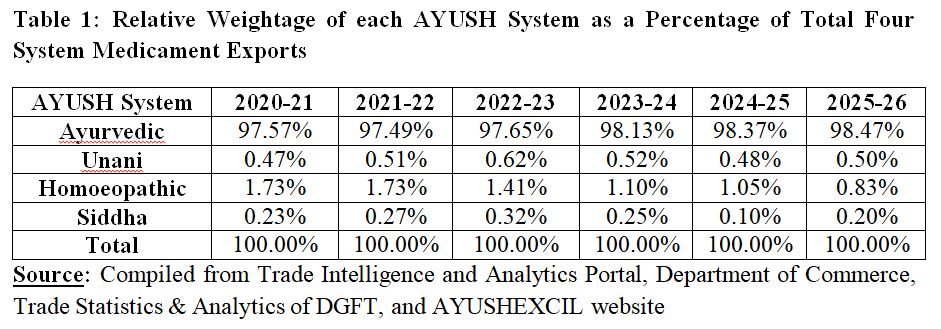
In explicitly “system-designated” HS Codes (8 in number), the Ayurvedic System dominates AYUSH system medicament exports. Export values grew from ₹1,189.08 Cr in 2020–21 to a peak of ₹1,540.62 Cr in 2022–23, before a moderation in 2023–24 to ₹1,447.66 Cr and ₹1,484.32 Cr in 2024-25, followed by a recovery to ₹1,662.89 Cr in 2025–26. The Homoeopathic system is the second-largest, though at a considerably smaller scale. Exports peaked at ₹24.79 Cr in 2021–22 and have since declined consecutively to ₹13.96 Cr in 2025–26. Unani exports grew from ₹5.75 Cr in 2020–21 to a peak of ₹9.77 Cr in 2022–23, then declined and partially recovered to ₹8.45 Cr in 2025–26. Siddha is the smallest of the four systems. Exports rose from ₹2.77 Cr in 2020–21 to ₹4.97 Cr in 2022–23, then fell sharply to ₹1.51 Cr in 2024–25 before recovering to ₹3.43 Cr in 2025–26.
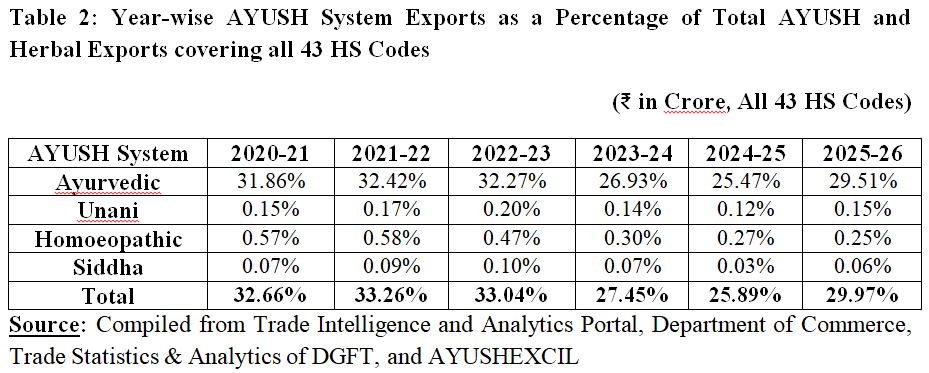
India’s AYUSH and herbal product exports, as recorded in the export data for the period 2020-21 to 2025-26, comprise 43 distinct HS (Harmonised System) codes. These 43 HS codes together represent the total composition of AYUSH and herbal product exports.
The data in Table 2 illustrates that, while Ayurvedic system medicaments dominate within the AYUSH system sub-category, the combined share of all four AYUSH system medicaments in the total AYUSH and herbal export basket is substantially smaller than the botanical raw material segment.
The AYUSH and herbal export sector of India encompasses a wide and heterogeneous range of products: raw botanical materials such as leaves, seeds, roots, barks, and dried plant parts; processed extracts and pharmaceutical-grade plant derivatives; and finished medicament formulations belonging to the Ayurvedic, Unani, Siddha, Homoeopathic, and related traditional medicine systems. These products are classified and traded internationally under the Harmonised System (HS) of nomenclature
Products covered under Top 10 HS Codes form 98.54 per cent of Cumulative Export Value from 2020-21 to 2025-26. The list of these HS Codes, description, six-year Cumulative Export Values, and Individual Percentage contributions to the Total Export Basket of AYUSH and Herbal Product exports is given in Table 3.
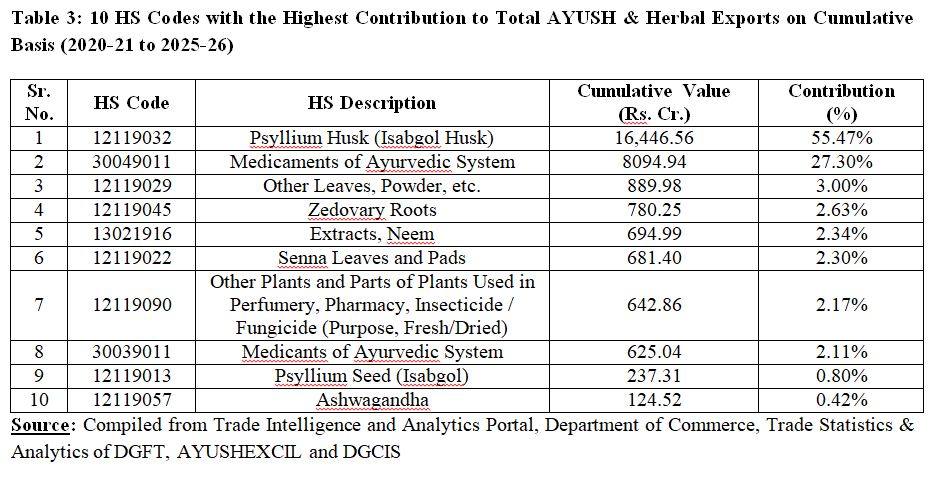
From Table 3, it can be observed that Psyllium Husk (Isabgol Husk, HS 12119032) alone accounts for 55.47% of total AYUSH and herbal exports – more than half of the entire basket. Medicaments of Ayurvedic System (HS 30049011) contributes a further 27.30%. Together, these two HS codes account for 82.77% of the total six-year export value. This extreme concentration in two products is the defining structural feature of India’s AYUSH and herbal export basket. Export of Psyllium Husk stood at ₹1,935.59 Crore in 2020-21, and it increased to ₹2,917.24 Crore in 2025-26. Similarly, Export of Medicaments of Ayurvedic System increased from ₹1,077.87 Crore in 2020-21 to ₹1,557.91 Crore. Significant volatility is observed for many items, e.g., Extracts of Neem had an export value of ₹125.46 Crore which touched ₹146.77 Crore in FY23, and came down to ₹66.21 in FY25, and clocked ₹109.98 Crore in FY26.
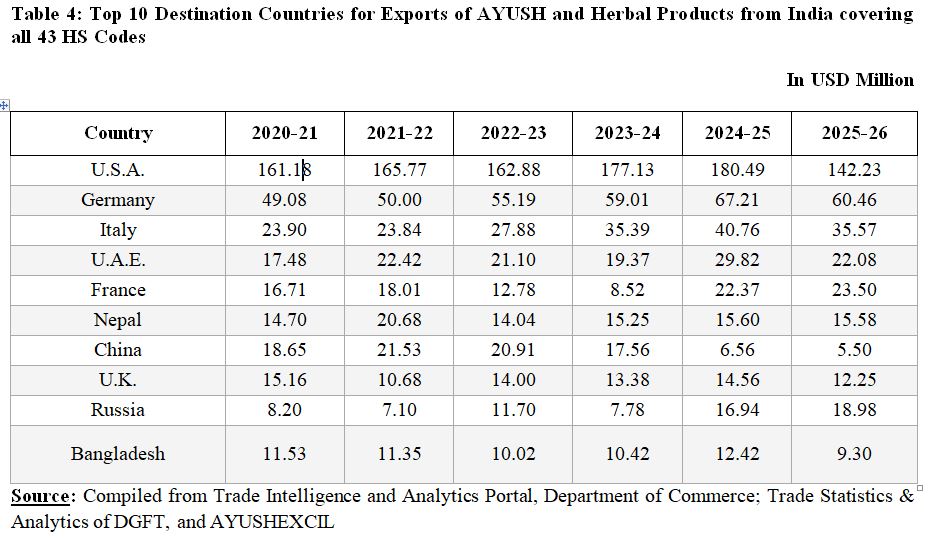
Significant traction has been observed in exports of AYUSH & Herbal products to South Korea, Australia, Vietnam, South Africa, Kenya, Kazakhstan, Mexico, Canada, Spain, and Netherlands. Huge variation is observed in product-specific exports, e.g., for HS 12119013 – Psyllium Seed (Isabgol), the top 10 destination countries together account for the majority of recorded exports across 2020-21 to 2025-26. Germany remained the leading destination with a cumulative export value of US$ 8.440 Mn (36.8% of the Top-10 total for this product), followed by Sweden (US$ 2.670 Mn) and the USA (US$ 2.630 Mn). The top three countries together accounted for 59.9% of the top-10 cumulative total for this product.
To conclude, it can be said that the product basket needs to be diversified to reduce Concentration Risk as evident from export values pertaining to two key HS Codes. The near-total dominance of Ayurveda (97.97%) within “system-designated” medicament exports, alongside the consistent decline of Homoeopathic exports and the marginal, volatile performance of Unani and Siddha, suggests these three systems remain significantly under-leveraged in international markets. Similarly, Market Concentration should be addressed through Destination diversification. Country-specific demand shifts need to be monitored for early warning to exporters of specific products, e.g., the sustained decline in China’s AYUSH imports from India (-74.4% from its 2021-22 peak) and the abrupt drop in US imports (-21.2%) in 2025-26 illustrate how quickly destination-market demand can shift. Besides this, there is a need to strengthen Trade Data Granularity.
Dr. Anil Kumar Angrish-Associate Professor, Department of Pharmaceutical Management, NIPER S.A.S. Nagar (Mohali), Punjab
Monika– M.B.A. (Pharm.) Student, Department of Pharmaceutical Management, NIPER S.A.S. Nagar (Mohali), Punjab
Disclaimer: Views are personal and do not represent the views of the Institute.