
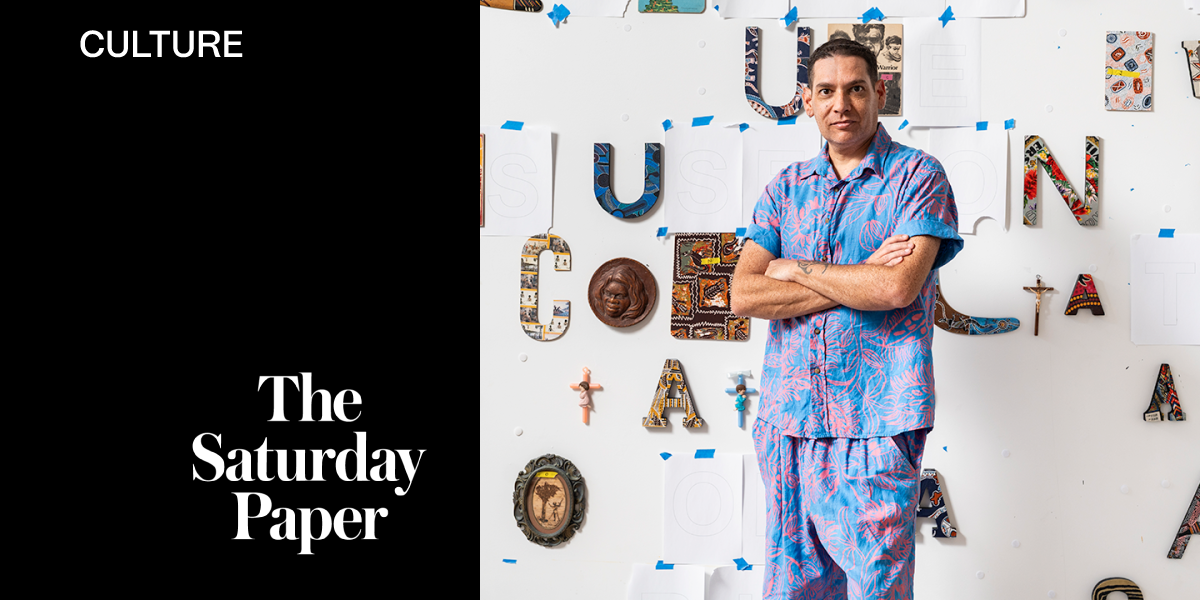
It took time for Tony Albert to understand the objects he collected as a child. Growing up in Brisbane, he frequented second-hand shops, drawn instinctively to the imagery of Aboriginal people he found there. “[It] was very significant for me as a child because there was a very innocent understanding of what these objects and images were,” he tells me. In an era of limited First Peoples representation, the kitsch 20th century ephemera he collected was a significant thing for a Girramay, Yidinji and Kuku Yalanji child.
Before he had the language to explain why, he amassed a shelf-full: plates, cups, salt and pepper shakers, tea towels, placemats that depicted First Peoples and cultures in racist and stereotypical ways. These objects were mass-produced and sold to tourists without the consent or consultation of Aboriginal and Torres Strait Islander people, distilling colonial histories into household bric-a-brac. Their sheer volume made them invisible, an everyday part of Australian households, normalising and further entrenching systemic racism.
“It was well after high school, not until kind of university, where the political understanding of these objects really was metaphorically attached to the condition of Indigenous people within Australia,” says Albert. “That we were to be seen and not heard, that we were delegated to this imagery.”
That child’s collection grew into one of the most significant and sustained bodies of work in contemporary Australian art. It grew so large that Albert moved it into his studio and there his ideas started to crystallise. “Just the nature of being surrounded by these objects when I work, iconography sort of started to come into things,” he says. “I was just playing with the collection, maybe putting all velvets together or picking a colour that day and grouping things and just being very playful as an artist.”
The reclamation of this ephemera also led to the creation of new language: Albert refers to them as “Aboriginalia”. It has culminated in Albert’s biggest show to date, at Sydney’s Museum of Contemporary Art (MCA): Tony Albert: Not a Souvenir, which is showing until October 19.
Albert says seeing artists such as Destiny Deacon and Julie Gough incorporate such objects into their practice gave him permission to do the same. The particular cruelty of how children were depicted forced him to critically engage with the imagery. “If you see these images, particularly the abundance of images of just children on their own, without family – the vulnerable nature of those children – I feel it … played into that psyche that what we are doing is okay. These children do need rescuing.”
The work that emerged spans video, painting, photography, sculpture, marked by Albert’s signature combination of formal rigour and disarming playfulness. “It’s kind of like a bit of a guerilla tactic or a political tool,” he says, “because it’s a much more effective way of engaging with the viewer. There’s an entry point that is either about the nostalgia, about the humour, about people understanding the playful nature of it.”
There’s power in that choice, because the political weight lands once you’re drawn in. The use of humour is also deliberate because, as Albert says, “You would literally be crying if you didn’t laugh. I feel humour is such, not just for Blackfella Australia, but a way in which a lot of minority communities deal with hurt and harm.”
Wierdi man Bruce Johnson McLean is the curator of the show and has known Albert for 25 years. “It was in 2001 and we began a traineeship together at the Queensland Art Gallery,” he says. “Our families are connected to the north of Queensland and we both went into the museum as trainees on that project.” Since then, the pair have collaborated on various projects over the years. McLean stresses that Albert’s use of Aboriginalia is a radical act. “By collecting these objects and recasting them into his works, in giving them new life, he’s really Indigenising them,” he says. “He’s giving them some sense of Indigenous identity, Indigenous conversation, Indigenous politic.”
“This Western idea that for something to make sense, it has to fit within a box … A lot of Indigenous art fits outside that way of thinking. It’s not about ownership, it’s about belonging.”
The site of the show is also fortuitous. The MCA sits on Sydney Harbour at Tallawoladah – known to most as The Rocks – ground that carries the double weight of being both the earliest point of British colonisation on the east coast and one of the country’s most visited tourist precincts. Its visual significance is not lost on Albert.
“There’s something about that site,” he says. “The visible history, with the sandstone, the convicts; the way in which that visible history, not just of Sydney, but of Australia on that site, rings so parallel in a way.”
The exhibition title is not subtle in its intent: Not a Souvenir plants a flag directly in opposition to what surrounds it: “That epicentre of cultural commodification, what is seen and what is unseen,” says Albert “And I love that the massive cruise boats and Captain Cook cruises are still, you know, sitting out the front. They’re on the harbour. There’s significant visual indicators of this colonial history offset against the work that is being done in the community about visualising Indigenous history.”
McLean puts it plainly: “Today you can walk three-odd minutes out of the MCA and you can be in one of three or four souvenir stores that are still selling fluorescent-coloured boomerangs probably produced in Indonesia. So that kind of history of consumption or commodification of Indigenous culture is something that is part of the history of the area.”
Albert says this exhibition “wouldn’t have existed 20 years ago” and attributes that shift to the presence of First Peoples within cultural institutions, not only as artists but as curators, programmers and historians who are actively shaping these conversations in spaces that historically excluded their perspectives.
“I was with the Fondation Cartier for two years, as the inaugural First Nations fellow,” he says. “We’ve had Kimberley Moulton at the Tate, the very first Indigenous curator there from Australia. I really see a global movement, which is led through this presence of First Nations people inside these institutions. I’ve been so lucky to be able to travel internationally. And I always say I go with kind of a clenched fist ready to ignite these big issues and I’m always amazed at how, globally, our brothers and sisters are so, like, ‘Wow, what you guys have done in Australia is really significant and really important.’ ”
While Albert celebrates this landmark exhibition and the publication of his first monograph, also called Tony Albert: Not a Souvenir, his attention and focus is on others. He positions his work within a broader movement of Indigenising cultural institutions, not only in Australia but internationally. He lists the trailblazing curatorial work of Moulton, Erin Vink at the Art Gallery of New South Wales and Marcia Langton, as well as Archie Moore’s Golden Lion-winning representation at the Venice Biennale, kith and kin, as an exciting change in Australian art that has challenged Western ways of seeing and thinking, and about what it means to present culture in spaces that were not built for it.
“We can’t be naive and think this hasn’t come from a hell of a lot of work by people breaking down those doors,” says Albert. “And I really give a lot of elevated presence to those who have come before, because it’s made my job much easier. Those doors are now open for me.”
While Albert recognises that some might consider him a political artist, he pushes back on narrow definitions of what constitutes “Aboriginal art”. “It brings up an interesting question and it gives us an opportunity to kind of redefine this but also under those institutional gazes,” he says. “It challenges this idea that it has to be categorised for it to fit in, and actually that in itself almost becomes problematic. This Western idea that for something to make sense, it has to fit within a box or suit a certain criteria. A lot of Indigenous art fits outside of that way of thinking. It’s not about ownership, it’s about belonging.
“My mandate through my work certainly doesn’t have to be one of yelling and screaming or bashing down those doors, because that has happened for us. But now it’s looking at navigating those spaces. At this point in time, are we successfully navigating those conversations and spreading these messages?”
For Albert, creating space for others sits at the heart of that question. He speaks of his time as Richard Bell’s assistant, of residencies, of the Indigenous Art Triennial, where he stepped into a curatorial role to platform other artists. “My career is responsible to other people who have done really great things for me. Now, I’m the person with the visibility and the voice and the seat at the table and I need to make sure that those opportunities that were afforded to me are paid back.”
McLean says there is a generosity in Albert’s work. “Tony has a really beautiful way of engaging people in a soft kind of way that allows people to enter into these conversations that can otherwise be quite confronting and difficult.”
A stand-out work in the show for McLean is the Sorry installation – a text assemblage that features Aboriginalia objects hung to spell the word “sorry” in reverse. It began as a response to former prime minister Kevin Rudd’s 2008 national Apology to the Stolen Generations. The work was made in the presence of the late Arthur Pambegan Jr, a painter, sculptor and senior songman for the Winchanam clan of the Wik people in Far North Queensland, whom both Albert and McLean had first met during their traineeship at the Queensland Art Gallery in 2001.
“Arthur was staying with Tony at his mother’s place and they watched the Apology together,” says McLean. “And Arthur, as a senior man, pretty much every part of his life was controlled by government policy, and at the end of the Apology, Arthur said, ‘Look, I’ve been through a lot in my life. A lot of it’s been controlled by the government, but I can accept that apology.’ ”
McLean acquired Sorry for the Queensland Art Gallery’s collection. Four years later, the gallery wanted to display it again and McLean reached out to Albert, whose thinking about the work had shifted. “And Tony said, ‘Well, can I flip the work around? Because to me, the work doesn’t hold its original currency, its original intent,’ ” says McLean. “What does that Apology mean now? What’s changed for Aboriginal people? We have these things like Closing the Gap and the markers. All of the indicators are failing and Aboriginal children are still being taken away in record numbers through the social system.”
The institution had what McLean diplomatically describes as “a slight panic attack”, but the work was flipped and now hangs in reverse. McLean hopes it prompts viewers to ask questions about what the Apology means today.
For Albert, the MCA show is deeply personal. “I value and cherish the fact that this young Brisbane kid who had this dream of being an artist has a 400-page monograph coming up. It blows my mind sometimes, and I hope there’s something aspirational or meaningful behind that as well.” Before he can say more, the interview is interrupted by Missy, Albert’s six-month-old chihuahua, who has decided she has been patient long enough. The ending is very much in Albert’s style: playful and profound at the same time.