

Agentic AI is exposing an uncomfortable truth: the organisations getting value from it are not the ones with the best technology, but the ones working closely with their teams to redesign how they work.
Caryn Katsikogianis is the former Chief People Officer of Woolworths Group, capping a 25-year career in HR leadership across Australian retail. She reflects here on perspectives drawn from that journey, including conversations with other senior People leaders. Gavin Parker is a Managing Director and Senior Partner at Boston Consulting Group, and Alan Wong is a Partner at BCG, bringing BCG’s global perspectives from supporting clients across industries and geographies on AI transformation. Together, they explore how organisations are scaling agentic AI.
Introduction
How organisations scale AI is changing how change itself happens. Transformation programs have traditionally been rolled out by a central team in steady, sequential phases. But with AI-led transformations, particularly those drawing on GenAI and agentic AI, many teams across the organisation are being asked to transform — often simultaneously. While it’s widely recognised that AI adoption will lead to some job displacement in the short term, it is also expected to drive net job creation and new forms of work in the near future, increasing the urgency for organisations to adapt how work is designed and delivered.
GenAI has reached 70% adoption in just three years. It’s high on the agenda at every boardroom and management meeting, yet only 16% of Australian executives report significant value from GenAI today. Discussion to date has focused on the technology, but experience shows that organisations derive value from AI only when it is deployed in service of strategic priorities — not treated as a tool confined to the CIO’s toolkit. That shift is already visible in the C-suite: more than 70% of CEOs state that they are now the primary decision-maker when it comes to AI, recognising AI’s role as an enabler of strategy rather than a purely technical capability.
The adoption-value constraint is no longer the technology, but whether teams have the confidence, capability and permission to change how they work to deliver organisational goals. In other words, the bottleneck in AI transformation has shifted from technology to organisational capability.
Generative AI (GenAI) refers to systems that generate outputs from prompts or data, including large language models (LLMs) such as ChatGPT and Claude. Agentic AI extends this capability by enabling systems to autonomously plan, decide and act across multiple steps to achieve an outcome.
While this article focuses on agentic AI, the implications apply to GenAI and even more traditional forms of AI (e.g. machine learning) which are reshaping how teams work.
Agentic AI Is Changing the Nature of Transformation
Agentic AI is still emerging, but it is already changing how work gets done. Work is shifting from execution to orchestration. Teams are flattening into human-AI structures, changing what it means to ‘manage’. Organisational design, talent and governance are being reshaped in response.
Yet focusing on the adoption of AI is not enough to unlock the full potential of GenAI and agentic AI — what matters is quality adoption of AI to deliver a measurable business outcome. In three stages of AI adoption, Deploy can create immediate value in organisations, but most of the value will come from using AI to Reshape critical functions and to Invent new AI-led experiences.
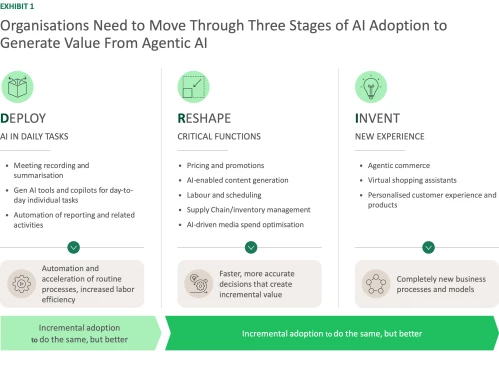
What does ‘reshape’ look like in practice? A company sets a strategic objective to dramatically scale the volume and personalisation of its marketing. It deploys agentic AI to automate much of the campaign development process, from generating creative assets to tailoring messaging for different audiences and channels. The marketing function then reshapes itself around this new capability, redesigning workflows end-to-end and removing large amounts of manual work. Routine tasks are automated, allowing teams to focus on strategy, creativity and experimentation.
To drive effective, sustained adoption in this context, we need to understand how GenAI and agentic AI are changing how transformation occurs in organisations. Five structural shifts explain why transformation is becoming more distributed and team-led:
Work is changing faster than central programs can keep up: Agentic AI capabilities are evolving weekly, if not daily. Recent examples include Anthropic releasing the Mythos-class Claude Fable 5 in June 2026 and OpenAI releasing GPT-5.5 – rebuilt for agentic workflows – in April 2026.Innovation becomes grassroots: Teams can often access generative AI tools themselves, meaning that pockets of innovation are occurring regardless of company guidance. These green shoots can lead to uplifts in effectiveness and efficiency, but also introduce organisational risk if left unaddressed.Transformation multiplies: When nearly every team is affected by agentic AI, transformation no longer scales through a handful of large programs. It scales through hundreds of small, local reinventions happening in parallel.Teams become the engine of change: As agentic transformation starts with rethinking end-to-end workflows in prioritised business domains, change has to run through the teams that hold the expertise. The leadership task is to channel that capability towards the organisation’s key strategic priorities.Roles are re-shaped in real time: Each team is effectively being asked to redesign how work gets done, while still delivering day-to-day outcomes and navigating uncertainty about the future – leading to resistance to change.
Agentic AI does more than improve productivity; it brings transformation closer to teams. Organisations that recognise that teams need to be involved in redesigning their own workflows in pursuit of business outcomes are the ones driving sustainable change. Distributed change does not mean undirected change. The organisations getting real value are not letting every team experiment at once; they are pointing this team-led energy at the two or three domains that move a business metric, and reshaping these domains end to end.
Weekly Insights Subscription
Stay ahead with BCG insights on artificial intelligence
Agentic in Practice: Insights from an Industry Leader
To close the adoption-value gap, focus on teams before technology and understand how to empower teams to drive change. Bringing this to life is a case study of one global industry leader’s journey.
Case Study: AWS Software Development Lifecycle Transformation
An Executive Checklist for Empowering Your Teams to Scale AI
Realising value from AI requires a reshape of organisations as transformation shifts from central programs to guided change that unfolds team-by-team. While no silver bullet change playbook exists to navigate transformation with new technologies, a people-led approach can close the gap between adoption and value. Drawing on Caryn’s experience as a senior People leader in Australian retail and BCG’s global perspectives, we have created a checklist to guide organisations to align agentic AI use cases with business priorities and empower their teams to deliver.
Expand All
1. Be honest about whether AI actually serves your strategy, or just decorates it
2. Put your CHRO at the centre of the AI agenda, as Chief Transformation and Capability Officer
3. Treat adoption quality, not access, as the goal
4. Separate how you transform from how you run, and protect the difference
5. Make build, buy or partner a deliberate decision, not a default
Close the Adoption-Value Gap with a Team-Led Approach to Agentic AI
If organisations see AI only as a tool to increase productivity, they will miss its full potential. The real value in agentic AI isn’t about removing humans from the equation; it’s about changing how we work.
Most of the work required to scale agentic AI still lies ahead. Agentic AI will create significant value, but success requires a fundamental evolution in how organisations approach change. Organisations often have deep expertise in programs such as reviewing your customer offer or assessing a new market; rethinking how you embed and transform your organisation with AI will feel a bit like stepping into the unknown for many executives. The only way that executives can address this uncertainty is to allocate sufficient time, resources, and focus to this critical strategic agenda. Organisations that succeed will not just deploy AI; they will institutionalise the capability for teams to continuously redesign how work gets done.
We’ve provided our reflections on how the transformation and change journey needs to evolve with agentic AI; let us know yours.