
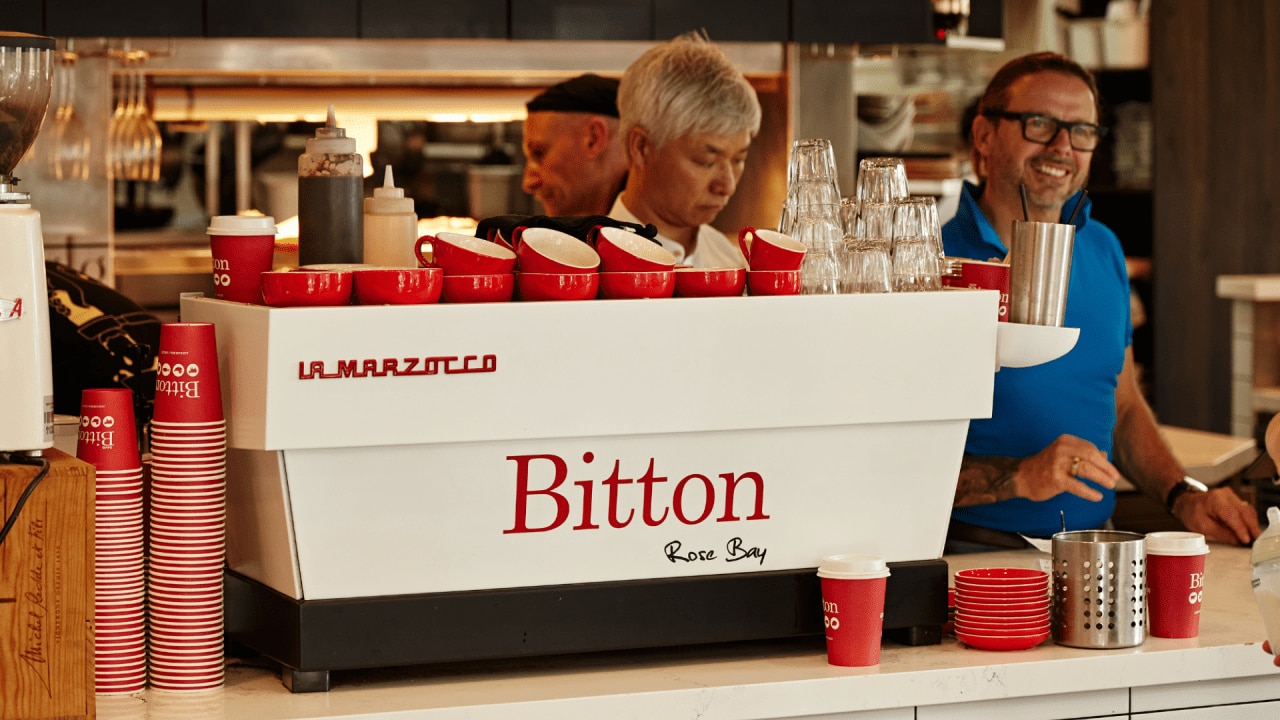
Small business café owners across Australia are warning that Aussie cafe culture as we know it is on the line, due to rising costs across the industry.
Owners have warned people should expect to pay more for their caffeine hit – or see their local coffee shop close down.
Phillip Di Bella of Coffee Commune, a commune for independent coffee retailers in Queensland, told Skynews.com.au that coffee operators are “worn out” and “sick and tired.”
“They’d get more money if they put their investment in the bank,” he said.
“Last year we saw more businesses closed than open. Nobody’s going to get involved in an industry that is overworked and underpaid.”
From July 1, café workers will have their industry rate raised by 4.75 percent – an increase owners will need to cover.
Super will be required to be paid weekly, which owners say will detrimentally hinder cash flow.
“The ATO still says that cafes should be running at 30 to 35% wages, which is a joke,” says Mr Di Bella.
“I can tell you that from the 1,300 cafes (where) we get the data, the wages are running 45 to 50%. So what’s happened is that the wages have gone up higher than what the venues can charge.
“No one is advocating low wages at all, (it is) the opposite.
“What cafe owners are saying, as independent operators, is we cannot afford to pay more than 35 percent of wages of our turnover, because we just lose money.”
David Bitton owns a café bistro in Sydney and said to Skynews.com.au that he expects to have to pay tens of thousands of dollars more due to this change.
“This little 4.75 percent for me means 1,500 (dollars) a week extra that I have to pull out.
“Then (over) 50 weeks, (that) suddenly becomes $65,000,” he said.
Come October, cafes will have to swallow merchant fees too, as the government bans card fees for customers despite the banks continuing to charge retailers.
Mr Bitton says he was paying up to $40,000 in merchant fees when he used to own multiple venues.
“I was able to pass it on, now from the first of October I’m going to absorb that cost,” he said.
“Why pass it on to us? And if (they’re) going to pass it onto us, why can’t we pass it to people? It’s a bit of a vicious cycle.”
These charges are on top of fuel fees added by suppliers following record high fuel prices.
While cafes are paying out more than ever before, they say customers are spending less due to lower disposable incomes.
Lawrence Daniels, managing director at café and roasters Fuego Coffee, described the cycle as “never-ending” to Skynews.com.au, warning that Aussie café culture will see a “dump and fill” soon.
“Some of these smaller ones will probably dissipate and you’ll only have a handful of players in the field,” he said.
Last year saw more than 10 percent of food service providers close their doors, and it is a number expected by owners to only grow.
In an attempt to offset these rising costs, customers are warned to expect to pay much more for their coffee – and to understand exactly why.
“What should a coffee be? It should be $10 a cup, but it can’t be $10 a cup because nobody can afford that,” Mr Di Bella.
“People say, why do we wait ten minutes when it’s busy? And I say, because you pay $5.50 for a coffee. If you wait five minutes, I need to charge you $6.50 because I need to put a third barista on. Would you rather wait 10 minutes and pay $5.50 or get your coffee in five and pay $6.50.
“The consensus is no; we’d rather wait and pay $5.50 because they simply don’t have the money.”
Mr Bitton says that small businesses are always “s**tscared” to increase prices, but that there is no other option now.
“Nobody knows that the (price of a) coffee bean itself increased by 70 per cent in the last two years, no one knows that (because) your coffee didn’t go up 70%,” Mr Bitton said.
“I was selling my coffee at $5 a few months ago and I just put it up to $5.50, and I was really worried.
“No one said boo, because people are starting to understand that we are not trying to rip people off.”
Instead, owners say they are trying to make it as one of the few cafes set to survive in an industry on the edge.
“I’m telling you, a lot of people are going to go bankrupt, and a lot of people are going to suffer, and that’s my belief,” said Mr Bitton.
“It’s going to be a snowball effect, a disaster.”
Mr Daniels said he plans to be “bold” with transparency if he ups his prices soon, writing a breakdown of costs he pays on a blackboard inside his Queensland café.
“Let’s really work out the cup of coffee price against the wages of $34 an hour. How many coffees do I need to sell per hour to pay that barista her wages to support her family?”
The very Aussie ability to get a good coffee anywhere at any time might be changing.
“What’s happening is they’re closing on public holidays. People are not opening on Saturday and Sundays, or they’re opening less hours,” Mr Di Bella said.
Even bigger players are moving their companies offshore, said Mr Di Bella – aiming for places like the UAE and New Zealand, which have more appealing tax offers.
“I’m not optimistic at all,” he said.
“We’re seeing a lot of our great operators go overseas.”
Owners are calling on the government to make some changes to help save the café industry, which they say is an integral part of modern Aussie life.
Mr Bitton hopes small businesses will be allowed exemption from the surcharge ban, or that banks will be made to only charge the actual processing cost of 0.1 percent.
He says that energy rebates should be considered and small business tax changes, in particular payroll tax.
Mr Di Bella agrees, favouring upping of GST to replace payroll tax, saying he feels businesses are still being “taxed to employ people.”
“These people in government are far smarter than I am. There are solutions. It’s just they don’t they want to put these solutions in play,” he says.
“How do we increase the disposable income of an Australian? How do we put more money in Australian people’s pocket for them to cover all of their expenses and have some fun?
“That’s the only barometer and metric that every politician should be working towards.”