
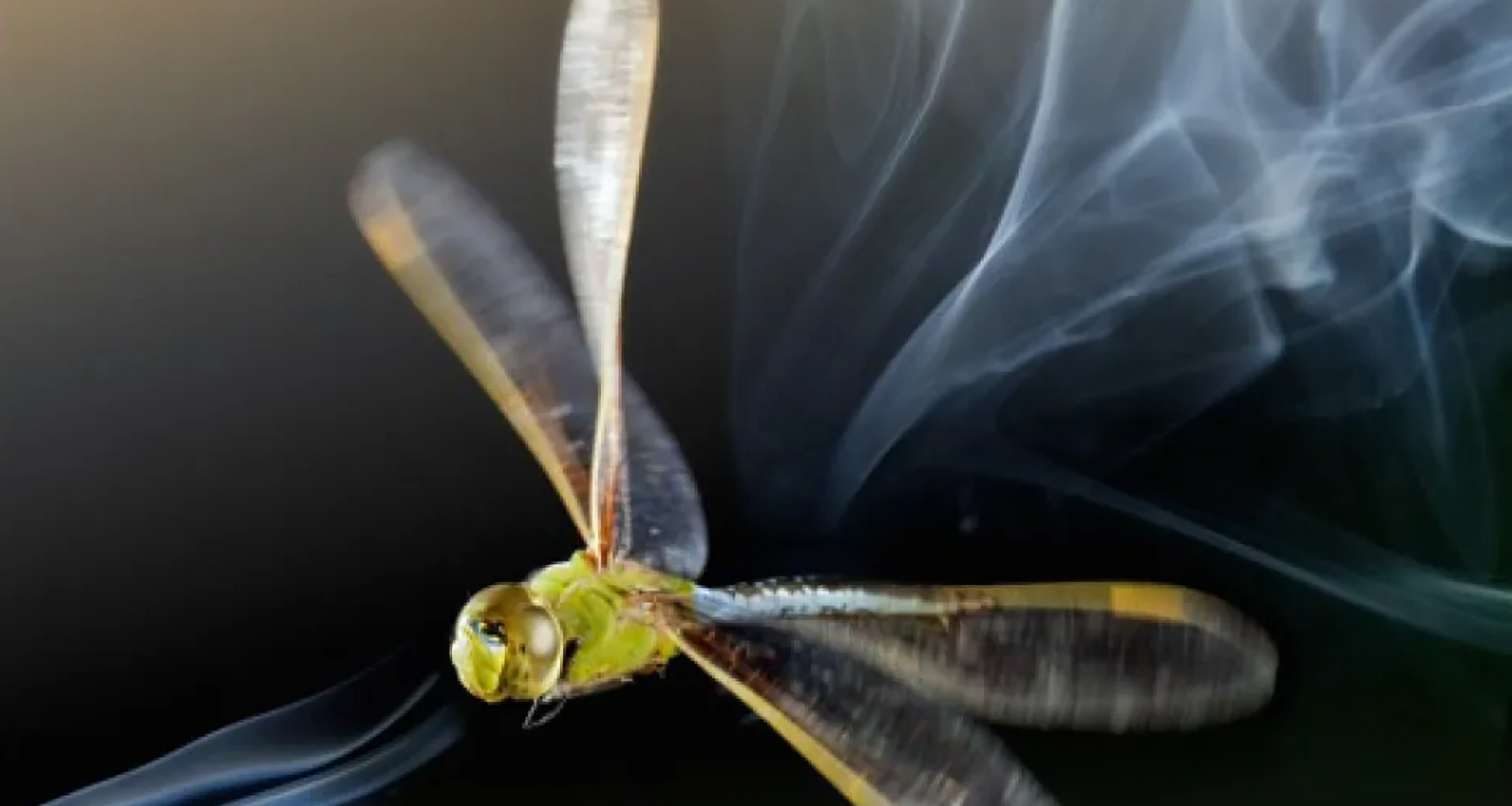
An American emperor dragonfly accelerates streaks of smoke down when it flaps its four wings. The photo has been edited.
IGOR SIWANOWICZ/HUAI-TI LIN/Lunduniversity.lu.se
A creature weighing less than a paperclip — and small enough to land on a fingernail — turns out to be one of the most extreme long-distance migrants on Earth. A comprehensive global review published in Biological Reviews on June 12 has confirmed, for the first time, that at least 100 species of dragonflies and damselflies migrate, with some crossing entire oceans on seasonal winds and completing multigenerational circuits that span continents.
The research, led by Dr. Johanna Hedlund of Lund University and the University of Exeter, drew on 392 prior studies to build the first systematic global picture of migration in the insect order Odonata. The tally surprised even the researchers compiling it. Only about 1.5% of all dragonfly and damselfly species migrate — yet those migrations can involve millions of individuals covering thousands of kilometers, rivaling or exceeding the distances logged by the most celebrated long-distance travelers in the animal kingdom.
“Dragonflies and damselflies are not usually thought of as migratory insects,” Hedlund said. “However, our review found evidence of migration in four dragonfly families and two damselfly families, and analysis suggests migration has evolved independently multiple times.”
Globe Skimmer Crosses Indian Ocean in Single Flight
The most striking finding involves the globe skimmer (Pantala flavescens), a dragonfly barely five centimeters long that weighs 300 milligrams — less than a typical paperclip. Globe skimmers fly more than 2,500 kilometers from northeastern India to the Maldives in a single, unbroken ocean crossing, riding rain-bearing trade winds at altitudes above 1,000 meters. From the Maldives, they continue toward East Africa, making the full India-to-Africa crossing one of the longest transoceanic migrations ever documented for any animal relative to body size.
That alone is remarkable. But the review also integrates evidence, drawn from earlier isotope studies and ecological surveys, that the complete India–Africa–India circuit is multigenerational. No individual globe skimmer makes the full round trip. One generation flies toward Africa in autumn, breeds at intermediate stops using the ephemeral rain pools the monsoon creates, and its offspring continue the journey. A subsequent generation makes the return leg the following spring.
Before this review, only one other insect on Earth had been confirmed to operate on a multigenerational migration model: the monarch butterfly.
How a 300-Milligram Insect Crosses an Ocean
The mechanics of the ocean crossing are precisely understood, though they strain intuition. A 2021 energetic flight model published in Frontiers in Ecology and Evolution — from the same Lund University research group — calculated that globe skimmers cannot cross the Indian Ocean using fat stores and wing power alone. Continuous flapping flight would exhaust the insect in approximately four hours. Instead, the crossing depends on a strategy of alternating between active flapping and passive gliding on rising air — a mixed regime that can keep a globe skimmer aloft for up to 230 to 286 hours.
Even with that extended endurance, the wind must cooperate. Globe skimmers time their departure to the seasonal passage of the Inter-Tropical Convergence Zone, the atmospheric belt near the equator where trade winds from the Northern and Southern hemispheres converge and produce the powerful high-altitude tailwinds that drive the Indian monsoon. The timing is not flexible: the same wind modeling found that only about 15% of simulated autumn trajectories (India toward Africa) produced a successful landfall. Spring crossings, traveling the opposite direction, succeed at nearly triple the rate — roughly 40% — because the monsoon reversal produces more favorable tailwind geometry.
The result is a migration where the dragonfly is less a navigator than a passenger, ascending to altitude, orienting into the ITCZ-driven flow, and riding it across open ocean. The question of how successive generations inherit the instinct to board that atmospheric conveyor belt at the right moment — without any parental instruction — remains one of the field’s open problems.
Wing Chemistry as a Passport
The prior research that underpins the global review relied partly on an analytical approach that turns the insect’s own body into a geographic record. When a globe skimmer is still a nymph, developing in freshwater, it absorbs hydrogen from the local water supply. That hydrogen becomes chemically locked into the chitin of the wing as the insect grows. Because stable hydrogen isotope ratios vary predictably across the landscape — shifted by latitude, rainfall patterns, and the origin of water vapor — the wing retains a fingerprint of the pond where the insect was born.
A 2012 isotope study of globe skimmers intercepted in the Maldives used this approach to confirm that those dragonflies had originated in northern India, already having flown more than 2,000 kilometers before reaching the Maldives. The technique enabled geolocation of individual insects without attaching any device — a critical capability for creatures too small and fragile to carry a radio tag or GPS unit.
Predators Follow the Same Route
The globe skimmer does not make this crossing alone in any ecological sense. Amur falcons — small raptors that breed in northeastern Asia and winter in southern Africa — undertake an ocean crossing that matches the globe skimmer’s route with striking precision. According to Wikipedia’s entry on the Amur falcon, their migration over the Arabian Sea coincides with the timing of the dragonfly migration, and the falcons are thought to prey on globe skimmers during the most arduous segment of the crossing.
The 2021 Frontiers modeling paper found that GPS-tracked Amur falcon routes correspond closely to the wind trajectory simulations it generated for globe skimmers — suggesting that the two species are co-migrating on the same atmospheric highway, with the falcon exploiting the dragonfly as an in-flight food source over open water.
This ecological coupling has direct conservation implications. A disruption to globe skimmer migration would not merely affect the dragonflies. It would also affect every predator timing its own crossing to coincide with theirs.
What Climate Change Threatens
The review identifies climate change as the most significant structural threat to dragonfly migration — not through habitat loss at any single point, but through disruption of the wind systems the insects depend on. Changes in ocean surface temperature alter the position, timing, and strength of the ITCZ. Because the globe skimmer’s crossing window is already narrow — only about 15% of autumn trajectories succeed under current conditions — a shift in the ITCZ that reduces favorable tailwind availability even slightly could collapse the crossing to near zero.
The effects cascade. Amur falcons depend on the crossing window too. Wetlands on two continents receive a pulse of nutrients and biomass when millions of dragonflies arrive; disrupting that pulse ripples through the food webs that time their own activity to the dragonflies’ presence.
The review also notes that some species are already responding to warming in ways that make them useful climate indicators. The vagrant emperor (Anax ephippiger), once a rare visitor to the Mediterranean, now breeds regularly across Europe and reaches as far north as the United Kingdom and Scandinavia. A North African dragonfly that was a rarity in Europe forty years ago is now an annual presence because the thermal conditions it requires have moved poleward. Tracking where these species establish themselves, Hedlund argues, offers a window onto how the ITCZ and associated monsoon systems are shifting in real time.
A New Tool for Tracking Insect Movement
Beyond the globe skimmer, the review’s inventory of 100 confirmed migratory species — with 85 additional probable migrants — opens a broader scientific door. For decades, insect migration was assumed to be poorly documented simply because insects are small and inconvenient to track. The new global accounting demonstrates that the gap is methodological rather than biological: the migrations are there, they have always been there, and the combination of stable isotope analysis, wind modeling, and citizen science observation platforms has made them legible.
If wing chitin isotope analysis can be standardized and applied at scale, it could transform the study of insect migration across thousands of species — moths, beetles, aphids, and other groups whose continent-scale movements are currently invisible to science. Migratory insects move enormous quantities of biomass, nutrients, and genetic material across landscapes. They also include many of the species that function as crop pests, pollinators, and prey for larger animals. Understanding where they go is not merely a matter of natural history — it is a prerequisite for managing the ecosystems they move through.
Frequently Asked Questions
How far does the globe skimmer dragonfly actually migrate?
The globe skimmer (Pantala flavescens) flies more than 2,500 kilometers from northeastern India to the Maldives in a single crossing, according to the 2026 Biological Reviews global review. The full multigenerational circuit — spanning India, the Maldives, East Africa, and back — covers an estimated 14,000 to 16,000 kilometers across successive generations. No single dragonfly completes the full round trip. Individual adults can stay airborne for up to 230 to 286 hours when combining active flapping with gliding on wind currents, according to the 2021 energetic flight model that the review incorporated.
How do dragonflies navigate across open ocean without GPS or a map?
Globe skimmers do not navigate in the conventional sense. They exploit the Inter-Tropical Convergence Zone — the atmospheric belt near the equator where Northern and Southern Hemisphere trade winds meet — which produces powerful seasonal tailwinds at altitudes above 1,000 meters. The dragonflies ascend to that altitude during narrow seasonal windows when the ITCZ’s passage creates favorable winds toward their destination. The inherited instinct that tells each generation when to launch and at what altitude to cruise is not yet understood at the molecular level, and represents one of the field’s central open questions.
Why can climate change affect dragonfly migration?
Globe skimmers have almost no margin for error. Only about 15% of simulated autumn crossing trajectories from India reach Africa under current wind conditions. The Inter-Tropical Convergence Zone — the atmospheric system that provides the tailwinds — shifts position as ocean surface temperatures change. A warmer Indian Ocean alters the timing, strength, and direction of the winds the dragonflies depend on. Because Amur falcons and other predators time their own ocean crossings to coincide with the dragonfly migration, disruption to the dragonfly corridor would cascade through multiple levels of the food web simultaneously.
What makes dragonfly migration useful for detecting climate change?
Migratory dragonflies are indicator species — organisms whose distribution and behavior signal broader environmental shifts. The vagrant emperor (Anax ephippiger), a North African species, has gone from a rare Mediterranean visitor forty years ago to a common annual breeder in the United Kingdom and Scandinavia. That range expansion tracks the northward movement of the thermal conditions it requires. Because globe skimmers are recognizable, relatively easy to observe, and cosmopolitan in distribution, tracking where they appear each season provides a real-time signal of how the Inter-Tropical Convergence Zone and monsoon wind systems are shifting globally.