
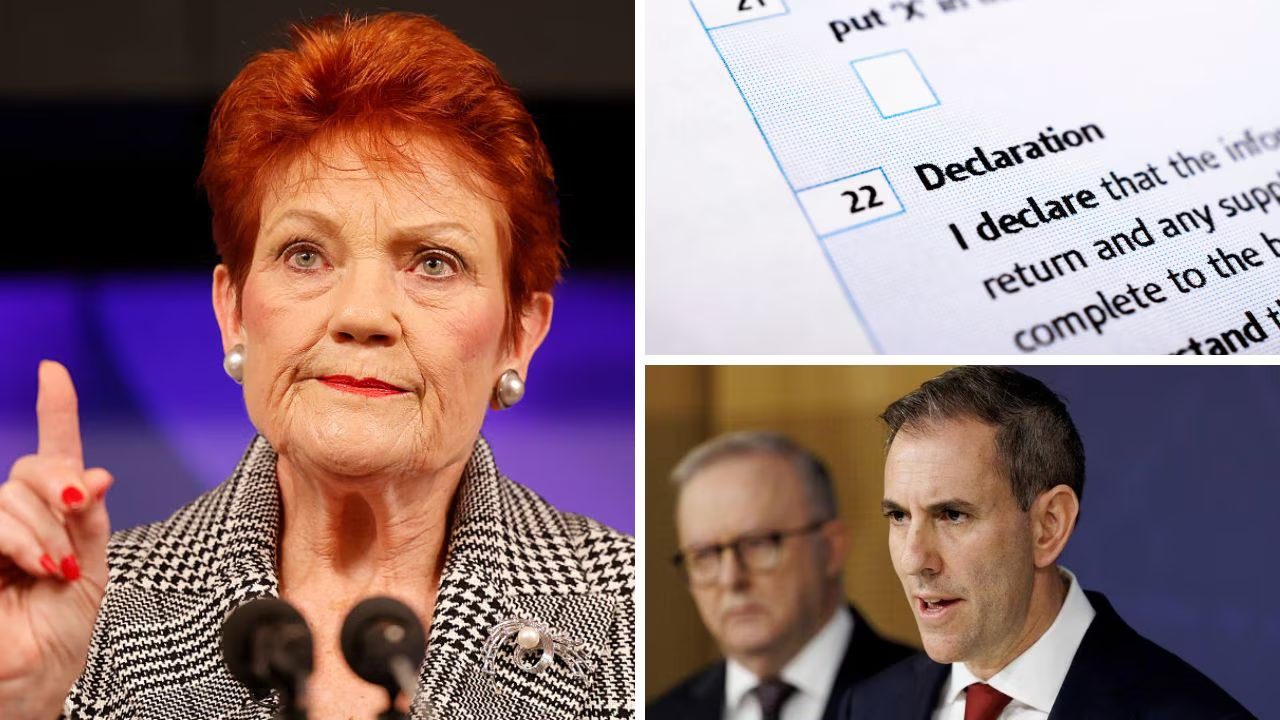
A proposal to introduce a tax scheme available for families overseas but not in Australia has been raised again as Pauline Hanson continues to highlight the cost-of-living crunch.
The Queensland Senator has reiterated her support for income splitting – which would allow couples to file joint tax returns – saying it could “significantly reduce” tax for Australians.
Ms Hanson, whose party was leading voter polls on a primary basis as of Monday, mused on the weekend on the benefits of introducing the measure.
.

“One of the best ways to support families and new parents is income splitting,” she wrote on X.
“Allow couples with at least 1 dependent child to file joint tax returns, significantly reducing their joint taxable income if one partner earns significantly more than the other.”
Income splitting is available in comparable countries like the US, Canada, Germany and France, under differing models.
Under how the scheme operates in France and Germany, if one parent earned $120,000 and the other $0, their tax would be calculated as if they earned $60,000 each.
That scenario would see more than $9000 in tax savings for that couple, under Australia’s progressive tax system, if One Nation’s policy were in effect.
The party announced income splitting as a policy ahead of last May’s federal election and plans to take it to the next national vote.
Ms Hanson spoke about the proposal during her eventful National Press Club address last week, saying “I want people to be able to split their incomes so that those families, whether mum or dad, want to stay home … to give them help”.
“But we’ve got … a lot of work to do. You need to actually rein in government spending.”
Australian families are currently able to split income for tax purposes through a family trust or company structure, something not available to most people.
Critics argue the scheme could encourage one parent not to work, which would lead to skills shortages and negatively impact productivity.
Leading economist Leith van Onselen has called such a policy both “economically reckless” and a “gimmick”.
“I am no fan as it is unaffordable, could lower labour force participation and is unfair to single people,” he said.
“(One Nation) should simply argue for lower income taxes and less government waste.”
Donovan Castelyn, a chartered accountant and expert at the University of Tasmania, noted One Nation’s policy appeared to be an uncapped model that “does not have a particularly close international equivalent”.
He said Germany’s finance minister wants to scrap its income model, which is dependent on marriage, and France capped its scheme depending on how many children were in the family.
“While there is a reasonable argument for recognising children and the family unit more explicitly within the tax system, most international examples either cap the available benefit or link it to family size,” he said.
“The One Nation proposal adopts a broader and more generous approach than many comparable overseas models.”
Mr Donovan said the bigger the gap between partners’ incomes, the bigger the tax benefits would be, adding couples with similar incomes “would see little or no benefit”.
Ms Hanson is not the first Australian politician to float the idea in recent times, with former Senator Gerrard Rennick also putting forward the proposal last year.
“The proposal would allow couples with a dependent to split their income for personal income tax purposes, so that it appears on their tax returns that they both earn the same amount,” his plan’s summary stated.
The Parliamentary Budget Office (PBO) assumed about 26 per cent of taxpayers would use income splitting, in line with the share of the population with at least one child or dependent with a severe disability.
“There would be no significant behavioural impact on labour supply or resultant impact on taxable income under the proposal, including no reduction in work associated with higher effective marginal tax rates for secondary earners,” advice on Mr Rennick’s proposal said.
The PBO estimated the measure would cost about $5.9 billion in lost tax revenue in the 2026-27 financial year, and grow to $9.4 billion in 2032-35.
A One Nation spokesman said the party accepted there would be a hit to revenue but argued it would help foster an economic environment where couples could seek to start a family earlier, or relieve the taxpayer burden of childcare subsidies by allowing one parent to stay home.
Its website states the policy would “encourage parents to look after their own children, and reduce the cost to the government of childcare, especially pre-school”.
“It will also encourage homeschooling.”
Nationals Leader Matt Canavan has also long supported the scheme and first raised it more than a decade ago, saying the tax system should be more “family friendly”.
“The situation now is that families with a single breadwinner are disadvantaged compared with families where both parents have paid employment, mainly through the tax-free threshold,” he said in 2015.
“Figures from the Parliamentary Library indicate a single-income household earning $120,000, for example, now pays around $10,000 more tax than a double income family with the same joint income of $120,000.
“The disparities carry on across various income levels.”
Last week Mr Canavan said he had “always backed a fairer tax system for families via income splitting”.
“It’s why I entered politics 12 years ago,” he said.
The Albanese government announced cost-of-living measures in its May budget, including a $250 tax offset and a $1000 instant deduction for this financial year.
However, the government has attracted strong criticism for not delivering bigger income tax reforms or addressing bracket creep amid a high-inflationary economy.
News.com.au has contacted Treasurer Jim Chalmers and the Treasury for comment.
Read related topics:Pauline Hanson