
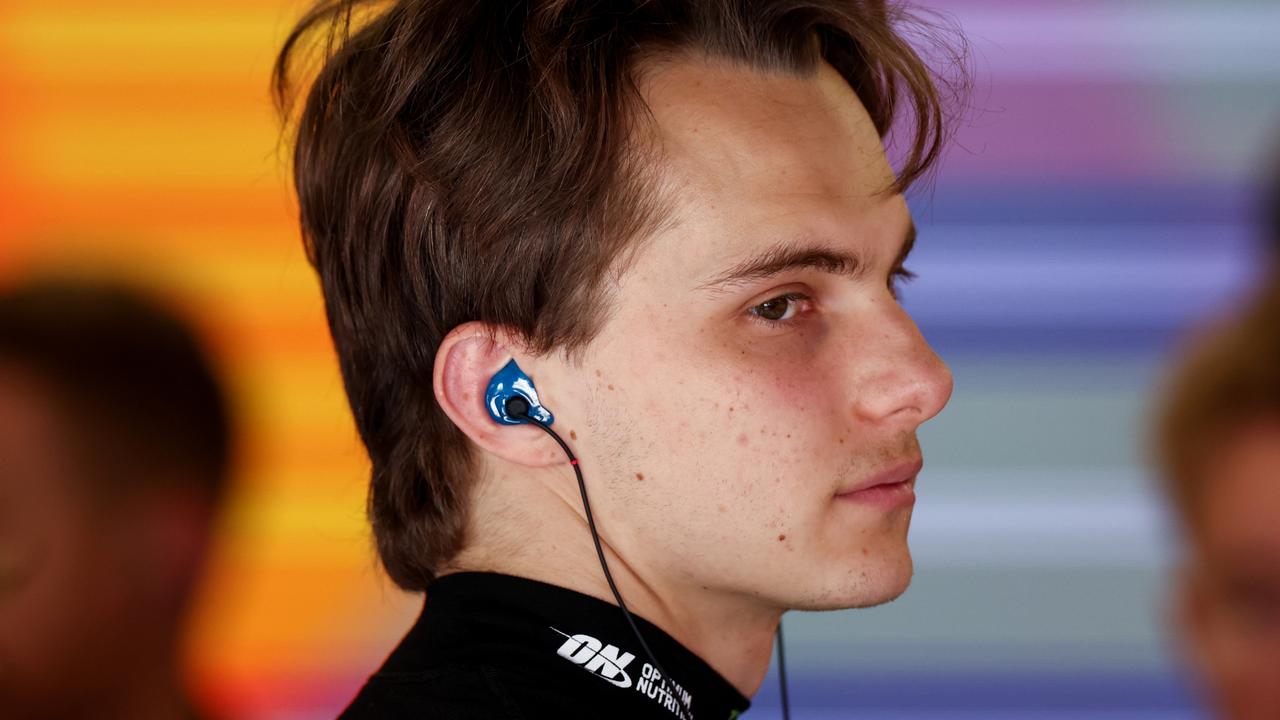
Emotional expression is only ever by degrees for Oscar Piastri, but the famously steady Australian was clearly tilting towards being downcast in the shadow of the Barcelona-Catalunya Grand Prix.
Piastri had just completed an anonymous weekend in Spain, where a narrow qualifying deficit had left him buried in Q3 and a surprising lack of pace in the grand prix meant he played no meaningful role in the battle for even the places on the podium’s periphery.
Fox Sports, available on Kayo Sports, is the only place to watch every practice, qualifying session and race in the 2026 FIA Formula One World Championship™ LIVE in 4K. New to Kayo? Join now and get your first month for just $1.

Piastri got within 13 points of last year’s world championship, but seven rounds into a season that feels like it’s yet to really get going for him, Spain seemed to sum up his year to date.
Or so it seemed to the commentariat.
“It’s not going too well for him as of late,” 2016 champion Nico Rosberg claimed to British broadcaster Sky Sports. “His market value has taken a bit of a plunge in the last weeks and months.
“A bit unexpected, because last year he was really on a par with Lando all the time, and this year Lando has jumped ahead somewhat with these new regulations, new cars, [and] Oscar is not feeling too comfortable yet.
“It’s a bit strange, and he really needs to work on that now, because he’s falling down.”
Jacques Villeneuve, the 1997 champion, readily agreed.
“We saw the trend last year. Halfway through the season he was the talk of the paddock, like ‘It’s great they signed him, because he showed it in Formula 2 — amazing,’ and then he collapsed, and his form went down, and he hasn’t recovered. It’s really odd,” he contended.
“Nobody’s talking about him anymore, and that’s in the space of, what, six months, even less. It’s very odd.
“But like we often say, you’re only as good as your last race. That’s what’s tough with sports — unless you’re Lewis [Hamilton] and you’ve won so many championships and so on, then okay, there’s something you can lean on.
“But otherwise, two, three bad races, and okay, [people] move on.”
It was a stunning both-barrels assault on a driver that led more grands prix than any other last season.
But it isn’t borne out by the data.
‘This one is something else’ | 01:29
‘THIS YEAR LANDO HAS JUMPED AHEAD’
Piastri impressed last season with how readily he took on the more experienced Norris in a title-contending McLaren. He started as the underdog to the established Briton, but he took the title lead after five rounds — needing to wait only because of his low-scoring result in the Australia season opener — and led the series for 15 weekends before a late wobble in the Americas left him vulnerable to his teammate.
The title assault nonetheless confirmed a significant step between his second and third campaigns, with the season statistics demonstrated there was almost nothing to separate the two drivers after 24 rounds of title rivalry.
The below data includes only grand prix results, with sprints excluded.
Piastri vs Norris, 2025
Qualifying head to head: Norris led 13-11
Qualifying differential: Norris ahead by 0.1 places
Time differential: Norris faster by 0.067 seconds
Race head to head: Norris led 12-9
Race differential: Norris ahead by 0.1 places
Points: Norris led 423-410 (50.8-49.2 per cent)
Almost every one of these metrics ranked Piastri and Norris as the most closely matched teammates in the sport.
Though there was always a risk that McLaren wouldn’t kick on this year given the change in regulations, expectations were that Norris and Piastri would continue their tight rivalry regardless of the machinery.
Despite the vibe given voice by Rosberg and Villeneuve, that’s exactly what’s happened.
Piastri vs Norris, 2026 so far
Qualifying head to head: Piastri leads 4-3
Qualifying differential: Norris ahead by 0.3 places
Time differential: Piastri faster by 0.040 seconds
Race head to head: Norris leads 2-1
Race differential: equal
Points: Norris ahead 73-68 (51.8-48.2 per cent)
There’s so little to separate them in qualifying that Piastri leads the head-to-head count with a slightly faster average times despite Norris starting slightly further up the grid.
Though it’s hard to draw many conclusions from the only three grands prix both have finished, a 2-1 record with nothing to split them on average finishing position is hardly a “collapse”.
Again, almost all these metrics rank Norris and Piastri as the most closely matched drivers in the sport.
Drought Broken! Lewis’ 1st Ferrari win | 02:51
‘HIS FORM WENT DOWN, AND HE HASN’T RECOVERED’
Villeneuve’s claim that Piastri has failed to recover since coming off the boil around the Americas rounds late last year is at best exaggerated.
It’s undeniable that the Australian’s form fell off a cliff around three-quarters of the way through last season, starting with the United States Grand Prix. He had, of course, already suffered his calamitous Azerbaijan Grand Prix weekend by then — something he put down to having not processed the team orders controversy from the preceding race in Italy — but he had rebounded in Singapore, outqualifying Norris and finishing behind his teammate only after being contentiously barged out of the way on the first lap.
Austin, though, kicked off four rounds of genuine struggle from Piastri, whose weakness on low-grip surfaces — whether because of high temperatures or smooth tracks or high-altitude, low-downforce conditions — was painfully exposed just as Norris found some punishing form.
In the space of three rounds Piastri saw a 22-point lead transformed into a 24-point deficit.
But then he rebounded spectacularly in Qatar, where he won the sprint but was prevented from dominating the grand prix from pole thanks to a team strategic blunder.
His upturn continued in Abu Dhabi, where he was only 0.029 seconds slower than Norris — less than his season-average deficit — and finished ahead of his teammate in the title decider.
Poor finishing records for both cars this year has made Piastri’s form relative to Norris harder to gauge, but he looked on track to win the Japanese Grand Prix — his first start of the season — in forceful fashion before the safety car.
He finished on the podium again in Miami the following weekend.
Consider Norris and Piastri’s season-best results in grands prix this year.
Headline stats, 2026 so far
Best qualifying: Piastri: P3 (Japan); Norris P3 (Canada)
Piastri average qualifying advantage: 0.143 seconds
Norris average qualifying advantage: 0.097 seconds
Best race: Piastri: P2 (Japan); Norris: P2 (Miami)
Piastri average race advantage: 9.757 seconds
Norris average race advantage: 29.385 seconds
The only real discrepancy above is Norris’s average race advantage — how much he’s finishing ahead of Piastri when both drivers see the flag.
It’s only here, in this singe metric, that there’s an interesting story to tell.
Piastri and Norris have finished only three grands prix together, but Norris has been by far the faster driver in two of those.
Though both finished on the podium in Miami, Piastri in third was 23.8 seconds behind Norris in second.
In Barcelona, Norris finished third and Piastri fifth, but the gap between them was an even larger 34.9 seconds.
Only once last year — in Mexico City — did the McLaren drivers finish with a bigger gap between them.
“I was trying a lot of different things and running into a lot of different problems, so I think just struggling a lot with grip, tyre life,” Piastri said of his Barcelona result, per Racer.
“I don’t have any answers at the moment; I’m sure there will be some answers later, but I’m surprised to struggle so much.
“There were a few laps here and there that felt a little bit better, but that normally came at a price a few laps later. So, it’s just not an easy afternoon at all.
“All I can hope is that we learn why it was so difficult. The points we gained were still reasonable, but we obviously wanted the performance to be a lot stronger than it was.”
Marquez reigns after Bezzecchi drama | 17:52
WHAT’S BEHIND THOSE BIG DEFICITS?
Part of Piastri’s story this year is McLaren stepping back from championship contention.
It’s not just that the car is less competitive; it’s what a less competitive car means in the context of this year’s regulations.
“We’re always lacking that last tenth or two or, in my case [in Barcelona], a lot more than that,” Piastri said. “But when you’re trying to chase that last little bit, things are a bit uncomfortable.
“You need to put the car in a place it doesn’t always like to be, and that comes with some challenges.”
This is a different proposition to last season, when the McLaren was easy to operate at almost every track while exhibiting very few and very specific weaknesses.
It may not be a coincidence too that Piastri is finding things “a bit uncomfortable” this year in a relative sense when the 2026 car is fundamentally lower in downforce and therefore grip than the previous generation of machines.
Piastri’s strengths last year were best expressed in high-grip conditions, especially when the circuit layout was replete with the sort of high-speed corners that elicited prodigious ground-effect downforce. Piastri’s feel for a car at the limit of grip in high speed — and the daring with which he could tackle some of the sport’s most ferocious corners — set him apart.
He was weaker at lower grip tracks — Austin, Mexico City, Interlagos and Las Vegas — and his struggles were made to look more severe because Norris is comparatively strong at coaxing speed from a car that doesn’t want to stick to the road.
An objective of the 2026 rules was to slash downforce — and the move away from ground-effect aerodynamics means the car no longer produce the same outrageous grip in high-speed corners. They’re much more limited by the grip generated by the combination of tyre and track surface.
The corollary of having less downforce and therefore less grip is that the tyres slide around more and degrade faster. Though Piastri’s tyre management last year was excellent, McLaren maintained that Norris was generally more effective at squeezing grip from tyres that had worn out.
Consider, now, the picture in Spain last weekend, where the track was a sizzling 52°C — so damaging for the tyres that Hamilton’s winning strategy was to use four sets of the Pirelli rubber.
Consider too that the Barcelona layout demands downforce that this year’s cars generally lack and that this year’s McLaren in particular is lacking.
Consider further that the lack of downforce triggered a tyre life spiral as Piastri attempted to chase cars with more aerodynamic performance.
“I think we’re just lacking a little bit across the board,” he said. “I think we are struggling with just we’re that 0.1 or 0.2 seconds off Mercedes and Ferrari, and when you’re needing to try and make up for that, you pay for that with tyre life and deg. That was a big struggle [in Barcelona].”
Tyre usage is also a particular relative weakness of McLaren this year, contrary to previous seasons.
“At the moment we are not as competitive as we were in 2025 in terms of tyre conditioning and degradation, a very clear objective for development,” McLaren principal Andrea Stella said, per Autosport. “We don’t seem to be having any particular advantage from this point of view.”
Miami, though less demanding in layout, is a similarly difficult circuit for grip and tyre management in the oppressively warm conditions.
Japan, intriguingly, is normally a tough race for tyres, but resurfacing over the last two seasons has produced a track very high in grip and surprisingly low in degradation, especially with the grand prix now taking place in much cooler March. Perhaps unsurprisingly, Piastri looked most convincing in Suzuka.
Piastri’s season is far more nuanced than some high-profile sound bites suggest. Certainly it’s not even close to being as bad as it’s been made to seem.
But the early evidence suggests the Australian has some work still to do to fully acclimatise to the 2026 regulations and his new, less competitive car.
Given everything we’ve learnt about him, however, you wouldn’t expect that to take long.