
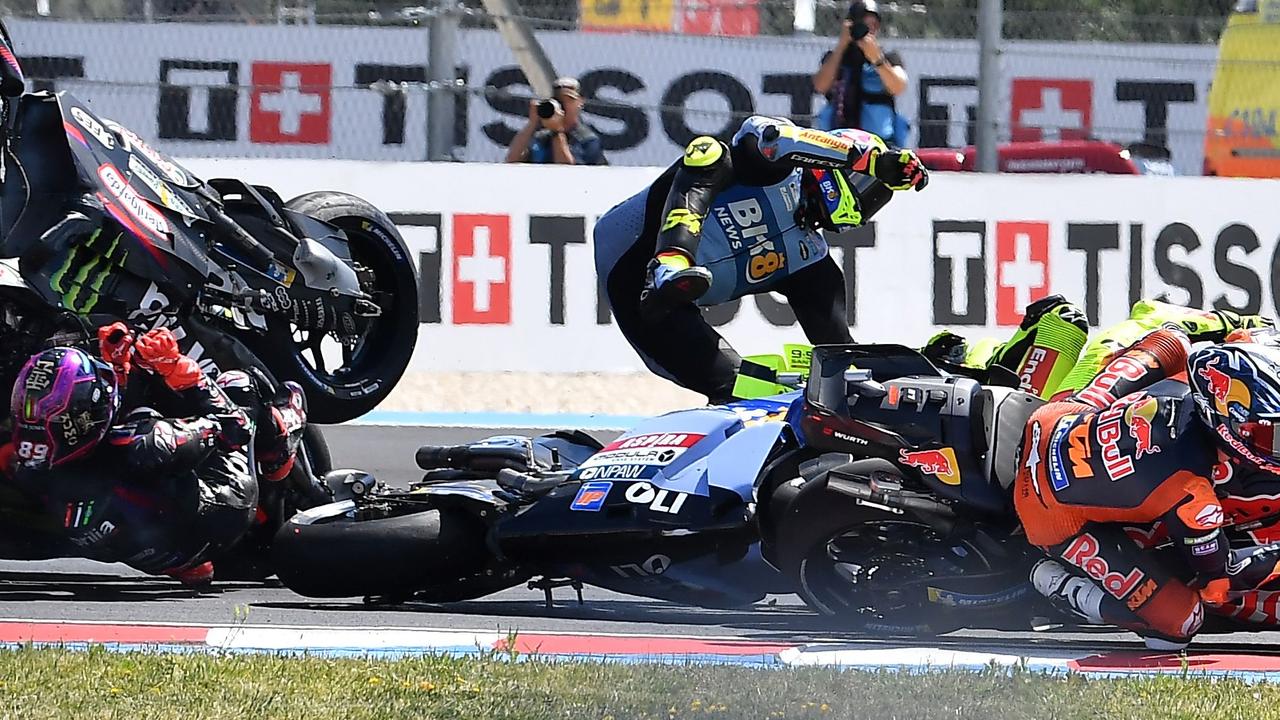
MotoGP has banned the use of holeshot devices for the start of races with immediate effect, and will expand the space between rows on the grid to try to make race starts safer after a spate of violent accidents at recent rounds of the 2026 season.
Every MotoGP qualifying, practice and race LIVE and ad-break free from lights out to the chequered flag. New to Kayo? Start Your Free Trial Today >
Elsewhere, Aprilia CEO Massimo Rivola addressed the one-race ban handed to world championship leader Marco Bezzecchi after the Italian struck a trackside marshal following his spill in Saturday’s sprint at the Grand Prix of Czechia, while MotoGP’s foremost crash magnet took a huge gamble that paid off in a season-best showing last Sunday at Brno.

There’s that and more in MotoGP Pit Talk, your news wrap of the stories behind the headlines after the Czech GP and before this weekend’s Dutch Grand Prix at Assen, round 10 of the 22-round season.
Marquez reigns after Bezzecchi drama | 17:52
HOLESHOT DEVICES BANNED MID-SEASON TO ALLEVIATE SAFETY CONCERNS
Front holeshot devices – otherwise known as start devices – will be outlawed from this weekend’s Dutch Grand Prix at Assen, after multiple riders expressed their concerns about the role the devices played in major first-corner crashes in Catalunya and Hungary.
MORE MOTOGP NEWS
TALKING POINTS Marquez makes Aprilia pay, Ogura’s wish, Aussie’s ‘s***ty feeling’
RACE REPORT Champ back in title fight after taking back-to-back wins in Czechia
Both front and rear holeshot devices have been banned in the upcoming 2027 regulations, where the sport will change from 1000cc to 850cc machinery, remove aerodynamic devices that have changed the physical appearance of MotoGP machines in the recent years, and switch from Michelin to Pirelli tyres.
In Barcelona, Honda rider Johann Zarco crashed at the first corner off the start and had his left knee trapped between the rear tyre and seat unit of Francesco Bagnaia’s crashed Ducati, the Frenchman suffering a torn ACL and PCL and burns from the exhaust of Bagnaia’s bike. Zarco hasn’t competed since, and there’s no timetable for his return.
In the next round at Balaton Park, Aprilia’s Jorge Martin lost control on the approach to the first turn on the opening lap and skittled teammate Marco Bezzecchi, fellow Aprilia rider Raul Fernandez, and Ducati pair Fabio Di Giannantonio and Fermin Aldeguer, eliminating four riders on the spot in a frightening crash that saw the 2024 world champion given a double long-lap penalty for last weekend’s Grand Prix at Brno.
Martin wipes out 5 riders in mass crash! | 00:53
While holeshot devices were not fully to blame for either accident, a growing number of riders – Australia’s Jack Miller among them – renewed calls to bring their abolition forward immediately rather than wait to the end of the season.
“You weren’t even really able, without locking the front, to really get enough [load] transfer to unlock the devices,” Miller explained in Hungary.
“Take off the front device, it makes everybody’s life easier and everybody is in the same boat. We’re all in the same boat at the moment, except that boat is going about 30km/h faster”.
To engage the holeshot device, riders activate a setting that manually lowers the bike’s suspension, minimising the propensity of the bike to wheelie and allowing for more effective torque transfer through the rear wheel. The device is disengaged when a rider brakes for the first corner, returning the machine to its normal clearance from the ground.
At last weekend’s Czech Grand Prix, riders were permitted to perform an extra practice start after the three practice sessions were completed on Friday and Saturday to assess the viability of starting sprints and Grands Prix without the holeshot device engaged.
On Monday night (AEST), MotoGP’s Grand Prix Commission (GPC) announced its decision to ban them immediately.
“Front Ride Height devices, known as holeshot devices, will be removed from all MotoGP machines from the Dutch Grand Prix onwards,” a statement read.
“This follows consultation with all MotoGP teams and after riders have had the opportunity to test their starts in extra practice start sessions.”
In the same GPC release, it was announced that MotoGP grids will have more space between rows from the German Grand Prix (July 10-12), with the gaps between rows being extended from nine metres to 12. Grids will remain at three riders per row; prior to 2004, grids featured four riders per row.
In addition, the GPC directive has placed a hard limit on a maximum of six bikes per manufacturer from 2028, meaning each of MotoGP’s five factories (Ducati, Aprilia, KTM, Honda and Yamaha) can provide bikes to two customer or satellite teams as well as running their own machines.
Before Pramac Racing switched from Ducati to Yamaha for the 2025 season, Ducati had eight bikes on the grid to either four or two for their rivals, giving the Italian manufacturer an outsize advantage and allowing for more data to be gathered for performance gains.
MotoGP’s current manufacturer configuration – which will hold for 2027 – features six Ducatis and four bikes from each of Aprilia, KTM, Honda and Aprilia.
Last Friday at Brno, MotoGP’s manufacturers signed a five-year contract with series promoters MotoGP Sports Entertainment Group (MSEG) to run the sport for the 2027-31 seasons, with Autosport reporting that the sport’s 11 teams will receive 8 million Euros (A$13.1 million) annually for the duration of the contract.
Extra space between rows on the grid to help make race starts safer will come on stream from the German Grand Prix in July (MotoGP Press)Source: Supplied
‘EVEN MORE INTIMIDATING’: APRILIA BOSS WARY OF SURGING MARQUEZ
Aprilia CEO Massimo Rivola said MotoGP’s standout manufacturer of 2026 never saw reigning world champion Marc Marquez as anything other than a title threat, with Marquez storming to within 40 points of series leader Marco Bezzecchi after winning his second Grand Prix in succession at Brno last Sunday.
MORE MOTOGP NEWS
DONE DEAL MotoGP teams, promoter agree on contract as rider market readies for launch
SPRINT REPORT Bagnaia wins, Bezzecchi cops ban for striking marshal after crash
Marquez required right shoulder and right foot surgeries after crashing out of the sprint race at round five in France in May, the Ducati missing the following round in Catalunya altogether and coming back for the Italian Grand Prix at the end of that month underdone, finishing just seventh in the main race while Aprilia teammates Bezzecchi and Jorge Martin took first and second.
Marquez fell to 102 points behind Bezzecchi after Italy, but has sliced 62 points off that deficit in just two rounds, winning the sprint and Grand Prix in Hungary, then winning on Sunday at Brno for back-to-back victories at the Czech track, where he’s won five times in his MotoGP career.
The consecutive wins for Ducati were against the run of play, with Bezzecchi and Martin combining to win five of the first seven Grands Prix of the season.
“We have been worried, if I may say, about Marc Marquez since race one,” Rivola told reporters at Brno last Sunday.
“Marc is a threat and Ducati is doing a great job, compliments to them. [Marquez] was a threat even when he wasn’t in top form … now he’s back in shape, he’s even more intimidating.”
Rivola also addressed the one-race ban given to lead rider Bezzecchi after his controversial altercation with a trackside marshal after he crashed at turn three on the penultimate lap of the sprint race, which has left the series leader with consecutive scoreless Grands Prix Sundays and with just seven points to Marquez’s 69 (from a maximum of 74) over the past two rounds.
Bezzecchi was banned for “an action prejudicial to the interests of the sport” after striking the volunteer trackside marshal twice. Aprilia appealed the ban, but in rejecting that appeal, the stewards said that while riders “involved in accidents may experience frustration, disappointment and heightened emotion immediately following an accident, such circumstances cannot excuse or justify physical aggression directed towards circuit personnel performing their official duties. Physical aggression towards marshals is wholly unacceptable in professional motorsport and cannot be tolerated.”
Rivola said Aprilia’s appeal was based on previous, adjacent incidents; in Qatar in 2023, then-Aprilia rider Aleix Espargaro slapped Ducati’s Franco Morbidelli during a practice session, and was hit with a six-place grid penalty and 10,000 Euro fine but allowed to race.
“My thought was maybe [suspension] is a bit too harsh,” Rivola said.
“Give him a big fine, give him a grid position penalty, but let him race because it never happened in the past. But if this is the way to go, I agree. Zero tolerance is also from our side, and that’s it. We set a precedent that it’s good to follow.”
Rivola didn’t feel Bezzecchi, who was back on track at Brno on Monday in MotoGP’s closed-door test of the new 850cc machinery for 2027, would let the incident linger.
“Marco is strong enough to bounce back, with the team’s support he’ll be even stronger,” Rivola said.
“I’m convinced he’ll respond in the right way.”
After dominating the early phase of the season, Bezzecchi has scored just seven points in the past two rounds. (Photo by Mirco Lazzari gp/Getty Images)Source: Getty Images
FORMER CHAMP’S GAMBLE PAYS OFF WITH SEASON-BEST SHOWING
Honda’s Joan Mir has earned praise for a season-best fifth place in the Czech Grand Prix, which came after the 2020 world champion made a bold tyre choice to surge forwards from 12th on the grid in sweltering conditions at Brno.
Mir, who will switch to the Gresini Ducati team next year when a host of 2027 rider contracts are announced in the coming days, was the only one of the 20 riders to take the start with the fast but brittle soft-compound Michelin rear tyre, his rivals electing for the slower but more durable medium rear on a 32-degree day where track temperatures nudged 50 degrees for the 40-minute race.
Mir gained four places on the first lap at Brno, moved into fifth place with seven laps to go, and avoided a last-lap showdown with Pedro Acosta when the Spaniard’s KTM crawled into retirement on the final lap.
Mir was rewarded for his calculated risk with a season-best performance at Brno. (Photo by Mirco Lazzari gp/Getty Images)Source: Getty Images
Mir spent the final eight laps lapping in the 1min 54sec range – the four riders ahead of him were almost exclusively in the 1:53s – but had enough in reserve to finish 12.810secs behind race-winner Marc Marquez for just his fourth finish in nine Grands Prix starts this year, the 28-year-old finishing just half (nine of 18) starts across sprints and Grands Prix this season.
Honda teammate Luca Marini, who finished three places and more than eight seconds behind Mir, was impressed.
“Joan did a really strange choice to put the soft [tyre] today, but it looks like that he didn’t have vibration,” Marini said.
“He was doing a fantastic race with very good pace at the beginning and he managed the rear tyre very well. Congratulations to him, because he achieved a really good position.”
Mir, who sits just 18th in the standings with 28 points despite having the pace to run inside the top 10 for 67 per cent of his 152 completed laps this season, said using the soft tyre was a gamble, but a calculated one based on how he prefers to ride.
“It’s easy to say this when at the end everything went right, but for me … I know my riding is more incisive in the entry and mid-corner, and with the medium [rear] tyre in that area you struggle more,” he said.
“My style is a bit more approaching the entry with more speed, and with the soft I could do it, but I had to manage more the tyre drop, but that’s something that in the past I was very good at.
“Finally we could put a realistic result, despite the only [position] that was not real was Acosta, he had a technical problem. Apart from that it was a real sixth, fifth position, that is something to be happy about.”