
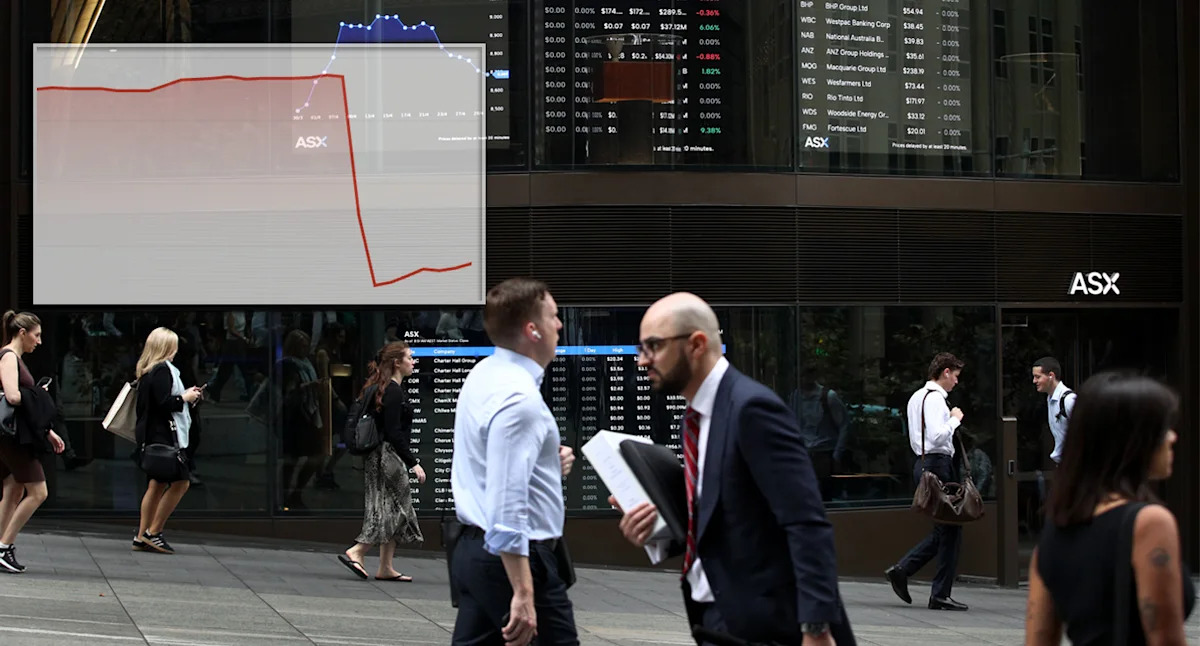
An Aussie bank has seen the valuation of its business on the Australian stock exchange nearly halve in a single trading day. Judo Bank’s share price plunged on Thursday after revealing bad debts to the market.
The bank, which lends to small and medium businesses, said three loans had gone bad in recent weeks, stoking concerns about the state of the economy and sending jitters through investors. One of the loans was to a business that had suddenly entered voluntary administration which caught the bank off guard as the business “deteriorated very rapidly”.
“Judo’s cost of risk has been impacted primarily by specific provision increases for three exposures across different sectors that have recently emerged,” the bank said in an update to the ASX.
RELATED
After the bank’s chief executive Chris Bayliss arranged a call with analysts this morning, the stock plunged more than 40 per cent.
The small bank now has a market cap of just over $1 billion.
Bayliss said the bad loans were specific to the borrowers, but pointed to the macro economic environment as playing a part in the troubles.
“We continue to see strong underlying momentum in the business. Recent credit outcomes have been driven by a small number of customers, who we are actively working with. These exposures have deteriorated subsequent to the customer-by-customer review undertaken in the third quarter and reflect recent, borrower-specific developments,” he said in a statement.
“While today’s update is partly a result of the macro environment, it is nevertheless disappointing. Regardless, we remain confident in the strength of our underlying business and the quality of the portfolio.”
The bad loans were reportedly to companies in the property, financial planning and manufacturing sectors of the economy. On top of the bad credit, the company revealed a worse than expected outlook compared to what analysts expected for next year.
The bank is due to deliver its financial year results on August 18.
The broader ASX200 was down as the market opened this morning but bounced after the ABS reported the economy added a better-than-expected 40,300 jobs in May, while the unemployment rate ticked down to 4.4 per cent, from 4.5 per cent.
“For an economy that is supposed to be losing momentum, Australians are still working and still spending,” VanEck’s head of investments and capital markets, Russel Chesler told AAP.
Get the latest Yahoo Finance news – follow us on Facebook, LinkedIn and Instagram.