

Welcome to the new NHL, where even the descendants of Winnipeg Jets stars collude to orchestrate trades to Florida.
If you were the Jets, dealing with the challenge of maximizing value for Connor Hellebuyck the summer after losing Nikolaj Ehlers to free agency and three years after honouring Pierre-Luc Dubois’ trade request to Los Angeles, you might take a moment to laugh. The NBA-ification of the NHL may come as a shock in other markets but Winnipeg is well versed in the idea of a player saying, “I love this place but I want out of it.” The Jets were born here. The rest of the NHL is just catching up.
For Winnipeg, the idea of star U.S.-born players orchestrating American exits is not the story. It is the exclamation mark at the end of it. For the Jets, the new reality is the same as it’s always been and the conclusion is the same one it’s always needed to reach. Winnipeg can’t win by making the signings and trades the way the Panthers do.
The Jets can only win by excelling at the less celebrated facets of teambuilding — drafting, developing, and retaining youth. By building a community of misfits, making value plays on underappreciated veterans, and by finding players who prefer the exhale of a prairie sky to the bustle of a big city. By being so obviously all-in on creating the best on- and off-ice experience available for its NHL players — off-ice luxuries, development coaches, training and recovery experts, and more — that they are as good at developing NHL talent as Florida is at being sunny.
Is Viggo Bjorck the best center in the NHL Draft?
Corey Pronman, Scott Wheeler and more
This is a big picture concept with immediate-term implications. It is paramount that Winnipeg makes its first-round pick, currently No. 8.
Today, we make the case for the Jets to improve upon it.
Winnipeg’s best route to elite talent that stays in Winnipeg has always been the draft. Draft picks remain under team control until their mid-20s. They build relationships with the city and develop insights into the community that outsiders can’t understand. And, when Winnipeg does a good enough job drafting and developing players, it wins — the most important recruitment tool at the Jets’ disposal. Remember that Hellebuyck’s presumed openness to an exit is not the result of disdain for Winnipeg. It is the product of a 33-year-old star player with one glaring hole on his NHL resume and the awareness that careers are short.
The Jets have never been, and may never be, a premier destination for top UFA talent or players with trade protection. But they’ve been better at retaining their best players —Hellebuyck and Mark Scheifele in this generation, Blake Wheeler before them — when management has been able to sell them on a realistic path to playoff success.
What’s that path now? Excelling at “the less celebrated facets of teambuilding” must include winning at the draft. There are only two ways to do that: Quantity, which we discussed in this piece that included analysis of ways to trade down, and quality. There is a steep decline in talent from the No. 1 pick in most draft years, with Gavin McKenna and Ivar Stenberg the projected 1A and 1B players in this class. If Winnipeg won’t trade down from No. 8, adding multiple shots at a top-six, top-four type of talent, why not up — perhaps to No. 4 or even No. 2, where the odds of a franchise player are just a little bit higher?
The Sharks’ pick at No. 2 is on the market, with “roughly five teams” showing serious interest. Stenberg would be the obvious selection, with so much offensive talent, great hands, and a high-end shot that has experts projecting top-line potential. At No. 4, there’s a case for Carson Carels, the projected top pairing defenceman from Cypress River, Man., who’s expected to be out of reach for Winnipeg at No. 8. He’s big, mean, scored 20 goals and 73 points for Prince George in the WHL last season, and has been balancing pre-draft preparation with calving duty on the farm.
Buffalo also has a viable second-line centre in Josh Norris, an established veteran goaltender in Ukko-Pekka Luukkonen, and an intriguing prospect pool that includes 6-foot-6, right-shot defenceman Radim Mrtka — not to mention centre Konsta Helenius, who the Sabres are unlikely to move. And if the Jets want a goaltending prospect back instead of at 27 year old in Luukkonen, there’s Devon Levi. There should be enough viable pieces for these two teams to make a trade.
No one is a sure thing, but the higher Winnipeg climbs, the more likely it is to grab one of the top talents in this year’s draft.
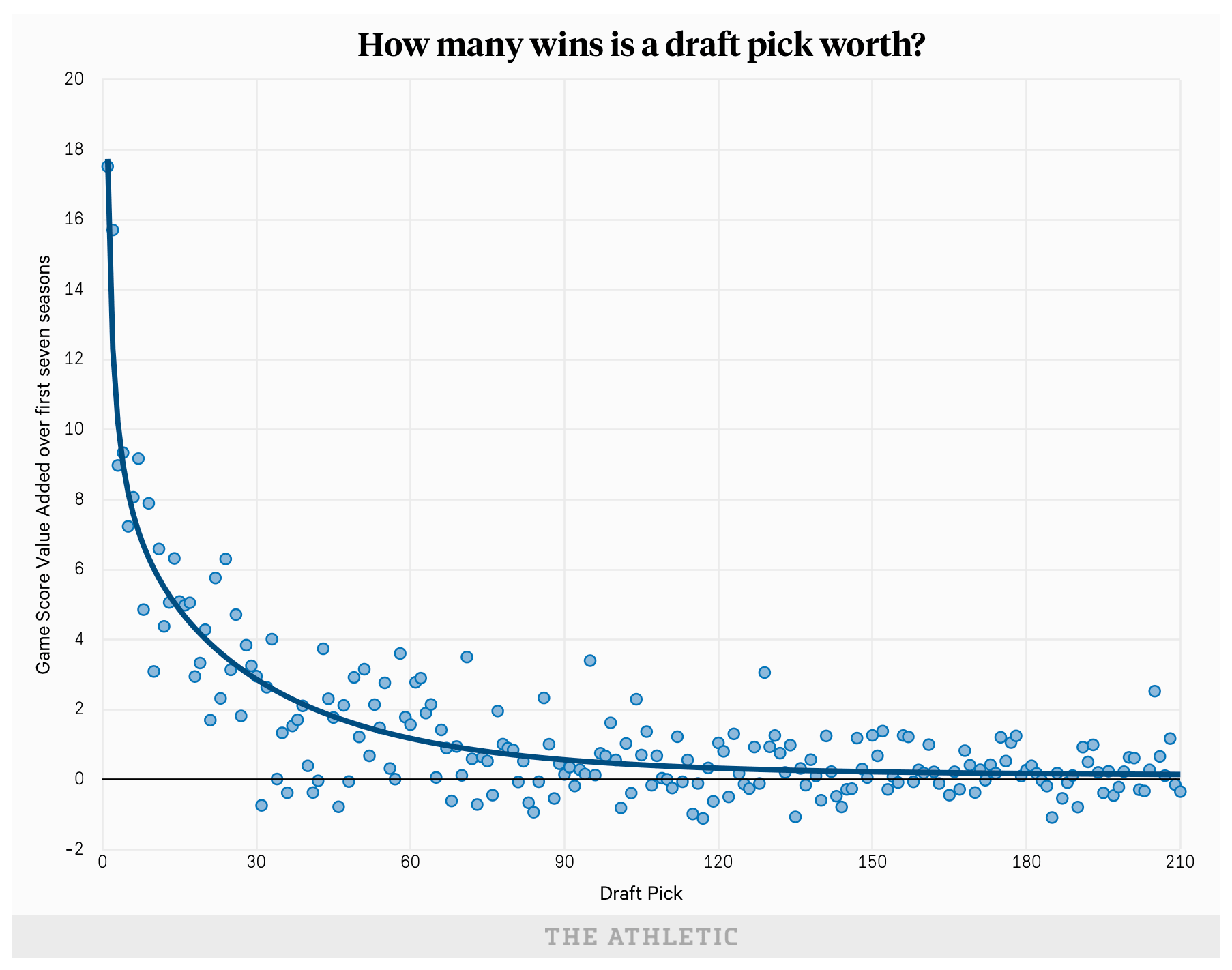
Winnipeg’s No. 8 pick could have been a viable piece of a Brady Tkachuk or Jordan Kyrou trade package, but those players’ no-trade clauses would have gotten in the way. The Jets’ veterans may be cheering for Winnipeg to trade the pick for immediate help, but there must be a life after the current core. The draft is the Jets’ best long-term route to elite talent, with multiple years of team control and the relationship building that comes with it.
There’s also the sheer number of top-10 picks already in play.
Ottawa acquired the No. 9 pick (and the No. 25 pick, a 2029 first-round pick and a 2027 second-round pick) for Brady Tkachuk
San Jose then acquired the No. 9 pick for William Eklund, Kasper Halttunen, and Brandon Svoboda
Buffalo acquired the No. 4 pick (and the No. 45 pick, along with Louis Crevier) for Bowen Byram and Jordan Greenway
It’s not a certainty that the Sabres peddle the No. 4 pick as currency, the same way that Ottawa did with the No. 9, but it could be a compelling part of a Hellebuyck deal. If the Jets had more of their own draft capital, it’s also possible to imagine a world where they’d be able to move up to No. 4 from No. 8.
The flurry of trades leaves the following teams with multiple first-round picks:
San Jose Sharks (No. 2, No. 9, and No. 27)
Vancouver Canucks (No. 3 and No. 24)
Buffalo Sabres (No. 4 and No. 20)
New York Rangers (No. 5 and No. 26)
Calgary Flames (No. 6 and No. 30)
St. Louis Blues (No. 11, No. 15, No. 16, and No. 29)
Ottawa Senators (No. 25 and No. 32)
What would it cost to add another top pick?
Sharks GM Mike Grier has said that he’s willing to move the No. 2 pick for a piece that helps San Jose in the immediate term. The Jets don’t have a spare Bowen Byram hanging around, although one subscriber pitched Dylan Samberg for the second pick in our “Who says no?” mailbag. The Sabres’ cap issues are essentially resolved with their sign-and-trade of Alex Tuch to the Washington Capitals. Outside of something truly shocking, involving Samberg, Josh Morrissey, or another core player, it looks like Hellebuyck is the most viable route.
It’s not the Jets’ habit to make several moves in succession, as the Panthers and then Senators did earlier this week, but it’s clear that first-round picks are liquid currency right now. If Winnipeg insists that it’s a win-now team, then a trade that added the No. 4 as part of a Hellebuyck trade could be followed by a secondary deal involving the No. 8 pick. The obvious hope would be for Carels or whoever the Jets drafted inside the Top-5 to be marginally better than options available at No. 8, so as to give Winnipeg value in the deal.
As always, the simplest play is the most likely: I think that Winnipeg will make the No. 8 pick on Friday. If they do so, they’re likely to get a very good prospect in Daxon Rudolph, Keaton Verhoeff, or even Viggo Björck if he falls that far. The idea of trading down must also be tempting, prioritizing quantity of first-round picks over quality — especially if St. Louis were willing to trade the No. 11 and No. 15 or 16 picks to get No. 8.
Winnipeg’s best path to contention is a return to its drafting roots and then a substantial upgrade on its developmental success. The latter may yet involve the hiring of Shane Doan. The former requires Winnipeg to keep its No. 8 pick at the very least and to move up if it’s available to them. The Jets are perhaps the hardest hit Canadian team when it comes to losing talent to the USA, via Jacob Trouba, Dubois, and the possibility of Hellebuyck. They must become the best at navigating what appears to be a growing reality for Canadian teams throughout the league.