
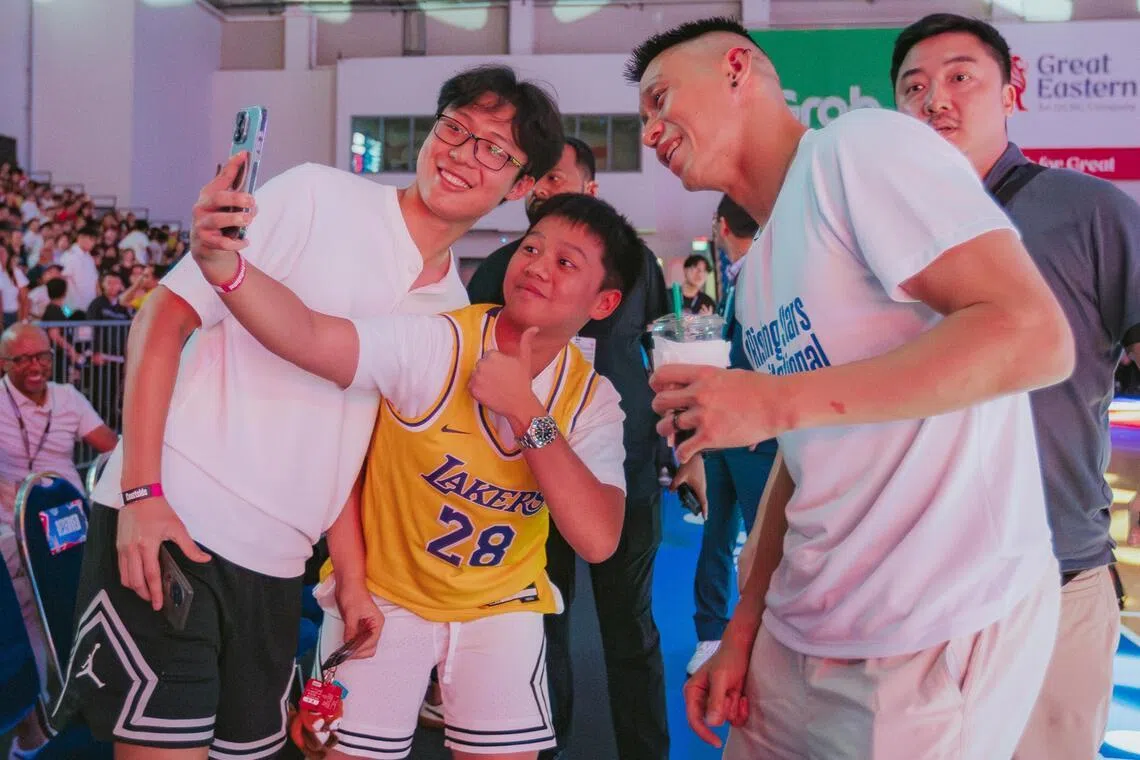
Q: Your former team, the New York Knicks, invited you back for Games 3 and 4 of the NBA Finals. How did it feel to watch them on the way to winning only their third NBA championship and first in 53 years?
Jeremy Lin: It was super joyful, it was healing for everybody to see the Knicks win. Honestly, I didn’t guess and couldn’t have predicted how dominant they were going to be. They won 15 of their last 16 games, and to be able to do that and sustain that level of mentality for that long was really impressive.
Q: Who, or what, was crucial in this championship-winning run?
Lin: Oh, who wasn’t crucial?
You can go down the list, even down to Mitchell Robinson, Jordan Clarkson and Jose Alvarado.
But beyond them, (Jalen) Brunson, OG (Anunoby), and KAT (Karl-Anthony Towns) were for me the top three difference-makers.
Q: At the start of your basketball journey, you didn’t receive any athletic scholarship offers, you were undrafted and you got waived. How did you still end up with “Linsanity” and the career you had, including becoming the first Asian-American to win the NBA championship?
Lin: Definitely there’s the hard work and perseverance, but also a lot of it is a bunch of things happening out of my control. So, I do consider “Linsanity” a miracle.
You can work as hard as you want and be as prepared as you want, but there are still many things outside of your control. It felt like everything came together at the right moment, and it really felt like a miracle from God, and that’s something I still feel to this day.
Q: Your family borrowed money, your mother emptied her employee retirement fund, and you had a spell eating the same US$5 (S$6.50) foot-long Subway every day just to fund your NBA dream. Why is it so expensive to pursue professional basketball in the US?
Lin: Because I eat a lot (laughs).
It’s expensive to be able to compete and have exposure. The reality is a huge part of your growth is what you’re exposed to.
When you get exposure to higher-level players, your standard continues to rise… to continue to be great, you have to be in that environment, and that costs money to constantly be travelling.
Staying in your own area and playing local basketball will only get you so far, so a lot of it is getting exposure to better players and better tournaments.
Q: This past season, there were just three Asian-born players – Rui Hachimura, Yuki Kawamura and Yang Hansen – in the NBA. Why do you think there still aren’t more, and do you think there should be more?
Lin: I would love to see more. I think there are many reasons, and it’s a systemic issue that has to be tackled holistically.
The biggest thing is creating an optimal environment for players in Asia to develop and grow. I think that is well on its way, but there are definitely many areas that can continue to be improved, so that we can continue to foster the right environment.
Q: Could you give us examples of some of the stereotypes Asian players face in the NBA?
Lin: A lot of Asian players will be seen as soft, just because Asian players come off as more quiet.
In Asian culture, you’re kind of taught not to stand out or be the loudest, and there’s a lot of respect for your elders and things like that. Culturally, to other people, that is seen as soft, even if you’re not soft.
Being passive is another stereotype. Asian players may be more quiet, they seem pretty expressionless, and because of that, people start to guess, do they even like the game, do they care? And they often guess wrong.
It’s not true for everybody, of course. These are generalisations, but I think culturally there are a lot of things that aren’t aligned, so sometimes what is actually happening is not what is perceived to be happening.
Q: You’ve publicly spoken about a wide range of topics such as mental health, your faith, racism, and also made multiple donations to good causes. What made you so vocal and active about such things?
Lin: It’s just things that really strike a chord in my heart, things that I care about. Oftentimes, the things I care about are things that either I went through myself or things that I saw people I love go through.
Q: You retired from professional basketball in 2025 and we see on social media that you have picked up pickleball. What do you like about it, and what keeps you busy these days?
Lin: I love pickleball. I love improving, I love learning. Being able to apply myself to a new sport is really fun. I like to lose and fail because I think that elevates my growth.
Other than that, I’ve been doing a little bit of commentating and broadcasting here and there, as well as working on a lot of stuff on the brand side, and doing different things like the NBA Rising Stars Invitational here in Singapore.
We also have a mission-driven fund out here in Singapore which I’m able to do while I’m out here as well.
Q: You are a father to a two-year-old son. Would you want him to also become a professional basketball player?
Lin: I’m not going to push anything on my son. I’m going to support him in whatever he’s passionate about. If he wants to be a professional basketball player and has the ability to, then I’ll support him in that. But he doesn’t have to.
Q: What advice would you give young players, especially those from Singapore?
Lin: My advice to young basketball players is definitely to slow down and enjoy where you’re at.
Focus on the process and not the result. As long as you’re really putting forth your best effort every day, as long as you’re doing everything you can to be as great a basketball player as you can be, that is what you should be focused on, and not always the result.
The last thing is stay away from the comparison game. With social media, it is really hard to avoid, but so many players lose confidence because they’re comparing themselves to other people.
A lot of young players can fall into that trap of comparing too much. Oftentimes when you compare yourself to another player, you almost forget what makes you special or what your strengths are.
Dive into all the sporting action and trends in Singapore with ST’s weekly newsletter.