
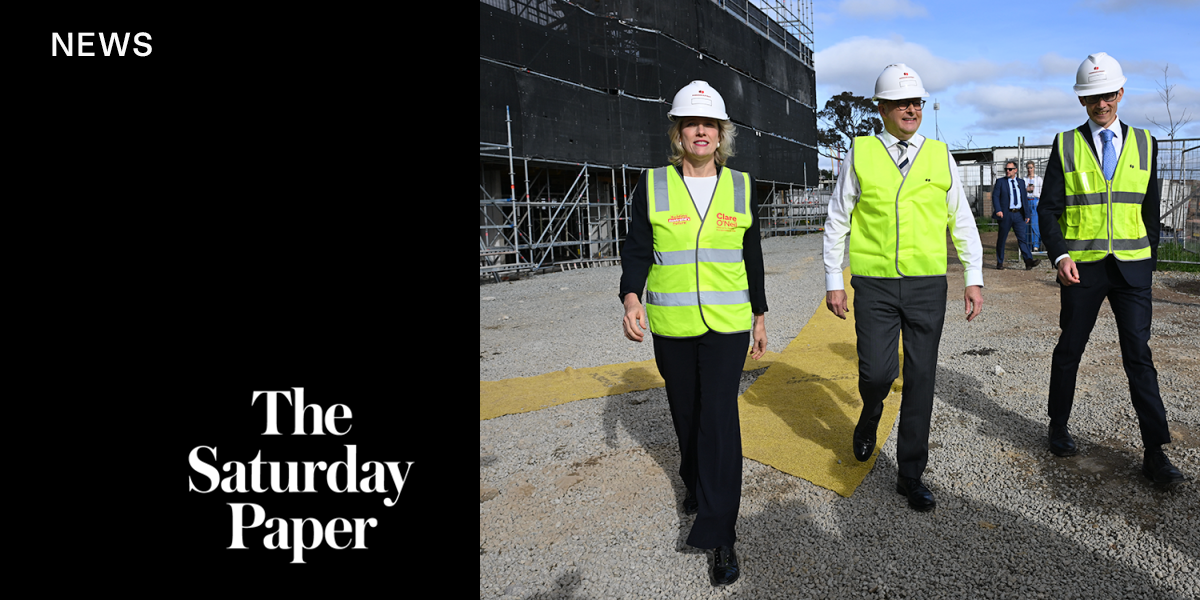
Labor flew into damage control this week after a moment of accidental candour from Clare O’Neil on ABC Radio.
Responding to questions about house prices, the Housing minister delivered what might seem a statement of the obvious about the cyclical nature of the real estate market.
“We see periods of very significant house price growth and then we see the market make a correction, and that’s what we’re seeing at the moment,” O’Neil said.
That word has a specific meaning in relation to markets, however. A correction is generally considered to refer to a fall in prices of between 10 and 20 per cent. A deeper decline is known as a bear market, characterised by widespread investor pessimism.
The mere use of the word was enough to make headlines, particularly in the financial media, and those hostile to the Labor government and its budget changes to the capital gains tax and negative gearing treatment of real estate.
No matter that the minister went on to quote Treasury modelling that forecast the tax changes would cause only a slowing of house price growth by about 2 per cent below what it otherwise would have been, which she called “meaningful but moderate”.
No matter, either, that Treasurer Jim Chalmers later corrected her use of “correction”, saying she meant it only in the general sense of the word.
O’Neil’s comment and the aftermath perfectly illustrates the government’s dilemma – one that prevents it from touting the apparent success of its biggest reform. Labor must make the case that the tax changes in the budget will make it easier for first-home buyers to compete with property investors, knowing the political risks of any action that might reduce the wealth of those who already own homes.
O’Neil’s choice of language was all the more problematic because it echoed what others were saying.
The veteran finance journalist Alan Kohler, for example, a former editor of both The Australian Financial Review and The Age newspapers and long-time finance presenter on ABC News, also used the word in one of his spots this week.
“Housing is in full correction mode, with the [national] auction clearance rate down to a six-year low of 47.4 per cent,” he said, citing the numbers for the week to last Sunday from the property data company Cotality.
The number of houses put up for auction fell 10 per cent compared with the previous week, Kohler noted, almost a quarter of scheduled auctions were withdrawn and a half of those were sold before auction.
“So, obviously, vendors don’t want to take their chances with an auction at the moment,” he said.
Notably, the Cotality data showed the fall in auction clearance rates was most dramatic in the cities where prices had previously been growing fastest. In Perth and Adelaide, only 40 per cent of homes that went under the hammer were sold. In Brisbane, the rate was a miserable 33 per cent.
The auction clearance rate is a leading indicator. When it plunges, prices inevitably follow. Historically, the pattern is that they decline between about 4 and 8 per cent, then after a year or two the market recovers and prices continue their general upward trajectory.
“What we need to see is house prices remaining flat for 10 or 15 years in order for incomes to catch up.”
The two most recent declines have been particularly large, says Cotality’s research director, Tim Lawless.
“The largest decline we’ve seen across our combined capitals index was an 8.2 per cent drop in housing values from peak to trough, and that was between 2017 and 2019. The second largest fall was just over 8 per cent through the middle of 2022 to early 2023.
“With that context in mind, a 6 to 8 per cent drop – or even more than that – it seems the historical precedents are already there. Arguably we’re facing stronger headwinds now than were there for those previous downturns,” says Lawless.
Most of the banks and other big financial institutions are forecasting a smaller decline than that, although at least one, the United States investment bank Morgan Stanley, is tipping a 10 per cent drop – into correction territory.
Many bank economists, as well as Lawless, nominate drivers other than the tax changes. A bigger influence, they say, is rising interest rates. The Reserve Bank has increased the cash rate three times this year, in February, March and May, each time by 25 basis points. Most financial analysts predict one or two more hikes before rates start coming down, sometime in the latter half of next year.
Even before rates started rising, says Lawless, other factors – such as the declining affordability of houses, inflation, the cost of petrol, the Iran war and general unease about the state of the nation and the world – were combining to slow the market.
“On our numbers, the market actually moved through its peak rate of growth, at least on a national basis, in October last year. Back then we were seeing national home values rising at 1.3 per cent a month. And it’s been gradually fading since, to a flat result in May,” he says.
“Looking at how the daily index is tracking, I expect our national index will be slightly down at the end of June, by about 0.2 or 0.3 per cent.”
His point is that the housing market was turning long before the government announced its tax changes. “There is definitely a bit of a pile-on [on] the budget,” he says.
Despite all the criticism, the changes are not particularly radical. They limit negative gearing for residential property investments to new builds and replace the existing 50 per cent capital gains discount with a new “cost base index” that adjusts for inflation and imposes a minimum 30 per cent tax on gains. The aim is to remove the advantage that property investors have over owner-occupiers, particularly first-home buyers.
Existing investors will be grandfathered. Furthermore, the changes do not come into effect until July 1, 2027 – by which time, it is hoped, the other factors depressing prices will have abated. The cycle of interest rate rises is expected to be over.
The weird thing is that the government has been so cautious in its defence of the measures, if not of the problem they are intended to fix.
As O’Neil said in that ABC interview, house prices had jumped 50 per cent “since just before Covid” in 2020.
“Our government is reacting to what we are seeing in Australia today, which is home ownership rates for young people falling through the floor. Let’s not beat around the bush here. We’ve got a broken housing market.”
Runaway house prices were not just hurting young people, she said, but were changing “what fairness and equality mean in Australia”.
A report from the Grattan Institute last year set out the magnitude of this problem in disturbing statistical detail.
Since the turn of the century, it said, the cost of housing had far outpaced wages, with the result that the price of a typical home had grown from about four times median income to eight, and nearly 10 times in Sydney.
On average, it took 12 years just to save up a deposit.
“Unsurprisingly,” it said, “home ownership rates are falling fastest for younger people. Whereas 57% of 30–34-year-olds owned their home in 2001, just 50% did so by 2021. And just 36% of 25–29-year-olds own their home today, down from 43% in 2001.”
The decline in the ownership rate was even greater for the poorest 40 per cent in each age group.
Housing was the major driver of increasing wealth inequality in Australia, Grattan said.
“Since 2003–04, the wealth of high-income households has grown by more than 50%, much of that due to increasing property values. By contrast, the wealth of low-income households – mostly non-homeowners – has grown by less than 10%.
“The growing divide between the housing ‘haves’ and ‘have nots’ is largely generational.”
That fast-growing cohort of mostly young people unable to buy a home was doubly cursed by rising rents – up “roughly 20% in Sydney and Melbourne in the past four years, and by much more in Brisbane, Adelaide, and Perth”.
Since that report was published in March last year, Australia’s housing crisis has worsened. According to figures from the Real Estate Institute of Australia, house prices went up a further 12 per cent nationally.
So the market was due for a correction, but the government is keen to downplay the role of its policy changes. In that interview O’Neil “absolutely” claimed credit for making it easier for first-home buyers to get into the market but ducked questions about collapsing auction clearance rates.
Likewise, another Labor frontbencher, Tanya Plibersek – usually one of the government’s most assured media performers – stumbled through an interview on the Seven Network’s Sunrise program, talking down the impact of the policy changes when host Natalie Barr repeatedly pressed her on whether the government wanted house prices to fall.
“Well, what we anticipate over time is not that house prices will continue to fall but that they will grow more slowly,” she said.
But the problem will not be fixed if that happens, says Matt Grudnoff, senior economist with The Australia Institute.
“What we need to see is house prices remaining flat for 10 or 15 years in order for incomes to catch up,” he says.
His hope is that the current cyclical downturn will not end in the same way as others have over recent decades, with investors re-entering the market and prices booming again.
Because the government’s tax changes make housing less attractive to investors, he says, “I think this will actually, for the first time ever, have an impact and flatten out prices.
“There are some people out there who will be upset by a flat housing market. They’re the people making money from the current [tax regime]. But if we want home ownership rates to go up, then we need investors to sell up, and we need first-home buyers to be able to get into the market.”
There are more than 2.3 million individual housing investors, equivalent to roughly 10 per cent of the working-age population, according to the Reserve Bank. Most of them are so-called “mum and dad” investors, who own only one rental property. Many people who do not own an investment property aspire to do so.
The “narrative” around wealth accumulation, says Andrew Saikal-Skea, an independent financial adviser, has long been “that if you want to get ahead in Australia, buy property”.
“There’s been such consistent and such tremendous growth in residential property for so long that a lot of people really viewed that as almost a defensive asset. It’s not a defensive asset, it’s very much a growth asset.”
He believes the tax changes will alter that narrative.
“I think what this is signalling is that the government, the [tax] environment is not just going to be wildly supportive of continued huge property growth.
“And I think that change in the narrative is really contrary to the Australian story over the last 30 years, and that’s probably more impactful than the actual economics,” he says.
Experts differ over exactly when and how Australian attitudes to housing shifted, from houses being places to live to becoming vehicles for wealth accumulation. In his Quarterly Essay on Australia’s housing “mess” a few years ago, Alan Kohler nominated a date – December 23, 1999 – as crucial. That was when the Howard/Costello government cut the capital gains tax by 50 per cent.
It’s true that this cut, in combination with the generous provisions for negative gearing – now undone by Labor’s changes – coincided with the rapid escalation in house prices. But Kohler and other economists also cited other factors. Between 2003 and 2009, net migration tripled and has remained high since. Periods of very low interest rates also encouraged people to borrow more. And grant schemes for first-home buyers, brought in by various governments, state and federal, Labor and Coalition, served to increase demand, while doing nothing to increase the supply of housing.
Though the Albanese government has sought to lay most blame on Howard’s CGT cut of 1999, Grattan’s report from last year argued that its impact is greatly overstated.
“The value of these tax advantages – about $10.9 billion a year – is tiny compared to Australia’s $11 trillion housing market,” the report noted. “Instead, the biggest problem is that housing construction in recent years hasn’t kept up with increasing demand.”
Close to $11 billion is still a huge amount to be handing to investors, every year. And the claim that the problem is supply requires some clarification.
The problem, says Grudnoff, is not a lack of housing, “it’s who’s buying the housing”.
When he compared census data on Australia’s population growth with the growth in the number of dwellings, he found that the number of houses was increasing faster.
Over the two decades to the most recent census in 2021, he says, “the population increased by 34 per cent, but the number of homes increased by 39 per cent”.
More recent quarterly data from the Australian Bureau of Statistics, he says, shows the number of dwellings is still increasing faster than the population.
Moreover, the average number of people living in each household declined, from about 2.9 in the mid 1980s to 2.5 in the early 2000s. It has declined further since the pandemic, as more people have taken to working from home and want more space in which to work.
Also, more wealthy people have second houses, and the number of Airbnb-style short-term rentals has surged.
It comes back to that “narrative” cited by Saikal-Skea: Australians want more and better housing per person.
For that, Kevin McCloud and Scott Cam might be as much to blame as Howard and Costello. Their real estate makeover TV programs – Grand Designs and The Block – premiered about the same time as house prices took off. There are now at least a dozen such programs on Australian TV.
About a decade ago, the noted Yale economist Robert J. Shiller – best known for having established the US benchmark Case-Shiller Index of housing affordability with his fellow economist Karl Case – produced a paper on what he called narrative economics.
Economic decisions, he suggested, were infected by all manner of “deeply human phenomena that are difficult to study in a scientific manner”.
One of the case studies he offered was the global financial crisis of 2007-08.
The proximate factors that caused it were arcane financial instruments such as collateralised debt obligations and mortgage-backed securities, but essentially it came down to imprudent mortgage lending by financial institutions to people who could not afford it.
But, said Shiller: “A narrative approach to understanding the crisis might take us back further in time.” He went on to call out a couple of TV shows that had become wildly popular half a decade earlier, which “depicted individuals buying homes, fixing and prettifying them a little, and then reselling them at a large profit”.
It was the public buy-in to that narrative of growing wealth through property that led to the “liar loans”, the dodgy packaging and sale of them and thence to disaster.
The lesson is that solving the housing crisis will likely require more than change to the tax laws. It will require us to buy into a different narrative, such as existed decades ago, in which houses were homes, not positional goods or investment vehicles.