
This is the result George Russell has been looking for.
Pole position. Race victory. Never losing control of the lead.
Coming off his second consecutive pole position, victory at the Austrian Grand Prix was Russell’s first win since the season-opening race in Australian more than three months ago.

Fox Sports, available on Kayo Sports, is the only place to watch every practice, qualifying session and race in the 2026 FIA Formula One World Championship™ LIVE in 4K. New to Kayo? Join now and get your first month for just $1.
Who could have guessed then, after he left Melbourne with a seven-point title lead, that his next win would reduce his deficit to 40 points?
“Incredible to be back on the top step,” he said. “It’s been a little while.
“A lot of hard work with my team to get us back on track — there was a tricky run of form at one point.
“The tough races definitely test you psychologically, and these last two weekends for me have been vitally important to remind myself I can do it.
“Single lap, race pace — we were very strong this weekend, and on a track that is probably not very well suited to my style.”
Russell can admit to having a “tricky run of form” now that it seems to be behind him, whereas he’d previously lamented bad luck as the primary culprit for his difficult season. Having spent weeks scrambling for answers as to why the car he loved so much in Albert Park had suddenly turned treacherous, he’s now back on solid ground and can start thinking about momentum.
READ MORE
‘CLEAR PENALTY’: Max reignites bitter rivalry; strong Piastri signs as big title statement sent
‘OF COURSE’: Piastri-Max swap rumour reignites as McLaren chief’s ‘banana peel’ answer causes stir
Leclerc and Piastri clash in Austria! | 00:42
But while it’s the result he needed, it wasn’t sort of definitive performance to instantly swing the title towards him. This wasn’t a weekend of start-to-finish domination.
Up until Q3 he seemed as lost as he’d been at any other weekend and needed to rely on an increasingly characteristic last-gasp gamble to get him over the line.
His race execution cannot be faulted, but he was arguably only the third fastest driver on track.
Crucially, it was still Antonelli who looked quickest.
And Verstappen came within 1.6 seconds of what would have been — perhaps should have been — a remarkable victory.
SHOULD VERSTAPPEN HAVE WON THE RACE?
Somewhat unbelievably, second place in Austria is Max Verstappen’s second podium of the season — and, even more remarkably, his best finish of the year.
It was a classic Verstappen performance — feisty and aggressive to apply maximum pressure to a rival that he really shouldn’t have been able to catch with the machinery at his disposal.
He’s capable of those performances everywhere, but they feel especially unsurprising at the Red Bull Ring.
“It was a very good race for us,” he said.
“To be second, that close to a win, I think is extremely positive for us. In that sense for sure I’m very happy.”
But as big a boost as the result was — particularly given speculation about Verstappen’s future at the team if it can’t turn its season around — it’s hard not to see this as a victory lost.
There were two key inflection points.
The first wasn’t totally in his control: the memorable and fiery battle with Lewis Hamilton early in the race that gifted Russell a healthy lead. Starting fifth on the grid meant Verstappen was always going to have to pass cars, and that was influential in his outcome.
The second inflection point, though, is harder to explain away.
Verstappen had great late-stint pace throughout the race, and at the end of the second stint he’d slashed his deficit down to around 1.2 seconds — undercut range.
Mercedes, seeing the way the race was going, pulled the trigger first, bringing Russell in on lap 43.
Red Bull Racing then opted to leave Verstappen out for six laps to try to build a tyre offset, but it meant he was 11 seconds down on Russell when he rejoined after his pit stop.
It was too great a gap to close with 21 laps remaining. In retrospect banking on track position — undercutting Russell — would have been the better bet.
It’s somewhat unusual for Red Bull Racing to appear passive in strategy, and Verstappen said afterwards that he didn’t agree with the approach.
Hamilton admits Ferrari struggles | 00:29
“I personally felt like the laps that I stayed out, I probably lost a little bit too much compared to what I gained back of those extra laps on new tyres,” he said. “But it’s easy to say now.”
Team principal Laurent Mekies suggested a defensive race would have made more sense in retrospect.”
“I think it’s probably fair to say that Kimi was probably the fastest guy out there, and perhaps Max was, in fairness, a tiny bit faster than George and just behind Kimi,” he told Sky Sports — more on that later.
But the team boss remained buoyed by how competitive the car was after having finished 40 seconds off the lead last time out in Barcelona.
“For the first time this season we had the pace to be very, very close, to have enough to win,” he said.
“It’s something that happens not very often, that you can sell more than 1 second of pace delta in a few races, and the season is still very long.
“We know we will need more, because we know competition will also continue to bring upgrades, but certainly it’s very impressive that we are now within the last tenths of what we need to be on the top stop of the podium.”
Points might have been left on the table, but Austria could go down as a crucial weekend for Red Bull Racing nonetheless.
OR SHOULD ANTONELLI HAVE WON THE RACE?
Mekies undoubtedly would have had his mind partly on the political value of describing Russell as the slowest driver of the top three, but his assessment of the leading three drivers is justified by the numbers.
Averaging only the representative laps of the three drivers throughout the race showed them separated by less than 0.1 seconds. That’s practically nothing given the rubbery nature of race times, but for what it’s worth, Verstappen was slightly slower than Russell, who was slightly slower than Antonelli.
But Antonelli, much like Russell, had his race partly decided by where he started, which in turn stems from his mistake to not complete Q3 owing to a misreading of the yellow flags.
Had he started on the front row of the grid, where his final lap likely would have placed him, the race outcome could have been totally different.
Instead he compounded his misery with a scrappy opening two laps that had him briefly down to fifth, which meant that after 10 laps he was already 6.5 seconds down on Russell.
That set the tone for his entire opening stint and effectively set his race in stone.
“I did a lot of mistakes,” he admitted to Sky Sports. “I was struggling with the brakes. I had a split [temperature] with the brakes [between left and right] and I was just struggling to attack braking.
Antonelli calm despite Russell victory | 00:42
“I really struggled that first stint, did a lot of mistakes, but then second stint I kind of reset, and then the third stint was really strong but just arrived to the party a bit too late.”
Similar to Verstappen, he lost time staying out on old tyres, particularly in the first stint. Though this tyre offset eventually helped him to create a grandstand finish in pursuit of second place, it may have hurt him more than it helped him.
Also unhelpful was that for the first time this season, Antonelli might reflect that luck wasn’t on his side.
Both his pit stops were made one lap before a virtual safety car was deployed.
The first was for Carlos Sainz’s stopped Williams on the start-finish straight. The Spaniard ground to a halt just as Antonelli committed to entering pit lane — too late for his team to act.
Had he stayed out an extra lap and capitalised, he likely would have rejoined neck and neck with Verstappen and around three seconds off the lead; in fact he rejoined around 14 seconds off the lead and behind Charles Leclerc.
The second VSC was for debris. Had he been able to time his stop, he likely would have jumped Verstappen and put himself only three second behind Russell.
It’s not bad luck so much as it is an absence of good luck, so he can’t feel too hard done by about it.
‘Tough races test you psychologically’ | 00:21
But the near misses demonstrate that he had the pace this weekend but only lacked the execution — something he was clearly feeling the sting from after the race.
“I think this weekend was good learning for me, especially after starting the weekend so strong,” he told Sky Sports.
“I lost a little bit my rhythm. Maybe I relaxed a bit too much or I was too confident, but for sure that was good learning, and now I’ll be back stronger for Silverstone.”
FERRARI WILTS IN THE HEAT
So much for Ferrari’s big weekend.
The Italian team brought a new engine to Austria that it hoped would start closing the power gap to Mercedes, which has been its principal weakness all year.
It was reasonably competitive in qualifying, even if it was flattered somewhat by the yellow flag situation at the end of Q3.
Hamilton even looked like he was able to follow Russell early in the first stint.
But it all unravelled after that, with Hamilton finishing and almost half a minute off the pace, while Leclerc faded to eighth and was another 20 seconds adrift.
It ended up being a bafflingly uncompetitive performance just one round after Hamilton claimed the only non-Mercedes victory of the season.
The problems leading down the road to ruin were myriad.
The Ferrari engine remains less competitive than the Mercedes, which was exposed by this particular layout featuring successive straights joined by single slow corners. The high altitude and less dense atmosphere also appear to have played a role here.
The thinner air at altitude made cooling even more difficult on a sizzling day. Track temperature peaked above 52°C, according to the official readout, though some measurements placed it above 60°C. At one stage in the race Hamilton had to turn down his power unit just to cool it.
Hamilton & Verstappen do battle again! | 00:39
Despite Ferrari’s strong tyre management in Barcelona, it seemed to struggle with rubber in this week’s punishing conditions.
Combined, these factors ripped the team’s race apart.
“I think we are all on the edge in this situation, and if you don’t have the pace, you will push, you will take some risk on the strategy, and when it’s not paying off, you have to do the addition of the deficit and you pay the bill at the end,” Ferrari boss Frédéric Vasseur told Sky Sports. “That’s what happened today for us.
“We didn’t have the pace to fight with Mercedes and Max, and we over pushed the first couple of laps [to chase them]. We had to change the strategy. Everything went in the wrong direction, but it’s a good lesson.”
We’ll need a bigger sample size of races to understand how sustainable Ferrari’s progress really is, but optimism of a Ferrari resurgence has certainly taken a knock.
McLAREN’S REALITY CHECK CONTINUES
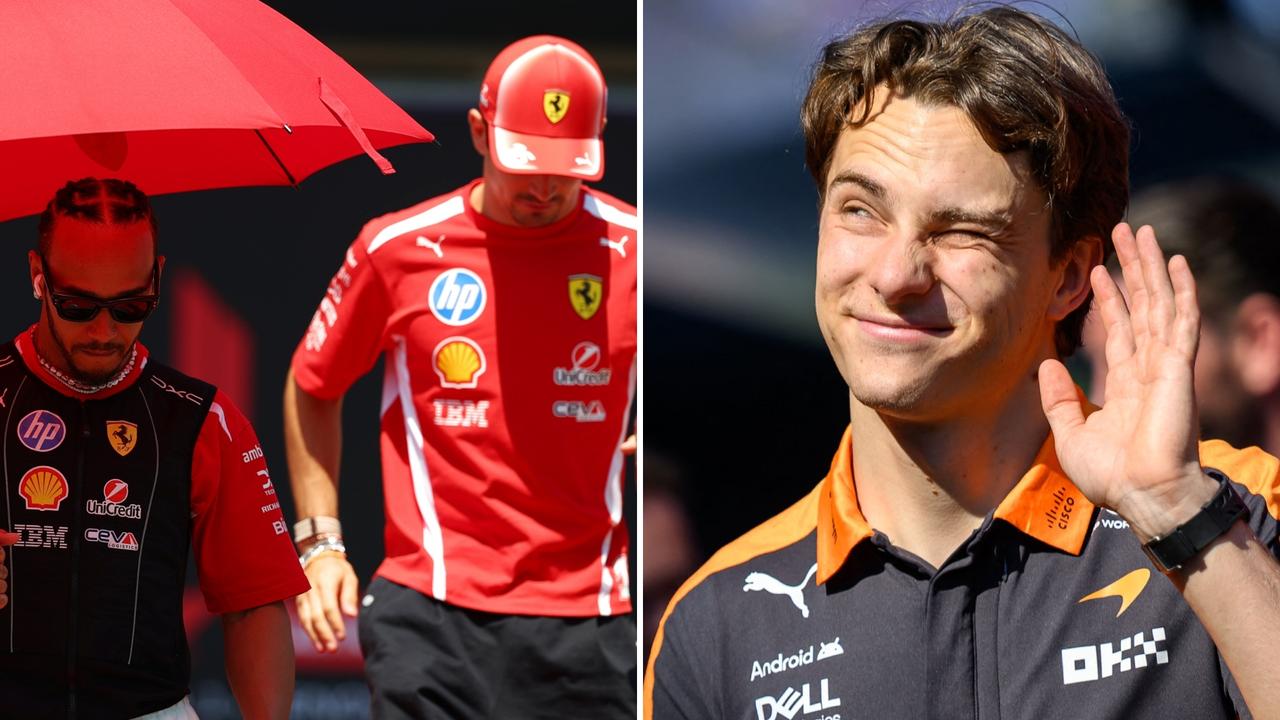
Oscar Piastri finished a strong fourth in Austria, but it wasn’t the sort of result McLaren has been looking for.
At a weekend Mercedes and Red Bull Racing looked like credible challengers and Ferrari intermittently threatened to do something interesting, McLaren was adrift of the pack.
Though Piastri overcame both Ferrari drivers in the race, he and the team seemed to be at a loss to explain why the scarlet cars were so much less competitive than they had been in qualifying — in other words, it was more about others folding than McLaren moving forwards.
“We have to accept that our competitiveness is not such that we can fight for the podium,” team boss Andrea Stella told Sky Sports.
“We know the mission is very clear: we need to add performance to the car. We have upgrades coming. We need to deliver them. That’s what we are working on.”
Piastri could at least enjoy rebounding from his dire performance in Barcelona, leaving Austria as the best McLaren driver of the weekend.
It’s the first time in Lando Norris’s career he has finished behind a teammate in Spielberg when he’s made it to the end of the grand prix.
“Oscar was driving very well,” Stella said. “We invested in understanding a few things after Barcelona, and Oscar delivered that.”
The result should put to bed hyperventilating over Piastri’s ‘form slump’ — a slump that lasted all of one grand prix — and has moved the Australian up to fourth in the standings ahead of his teammate, but these facts will be of cold comfort given the gap to the front.