
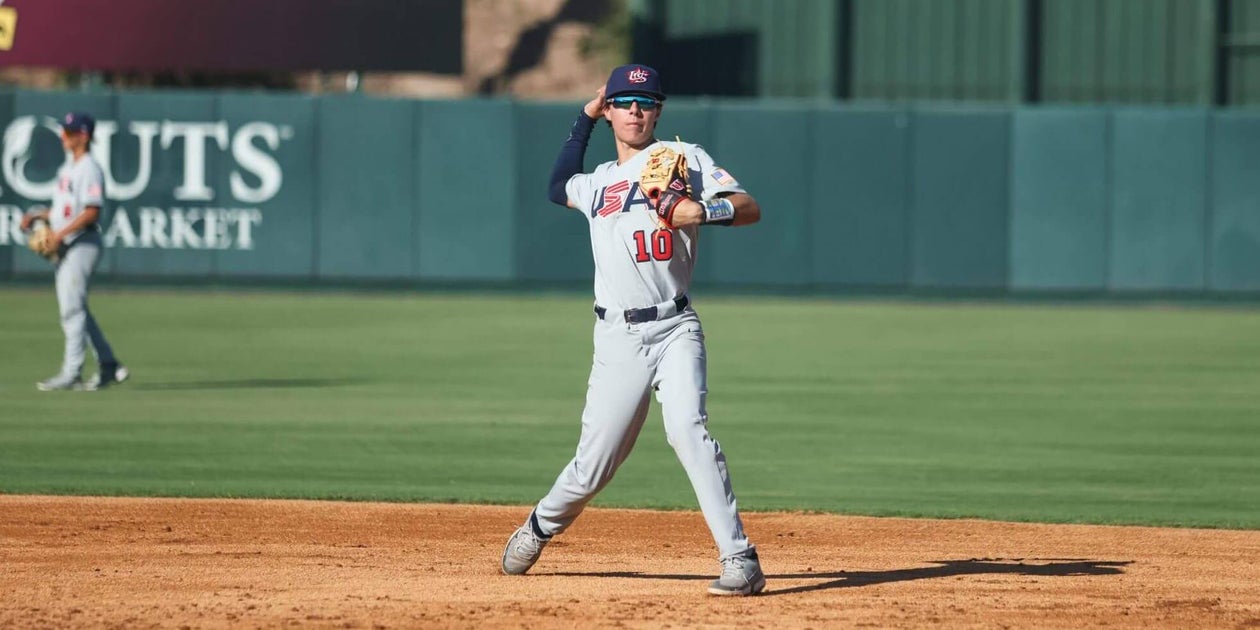
SOUTHLAKE, Texas — Rusty Greer experienced the circus around young baseball stars once before, with a highly touted player who, one year after making his MLB debut, went on to become a perennial MVP candidate before he turned 25. If there was one thing he wanted his pupil, Grady Emerson, to do before his senior season at a suburban Dallas/Fort Worth high school this year, it was talk to the guy who navigated the same waters not that long ago.
So, the former Texas Rangers outfielder-turned-high-school-coach called in a favor to one of his son’s teammates from high school: Bobby Witt Jr.
Emerson, like Witt around this time seven years ago, is expected to become the top prep player selected in the upcoming amateur baseball draft. Some top prospect evaluators think he could go as high as No. 2, behind UCLA shortstop Roch Cholowsky. In his most recent mock draft for The Athletic, Keith Law predicted the San Francisco Giants would take him with the fourth pick.
Either way, Emerson will have a huge payday. Even the No. 4 pick this year was assigned a slot value of over $8.9 million, more than $1 million above what Witt received as the No. 2 pick in 2019.
Expecting the hoopla surrounding Emerson to be as frenzied, if not more so, Greer arranged a lunch with Witt, whose father played with him in the majors 30 years earlier. The point was for Emerson, also a shortstop, to pick the Kansas City Royals superstar’s brain about the distractions headed his way.
Six months later, Greer is thrilled with how Emerson handled the attention during a spectacular season that culminated in Gatorade National Baseball Player of the Year honors. Not only did Emerson bat .508 with eight home runs, 56 RBIs and 61 runs for Texas Division II runner-up Fort Worth Christian, but he also joined Witt as the only high schoolers to be named Golden Spikes Award semifinalists in the last 20 years.
“That’s a tribute to where he is from a maturity standpoint,” Greer said. “You can’t help but be proud to coach a kid like that and watch him go. It’s really more rewarding because you understand he’s going to get to realize the dream he’s been after for years and years and years.”
Greer believes the 18-year-old star is in this position because of his elite aptitude and internal drive to improve.
He foresaw Emerson separating himself from the competition as a 9-year-old at Greer’s summer “hardcore camps,” where he quickly applied new concepts faster than other laser-focused peers.
By 13, Emerson was traveling to Georgia for elite travel ball tournaments. The summer before his freshman year of high school, Emerson committed to play college baseball at Texas Christian University.
As he continued to establish himself in the upper echelon of his draft class, invitations to prestigious events poured in. Over the past four years, he has traveled the globe playing on Team USA, culminating with Emerson being named to the All-World Team in 2025.
Emerson sees top competition as simply another way to sharpen his craft. He finds himself at ease around older players.
“All I see is an opportunity to learn more about the game,” Emerson said. “When you’re sitting around with guys who are in a position you want to be in, you want to soak every moment up and learn everything you can.
“I’m 18 years old. I don’t know everything. There’s still a lot I need to learn.”
His direct messages may be filled with people looking to collaborate, and scouts and agents may monitor his every step. Greer describes Emerson as having a “yes sir, no sir” mentality and the necessary “horsepower” to commit to baseball as a career. They only spent one lunch together six months ago, but even Witt immediately recognized Emerson’s drive and humility.
“With where his head is at, he’ll be in a good spot,” Witt said.
As he watched batting practice at Globe Life Field last month, Emerson seemed confident while mingling with Minnesota Twins players and coaches.
He traded stories with Royce Lewis, the top pick of the 2017 draft, and Twins manager Derek Shelton. He even held court with bullpen coach LaTroy Hawkins.
Excelling in amateur baseball’s highest levels the past six years seems to have created preternatural ease.
“Getting to play with the best in the world, it only makes you better,” Emerson said. “I have to accept that they could beat me. It really kicks in that competitive spirit and makes you say, ‘I’m going to go out there and compete. I’m going to show them why I’m part of this elite group.’”
Emerson has always thrived in front of first-class talent.
He played for an AAU basketball team coached by Indiana Pacers legend Jermaine O’Neal and was invited to Nike tournaments in Oregon and Louisville.
Encouraged by his parents, Emerson tried other sports too. He played football and soccer, and even participated in triathlons and taekwondo.
But baseball won out.
And when he started traveling to play in high-level competitions at 13, his parents saw signs that he had the potential to climb the ladder.
“We didn’t know what to expect,” said Deanna, Emerson’s mother. “We’d heard all of these other names and these teams, and he held his own. Then he seemed to stand out from a talent perspective. It was like, ‘Maybe he can do this?’”
The milestones his father, Brandon, points to as proof came when Emerson was invited to play for the 15U and 18U Team USA squads earlier than expected.
But Brandon, who served as his son’s hitting coach until last year, was most impressed by one performance during Emerson’s sophomore year. He outshone teammates two years his senior at a tournament in Arizona, winning the team MVP.
“I thought he’d be nervous,” Brandon said. “He had a really good first game, and after the game he came over to me and (advisor) Sam Samardzija and said, ‘I’m not getting out the rest of this tournament.’ He hardly did after that. He was on the barrel the whole time.”
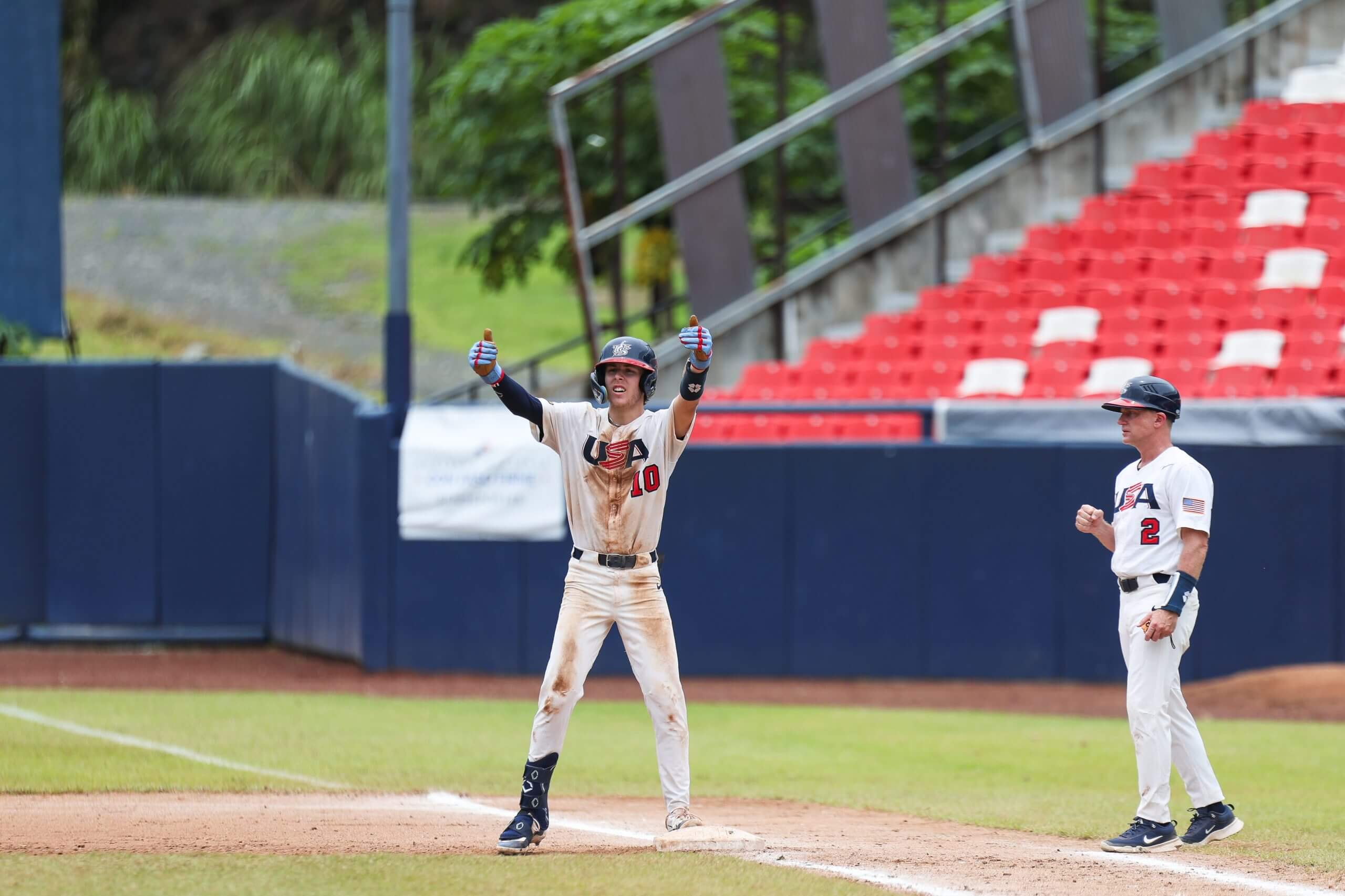
Grady Emerson batted .346 with a .949 OPS while playing every inning at third base for Team USA last summer, his second year on the 18U squad. (Courtesy of USA Baseball)
Performances like those in environments that can be both intimidating and grueling suggest he hasn’t just been padding his high school stats against mediocre pitchers.
“It holds a lot of weight because you get to see him against that caliber,” said one Texas-based baseball scout. “There’s a presence to him. His tools may not jump out, but they’re all a tick above average, and everything plays up.
“He’s always had a swing, and you believe he’s going to hit. He does a little bit of everything and those players are hard to find.”
The Emersons recognized finding new professional voices could help their son reach another level.
Brandon, who taught himself to coach his son’s hitting by becoming a self-professed “YouTube junkie,” wanted to find a coach under whom his son could both thrive and be comfortable.
The search brought them to Brandon Sherrard, who also works with Boston Red Sox infielder Trevor Story. Both the hitter and the coach describe themselves as “feel” guys rather than having an analytical approach, and Emerson calls their relationship “gold” in part because of the help he’s gotten on the mental side.
The next step Emerson’s parents took was to transfer him to Fort Worth Christian for his senior year, knowing Greer and fellow MLB alum Curtis Wilkerson would offer him guidance.
“They took a lot of pressure off me,” Emerson said. “(Greer) kept emphasizing throughout the year: ‘You already proved you can play. Just go have fun and enjoy your senior year.’ The biggest thing was really continuing to learn how to have fun in the game, not overthink things and be something I’m not.”
Emerson is not the next Bobby Witt Jr.
But he is equally “ultra famous” in the Dallas area, according to a scout granted anonymity for his candor. The scout watched Emerson throughout his high school career and is familiar with the noise Witt got at Colleyville Heritage High some 20 minutes from Fort Worth Christian.
Though he rarely posts, Emerson has a substantial social media following, including an inbox full of direct messages from people hoping to collaborate. He was good enough at age 13 to verbally commit to college, though he later reopened his commitment and switched to the University of Texas. Even fans at MLB games know him; Emerson signed several baseballs during the day he was at Globe Life Field.
“It’s still weird,” Deanna said. “This is just our kid. … I’m amazed at all that people recognize him.”
Though the draft noise around Emerson had already been rising, Greer thought meeting Witt would be a benefit to the teenager. His son Mason played with Witt on the Colleyville Heritage team that went 39-3 and won the state championship in its division.
“I had a front row seat to Bobby’s 2019 season with all that went on and all the distractions and all the eyes and everything that goes along with that,” Greer said. “I wanted Grady to hear from Bobby what to expect and how he handled it and how he grew from it and what he would have done different.”
When told of the plan, Emerson thought there was no way Witt would make time for him, but his coach, who played with Witt’s father on the Rangers from 1995-98, ensured he would.
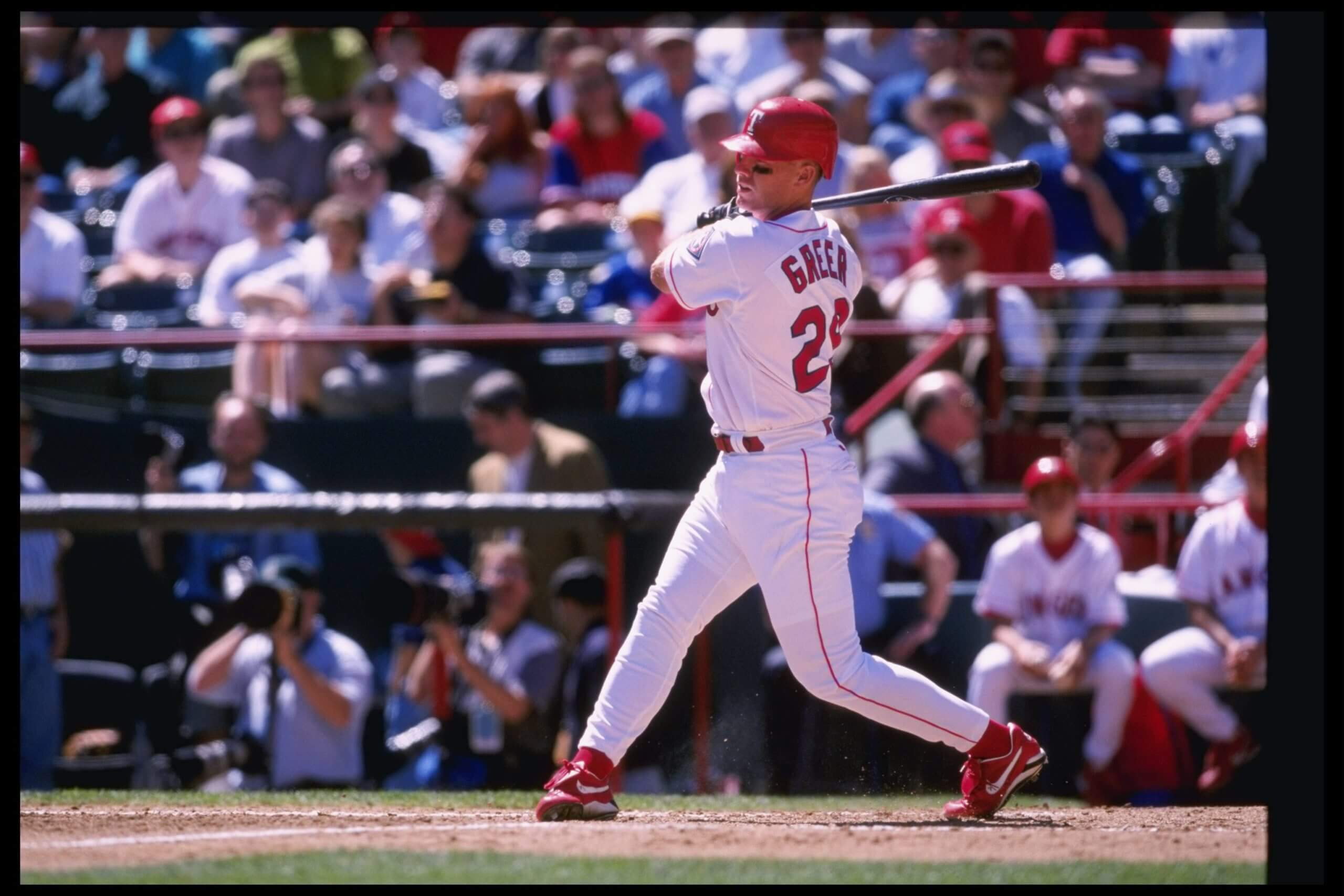
Rusty Greer, pictured in 1998, played with Bobby Witt Sr. on the Texas Rangers. A couple of decades later, their sons were in each other’s wedding parties. (Stephen Dunn / Allsport)
In December, Witt, Greer, Emerson and his father met for barbecue at Soulman’s, a local favorite. Emerson, though naturally comfortable around his peers, admits to being “a little starstruck” when Witt sat down.
“This is one of my role models, and I get to sit down and talk to him,” he said. “I was a little starstruck.”
Brandon didn’t notice his son’s nerves. He was in awe of how easily the two found common ground.
“It’s so interesting how, with the fraternity of baseball players that have been through the same experiences, how easy it is for them to relate,” Brandon said. “Somehow those guys are on the same path. Even though one is years ahead of the other, they shared so much.”
Emerson loved discovering his idol is a “normal dude.” He felt at ease discussing being in the spotlight.
Witt gave Emerson advice that has become even more relevant in the months since: Enjoy the attention because it’s a byproduct of all the hard work — but not too much.
“Hearing about the things he went through, it felt like I was talking to myself, which was really refreshing,” Emerson said. “He said, ‘At the end of the day you’ve got to focus on who’s important in your life. You can’t get wrapped up in it. You can’t start cutting people off because you think you’re big time. You’ve got to focus on your family and your friends and everybody who’s helped you get to where you want to be.’
“That really simplified it for me.”
The two spent more time, though, discussing Emerson’s long-term future. Witt spoke of his own early struggles in pro ball. He mentioned his so-so batting line, .262/.317/.354 in 37 games played, in the Arizona rookie league after being drafted by the Royals with the No. 2 pick. Then the pandemic wiped out the 2020 minor-league season, and Witt spent the entire summer facing professional pitchers in baseball facilities without the benefit of doing so in official games.
What he hoped Emerson took away from the conversation was that failure is inevitable.
“I would say it’s more about him learning to be a big leaguer at this age,” Witt said. “That’s what we talked about and what was the next step. He’s a great player, and there’s a lot of great players, but it’s that mentality of how can you get to that next level?”
Emerson knows he doesn’t have a clue about what failure will look like in the pros. But just as he’s done his entire life, he’s prepared to lean on teammates and coaches when tough times come around.
“I’m ready for it all,” Emerson said. “This is what I love doing.”