
Welcome to Sliders, a weekly in-season MLB column that focuses on both the timely and timeless elements of the game.
When the All-Stars line up along the baselines in Philadelphia July 14, nearly all deserving players will be there. Every summer, a flurry of replacements joins the team on the weekend before the All-Star Game. Some players will decline because of injuries, and some starting pitchers will need more rest.
That doesn’t help with this exercise.
The initial All-Star rosters will be announced on Saturday. In trying to decide who should make it, a couple of trends stand out: the American League is alarmingly thin on second basemen, and the National League is absolutely loaded with starting pitchers.
Take left-hander Foster Griffin of the Washington Nationals. He surged in June, allowing just four earned runs in five starts, with 33 strikeouts and four walks in 31 1/3 innings. Overall, Griffin is 8-2 with a 2.93 ERA, a rousing success story after three seasons in Japan.
“I didn’t want to put any expectations on myself,” he said this week before a game in Boston. “Goals and expectations are good to have, but I feel like they can either limit you or disappoint you very easily. So, mentally, I didn’t want to do that. I felt like I was in a good space, just knowing that I’ve changed some things. I feel I’ve matured as a baseball player and made some tweaks here and there that made me better, and I’d see where it took me.”
It should take him to Citizens Bank Park for the All-Star Game, but with teammates CJ Abrams and James Wood likely to be among the 20 NL position players, the Nats might not get a pitcher on the 12-man staff. Pitchers such as Braxton Ashcraft, Paul Skenes, Logan Webb and Justin Wrobleski couldn’t make the team below, yet all could make strong cases.
How did The Miz get this good, this fast?
Derek VanRiper and Eno Sarris
Luckily, for writers’ sake, we sit this one out. We vote for the major seasonal awards and the Hall of Fame, but not the All-Star Game. Fans elect the starters, and players cast their votes on the pitchers and reserves from June 24 to 28.
Players must select at least five starters and three relievers among their 12 pitchers. MLB makes sure every team is represented somewhere on the roster. But only nine starting pitchers, at most, can make the squad — before the replacement brigade, anyway.
Fortunately, Shohei Ohtani doesn’t count toward that total; he’s eligible to pitch but has already made the roster at designated hitter as the NL’s top vote-getter. Even so, through Thursday, there were 17 other NL pitchers (openers excluded) with at least 10 starts and an ERA of 3.33 or below. Apologies to the folks in that group who are not listed below.
As for the AL second basemen, well, there’s a reason Ernie Clement of the Toronto Blue Jays already has a spot.
Clement collected the most votes of any AL player, partly because he’s a doubles machine hitting around .300 — but also because the rest of the field is not exactly clustered with Lou Whitaker, Roberto Alomar, Dustin Pedroia or Robinson Canó. Clement is the only healthy AL second baseman with at least 25 games at the position and a .750 OPS.
First base, meanwhile, has six AL players with an OPS over .850. One or two will almost certainly miss out, especially if fans elect Vladimir Guerrero Jr., a slugger disguised as a singles hitter in the first half.
In any case, we’ll give it a try. For the starters, we picked from the finalists on the fan ballots. For the reserves, we also stuck to the rules: at least one representative from every team, at least three relievers and at least one backup at every position.
American LeagueNational LeagueFace it: Ashby just keeps winning
The Milwaukee Brewers started the second half of their schedule on Monday with a 5-3 victory over the Cincinnati Reds. To nobody’s surprise, Aaron Ashby was the winning pitcher. Ashby, who won 10 games in the Brewers’ first half, wasted no time in maintaining his 20-win pace.
The obligatory disclaimer when discussing pitcher wins: Yes, it’s a poor indicator of effectiveness because it depends on factors beyond the pitcher’s control. Relievers especially aren’t sure what to make of it.
With his MLB-leading 11th victory, though, Ashby matched the total from his first four seasons combined — and then he added his 12th win on Wednesday with another well-timed appearance against the Reds. It would be a fitting reflection on modern pitching if a reliever becomes MLB’s first 20-game winner since the Atlanta Braves’ Spencer Strider in 2023.
Ashby has a better chance at the wins record for relievers, held by Roy Face, who went 18-1 for the 1959 Pittsburgh Pirates. An early forkball specialist, Face is the Pirates’ career leader in games (802) and saves (186) — but he blew nine save opportunities in his famous season, with four of those turning into victories when the Pirates rallied to regain the lead.
While Face did finish seventh in the MVP voting for 1959 — ahead of Frank Robinson, who hit .311 with 36 homers and a .975 OPS — he was widely known to be having a charmed season.
Face’s last victory came when he gave up a run in a tie game, only for the Pirate hitters to rescue him. The Pittsburgh Sun-Telegraph ran an item about it on the front page the next day. “Elroy Face’s magic touch returned yesterday,” the story began, “as the Pirates became their old sensational selves again.”
If that sounds like a cheerleader writing the copy, well, consider that the byline was credited to “Pirate Pete.” Makes you wonder what Bernie Brewer will write about Ashby’s 18th win.
Five questions with…Dave Sims, Yankees radio broadcaster, on the HBCU Swingman Classic
The All-Star festivities at Citizens Bank Park begin next Friday with the fourth edition of the HBCU Swingman Classic, featuring 50 of the top players from historically Black colleges and universities. Ken Griffey Jr., Swingman himself, helps select the rosters, and years ago picked the broadcaster: Dave Sims, the radio play-by-play voice of the New York Yankees.
Sims, who spent 18 years in the Seattle Mariners’ booth, is one of only a few Black play-by-play broadcasters in the majors. At 73, he’s been on the job for decades and, this year, gets to call the game in his hometown of Philadelphia.
The game, presented by USA Baseball, will be shown on MLB Network. Griffey’s father, Ken Sr., is one of three honorary VIPs, along with Hall of Famer Andre Dawson, who went to Florida A&M, and 1974 NL batting title winner Ralph Garr, who attended Grambling State.
Dawson and Griffey Sr. were active in 1981, when Black participation in MLB reached its peak of 18.7 percent, according to SABR. It dipped to 6 percent in 2024 and stood at 6.8 percent on Opening Day 2026. It’s a vexing issue for MLB with no easy solutions, but events like the Swingman Classic can only help.
Here are some thoughts from Sims:
How did this gig come about? When (Ken Griffey Jr.) said he was doing it, he comes up to me and says, ‘I’m doing this game and you’re doing play-by-play.’ I said, ‘OK.’ It was basically that simple. But it’s been great. I get to work with Harold (Reynolds), and I get to see a lot of Black guys from recent vintage who are maybe not connected with big league clubs and it’s fun to see them, because you just don’t see these guys. In the ’70s, you were probably in the golden age of Black ballplayers in terms of like 18 or 20 percent. That number, as you know, is like six percent now. I think I’ve met everybody, all of the Black guys playing now. At least last year, I feel like I met maybe 60 or 70.
It’s a complicated issue, but how do you think we get to this point? I think one of the things is the immediacy of basketball and football. If you’re a stud player in either one of those sports, you can be in the pros as soon as you finish college. The mindset of a lot of people is, ‘Hey, man, I’m not going to go down to minor leagues and scuffle and eat sandwiches twice a day and hope that I get up there.’ While a lot of kids do that and succeed and they’re up here, a lot don’t. And to me, I think that’s a big part of it. …
Another thing, too: I think that we don’t promote our guys enough, Black or White or Hispanic. I think that would take, if you will, the sexiness, the coolness factor and raise that up, get baseball up much higher than where it is on the totem pole right now. There’s an “ooh-ahh factor” of what we do here, but in football and basketball, it’s so immediate. And there’s part of this generation still playing who grew up watching Junior, but we don’t have that one guy (like that) now. We have to find that guy. If there’s somebody out there, help them up. Let’s go.
How does this event help increase the visibility of young Black players? First of all, it’s to acknowledge that these kids are out there and give them a showcase. But also, you may find a diamond in the rough; there’s a whole bunch of stories of Major League Baseball drafting guys (late). I love what baseball is trying to do with the RBI academies and the showcases they do with the Andre Dawson games and the DREAM Series that Hunter Greene has been part of. But the thing is, they have academies in the Caribbean (countries), but how many do we have in the lower 48?
What’s your favorite part of calling this game? Just the joy these kids have playing and watching them at a big-league ballpark and talking to guys who are (otherwise) just names on Baseball Reference, or names they hear from their grandfather: Andre Dawson, Marvin Freeman, David Justice, Lenny Webster. This year, Jimmy Rollins and Rickie Weeks are managers, and last year it was David and Brian Jordan. So that’s a lot of fun. I know it’s fun for me.
Philly is your hometown, so how special will this be for you? Oh, I’d have killed to do this. There was an All-Star Game there in ’52, but it rained and the game was cut in half. The next one was ’76 and I was already up here in New York, and in ’96, I was at Channel 2 here. But it’s great for the city — because, speaking as a Philly guy, Philly is arguably the best sports town in the country.
Off the GridJimmie Foxx/MVP, season with 3.00 ERA or lower
When the Chicago Cubs wiped out the San Diego Padres on Wednesday, 23-3, it marked the fourth game in the last two seasons with a 20-run margin of victory. One thing all of those games had in common was a position player pitching for the losers.
In the Padres’ case, it was Rodolfo Durán, a rookie backup catcher who took the mound for the second time in five days. He worked a scoreless seventh inning before giving up eight runs, including a Dansby Swanson grand slam, in the eighth.
It’s become a farce. Whenever a team trails by at least eight runs now, it seems, a bench guy comes in to toss lollipop “pitches” that wouldn’t even register on the concourse radar gun. It makes you long for the days when Jeff Francoeur or Desi Relaford would take the mound and surprise you with legit stuff.
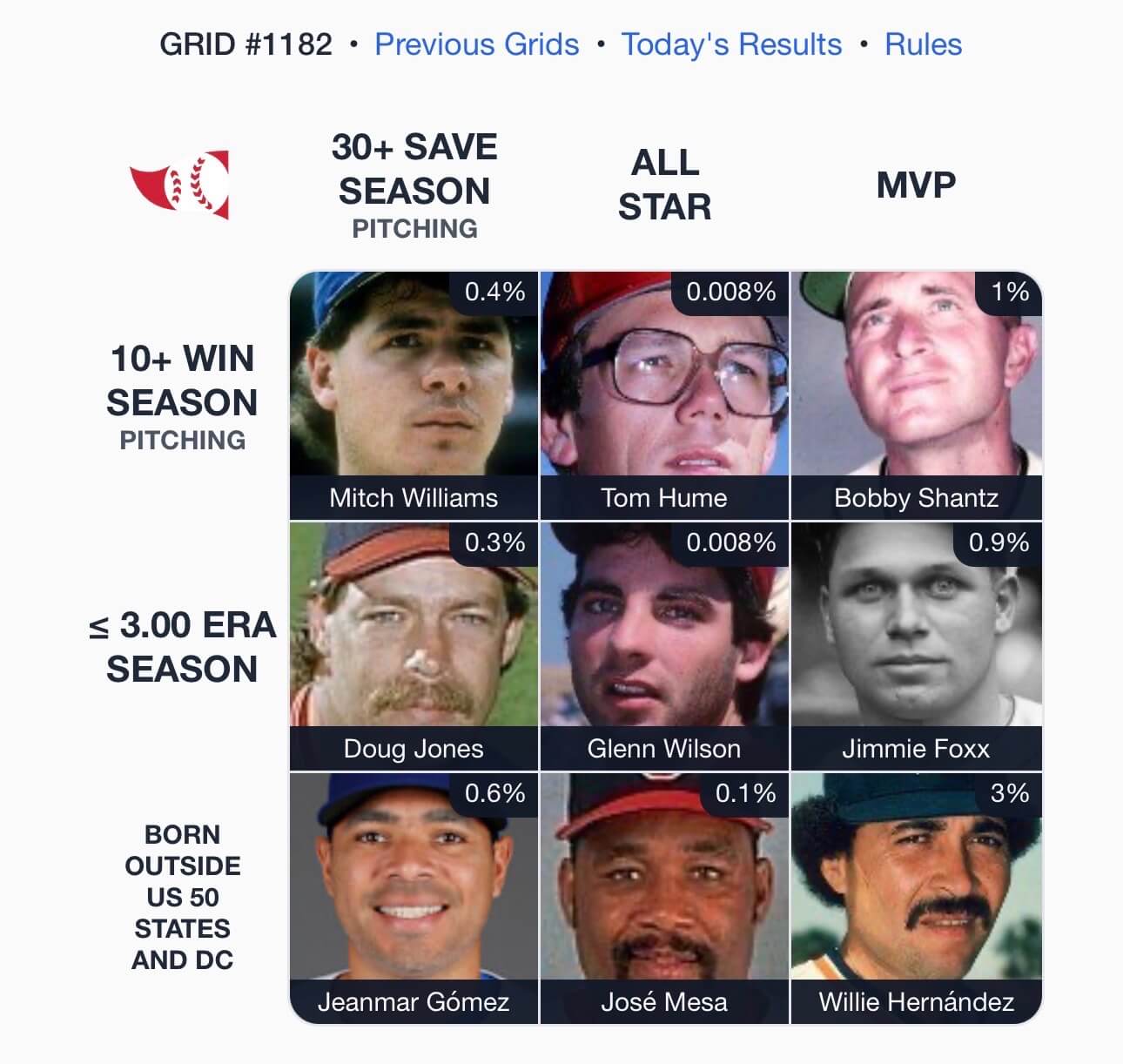
Position players pitching, however, is not new at all. The great Jimmie Foxx, the first right-handed hitter in the 500-home run club, pitched in 10 career games with a nifty 1.52 ERA. That qualified Foxx for the Grid square last Saturday asking for a Most Valuable Player who had a season with an ERA of 3.00 or lower.
Babe Ruth and Shohei Ohtani were obvious fits for that square, but a few other correct answers were less obvious: Ty Cobb (1925), Lew Fonseca (1932) and Josh Donaldson (2023) all tossed one scoreless inning. Then there’s George Sisler, who actually pitched in seven seasons, with a sub-3.00 ERA in six of them, from 1915 to 1928.
Of course, other MVPs took the mound without tricking ’em, including, but not limited to, Jose Canseco (one game, 27.00 ERA, one torn UCL), Albert Pujols (one game, 36.00 ERA), Ichiro Suzuki (one game, 9.00 ERA) and Ted Williams (one game, 4.50 ERA).
Classic ClipCarlton Fisk baseball card, “Good Will Hunting” deleted scene
The Chicago White Sox have been one of baseball’s best stories, following up three 100-loss seasons with a spirited run to the top of the AL Central. A playoff berth would be cathartic for their fans, though perhaps not as much as it was in 1983.
That year, after missing the postseason for 23 years, the White Sox surged to 99 victories to capture the AL West. The White Sox honored that “Winning Ugly” squad in a pre-game ceremony last Saturday; Ron Kittle, the AL Rookie of the Year that season, marked the occasion by getting married — with owner Jerry Reinsdorf officiating — the night before.
Hall of Famers Tony La Russa and Harold Baines attended the reunion, but another, catcher Carlton Fisk, was absent. Good news, though: we have your Fisk fix.
His home run, which won Game 6 of the 1975 World Series for the Boston Red Sox, was a famous plot point in “Good Will Hunting.” And as this deleted scene shows, it was nearly emphasized again near the very end of the film.
When Matt Damon’s character notices Fisk’s 1980 Topps card in Robin Williams’ office, it reminds him of their earlier exchange about Williams’ character missing Game 6 to “see about a girl.” The final cut doesn’t really need this scene, because Damon references Game 6 more subtly in his farewell letter.
But it’s still pretty cool to see what a touchstone Fisk was to the ending. Call it another walk-off for Pudge.