
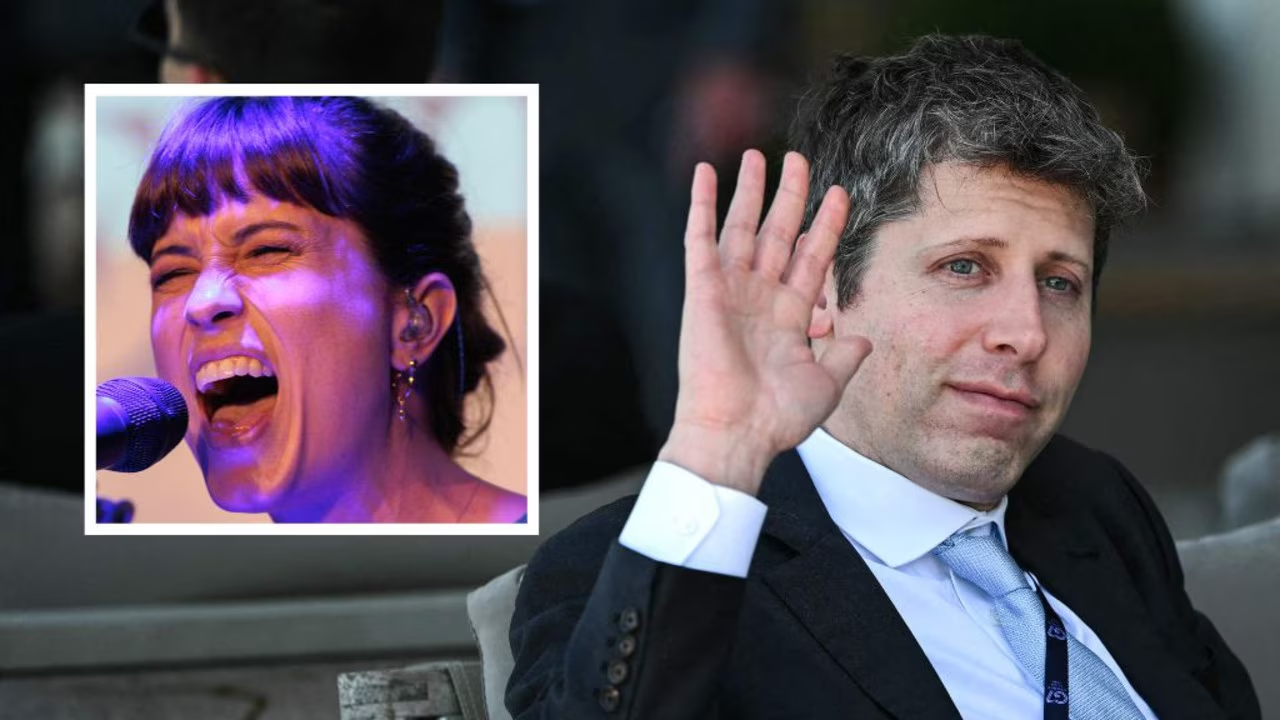
After decades watching one of the nation’s most beloved industries whittle away under all manner of unfortunate circumstances, Australia’s musicians are drawing a thick line in the sand when it comes to big tech.
From rusted-on pub heroes to ARIA darlings, artists are ramping up their fight against what they view as one of the biggest threats the industry has ever faced.
While many of us scoffed at Metallica going after bedroom pirates to protect their war chest, the issue has now snowballed into something that is simply out of control. Instead of smelly teenagers trying to save money downloading Nevermind on LimeWire, it’s now a multi-trillion-dollar, foreign-owned tech monopoly looking for a cheap ride.
At the centre of the battle is a deceptively simple question: Should AI companies be allowed to train on Australian music, books, films and journalism without asking permission or paying for it?
The answer, according to a growing coalition of Australia’s creative industries, is a very loud no.
They argue the country’s existing copyright laws are already fit for the AI era, requiring technology companies to negotiate licences before using Australian creative work. Weakening those protections, they say, would shift billions of dollars offshore and could fundamentally change who owns Australian culture in the age of cheap replication.
It all comes under the umbrella of a broad issue we must all face eventually, no matter which industry we’re in. Agency is being systematically stripped away year-by-year in the face of the all-encompassing, ever-advancing tech timeline.
Whether you’re paying attention or not, the idea of true “ownership”, whether it be purchased digital media or something you’ve uploaded yourself, is slowly being redefined.
It’s a debate now playing out in Canberra, where the Albanese Government is under immense pressure from some of the world’s biggest technology companies to make it easier for AI models to access copyrighted material.
A cohort of Australia’s most vocal creatives across multiple generations took the issue right to the top on Wednesday morning, but the bigger issue facing creators is much more than a political dance over who gets paid what.
News.com.au spoke to a number of people in various roles across the industry who are urging the Albanese Government to resist calls to weaken copyright protections as artificial intelligence companies look to expand.
For some, the issue is genuinely existential, with the concept of the eerie “AI crossover point” being discussed more frequently by the day.
The problem is, we may have already passed it.
Missy Higgins worried about AI ‘backflip’
Missy Higgins has been one of Australia’s most-loved folk-pop artists for over 20 years. She is acutely aware of the conundrum facing herself and anyone else who might baulk at the idea of their work being gobbled up by a billionaire without consent.
She emerged in the early 2000s, a time where artists had their own generational hurdles to leap. Now, after grinding out years of countless tours to build a successful career, she, like anyone else with a digital footprint, is now grappling with the idea that it was all to feed an offshore data centre.
She doesn’t even get a say, because those data centres are predominately owned and operated overseas outside Australia’s jurisdiction.
Artists now find themselves at a very peculiar moment in their careers, where they could soon witness echoes of their life’s work being spat back out by a tacky AI song generator, wielded by a dim acquaintance exclaiming: “How good is this!”
The software “learns” from anything it can get its digital mitts on, and then repackages it at warp speed to fit the prompt. The prompter then functionally “owns” the “creation” and can monetise it as they see fit, depending on each platform’s rules.
For America’s tech billionaires, who stand to profit immensely from this concept until the end of time, it appears both inevitable and beneficial for humanity for us to be sneezing out homogenised slop-rock on the loo.
Higgins says she hopes the government doesn’t “backflip” under the immense pressure of the AI tide.
“Everyone in Australia’s creative industries was very relieved late last year when the Prime Minister publicly refused to weaken our country’s copyright laws,” Higgins said.
“Back then big tech and their lobbyists wanted him to sell us down the river by creating a so-called Text and Data Mining exception. Such a change would have basically let AI do whatever it wanted with Australian stories and songs but thankfully the PM stood his ground.
“He publicly backed our musicians, authors and filmmakers and said ‘no’ to big tech’s demands. I really hope he’s not about to backflip on that decision.”
According to the AI music shills, typing “Australian female folk singer with piano and acoustic guitar” and immediately receiving a faux-polished tune sounding vaguely like Missy is a marvel we should all celebrate.
Artists retch at this concept, and they want the government to understand there’s a bit more to it than just a business deal involving a run-of-the-mill product.
Creative works, while still a “product”, add value to the culture they exist in. Without it, there is no culture.
But there’s no spreadsheet that can accurately track the “how much did this actually add to our culture” metric, so it is often overlooked.
Your sweat and soul goes into your music. It’s a concept very few tech CEOs appear to care about, or even attempt to understand.
With the big festivals going the way of the dodo, Aussie artists have been fighting uphill for years, and Higgins says the AI debacle is another giant piranha in the tank.
“Australian artists face enough challenges right now without adding weaker copyright laws to the list,” Higgins said.
“If these multinational AI companies want to make use of our creative work, they should simply follow Australia’s existing laws rather than demanding that the government change the rules to help big tech make even more obscene amounts of money.”
Mark Bergin: ‘We won’t know the crossover point’
Mark Bergin is one of thousands of journeymen musicians across Australia who have dedicated their careers to the age-old craft of entertaining fickle pub crowds.
He’s played thousands upon thousands of gigs, big and small. His fingertips are calloused to the bone. He’s dodged hundreds of schooner-wielding revellers tumbling towards his microphone to help him finish “Layla”. And he still enjoys every moment he gets to dedicate to making it all sound just a little bit sweeter.
Ask anyone who frequents the NSW Mid North Coast circuit and they’ll tell you “Bergo” is the real deal. He’s observed the market’s countless twists and turns through to the end of the vinyl era, into CDs, MP3s and back again. On the gig front, it’s a constant battle for bands in the face of solo DJs, or no live entertainment at all.
So for him, and many others like him, the AI conundrum is nothing new, just something that’s been sitting ominously on the horizon, glaring at working musicians from afar for decades.
Add in the inescapable prevalence of autotune across most charting music, on top of a backdrop of mysterious “overnight successes”, and you get a pretty daunting landscape for the next generation of musicians hoping to give it a serious crack.
But the Mark Bergins of the world still play on happily, because for them, working to become a genuine master of the craft has real value, even if the CEO of Suno believes you’ll feel better if you just prompted a song into existence.
That passion and general enjoyment for what you do, Bergin says, is something generative AI will never be able to replicate or understand.
He says audiences can feel it right away when something is procedurally generated, and react the best when something wild, unexpected and “human” hits them.
The tiny, random and sometimes indistinguishable imperfections add to the experience, no matter the genre. The trick is getting the chaos to work for you to make something cool happen.
“Performance-based musicianship gave us the best music I think that we’ve had, the 60s, 70s, 80s and the 90s as well,” Bergin told news.com.au.
He says the emergence of time-saving tools has been invaluable, but the rapid acceleration of technology in the creative space has slowly stripped away the emphasis on what makes music great in the first place.
“That, to me, was the start of AI in music, the automation and algorithm-ing of music. Things started becoming ‘less real’,” he continued.
“One big thing that I hear that is now a staple is auto-tune on vocals. It’s been around for ages, but it’s almost like a must for country music, or anything in that genre.
“It’s like all the country artists just have to have it turned right up to have this electronic chime about it.
“It’s homogenised, it’s flat. Like flat wallpaper. It’s not chunky and doing organic things that resonate naturally with the human ear.
“I now switch off anything that’s same-y sounding, and I don’t know what percentage of that is AI these days.
“We won’t know the crossover point without labels … we’re in the crossover point right now.”
One look at Bergin’s studio full of handmade microphones, old-but-gold valve amplifiers and meticulously customised instruments tells you all you need to know about which philosophy will stand the test of time. At least for human audiences.
Jessica Mauboy says it’s ‘unimaginable’
After two decades inside the major label system, ARIA Award-winning performer Jessica Mauboy is opting to go independent, rallying against the idea that big tech is getting a “free pass” to Aussie music.
She says launching her independent label had made her appreciate the importance of creative control more than ever.
“Releasing music on my very own label for the first time this year made me more aware than ever just how important control and creative choice are as an artist,” she told news.com.au.
“The idea that big tech might get a free pass to train AI on my music without my consent is unimaginable.
“The Albanese Government needs to protect Australian culture, and ensure artists have the right to choose how our work is used.”
‘We might not get a second chance’
Adelaide guitarist Nick Pipe has spent years building music the old-fashioned way, writing songs, playing live and fostering real-world communities around independent artists.
Now he’s preparing to launch his own independent record label dedicated to live recordings.
He agrees with the likes of Bergin that the speed of AI’s rise has left many musicians feeling like the debate is already behind them.“I’m very concerned, mostly because of the speed of the AI boom – it feels like we missed the starting gun… we’re trying to negotiate how AI can coexist with creative industries after it’s already begun scraping everything for content, not before,” he told news.com.au.
“It suggests we’re up against a system geared towards asking for forgiveness, not permission. And I hope something can be done in particular to make sure the rights of independent artists and labels are protected in all this, because they have extremely limited means of defending their IP themselves.
“It needs to be something we get right the first time, because we might not get a second chance.”
It’s why Pipe, who plays in Adelaide soul band Jupiter Saloon, believes live music, real musicianship and local communities have never been more important.
“The common thread that runs through all my original music projects is the idea of real-world community, and real people playing instruments with skills they actually learned!” he said.
“I think the turn towards online content as entertainment, now fuelled by AI, means there’s work to be done keeping the lights on in the real world, and making sure people don’t forget that very natural pleasure of going out and experiencing a band playing music.”
“So by playing gigs with my band, organising a festival, and now launching a record label dedicated to live recordings, I’m contributing to that cause, and proudly doing that as well as we can is what really drives me and my collaborators.”
The truly absurd King Gizzard mess
The debate over AI and copyright really kicked up a notch in Australia late last year when prolific Aussie psychedelic rock band King Gizzard and the Lizard Wizard discovered an impersonator had appeared on Spotify.
The band, which one of the most successful indie acts in the nation’s history, had removed its own catalogue from the platform in protest over Spotify CEO Daniel Ek’s investment in AI defence technology.
It didn’t take long before a fake artist, dubbing itself “King Lizard Wizard”, mimicked the band’s sound, artwork and song titles, with some tracks surfacing in Spotify’s algorithmic playlists before being removed.
It was at that moment Australian musicians knew they were f**ked. The idea of truly “owning” your work was dead.
Frontman Stu Mackenzie summed up the bizarre episode in a social media post shortly after.
“I’m trying to see the irony in this situation … but seriously wtf — we are truly doomed,” he said.
Spotify later removed the AI-generated account, saying it breached the platform’s rules on artist impersonation and confirming no royalties had been paid.
But there’s a fun little asterisk next to that as well.
There are no clear labels on AI music, why?
Despite the explosion of AI-generated music, most streaming platforms do not clearly label songs created entirely by artificial intelligence, meaning casual listeners often have very little idea whether they’re hearing a human musician or a computer-generated track.
Couldn’t think of that one ahead of time, could we?
The genie is now out of the bottle as a result.
There are some very soft protections. Spotify allows AI-generated music onto its platform provided it doesn’t “infringe copyright or impersonate another artist”. But it does not display a prominent label identifying AI-created songs.
AI-generated tracks have also appeared in Spotify’s recommendation algorithms and playlists, while fake AI artists amassing hundreds of thousands — and in some cases millions — of streams before being identified.
The platform has been heavily criticised for pushing out real artists for something that took 20 minutes to create, package and upload.
The philosophy, it seems, is to capitalise on users who enjoy the platform’s algorithm, which once served as an excellent tool to find new, and often overlooked, artists.
Filter in some cheap slop, and before you know it, there’s no bands left at all.
Thankfully, some streaming platforms have taken note of the outrage and are now taking a different approach.
French streaming service Deezer claims to automatically detect AI-generated music. It then labels it and excludes it from editorial playlists and algorithmic recommendations in a bid to prevent synthetic tracks crowding out human artists.
Tidal has also announced it will begin labelling fully AI-generated music and stop paying royalties on tracks created entirely by artificial intelligence, while continuing to allow AI-assisted works.
Spotify has begun rolling out new AI disclosure standards and authenticity measures, including “Verified by Spotify” badges for human artists and metadata identifying AI involvement where labels and distributors disclose it.
But the system relies heavily on voluntary reporting rather than platform-wide detection, meaning many AI-generated tracks may still appear without any obvious label.
For musicians campaigning for stronger copyright protections, that’s precisely the problem. There just doesn’t seem to be a plan, and the horse that bolted looks like a dot on the horizon.
If anyone wants to start an ear-splitting garage band for the sake of it, let me know. Claude can’t drum for sh*t.
alexander.blair@news.com.au