
Marc Márquez Interview
World Ducati Week 2026 – Misano
At World Ducati Week 2026, MCNews.com.au editor Trevor Hedge sat down with Marc Márquez for a rare one-on-one discussion that went beyond the usual race-weekend talking points.
The conversation covered Ducati’s internal culture, Gigi Dall’Igna’s influence, how aerodynamics have changed the craft of riding a MotoGP bike, why overtaking has become harder, what the 2027 rules may or may not fix, Phillip Island, Mick Doohan, Casey Stoner, bicycles and life after racing.
Trevor Hedge: Thanks, Marc, for your time. There are 100,000 people who want to talk to you here this weekend, so I’m very privileged to get some of your time privately.
Just to start on a light note, when you left the press conference you high-fived a little fella. He is the son of a Polish journalist, Andrzej Drzymulski; young Kazik knows everything about MotoGP and adores you, and the little kid has a V2 “Marc Marquez” replica, as in the motorcycle, not a model. You just made that kid’s life. (laughs)
Marc Márquez: “Oh really! I did not know. Nice, nice.”
Trevor Hedge: We’ll get stuck into trying to get some insights into MotoGP, the sort of questions that enthusiasts like me would like answered.
I’ll start off by saying all the best to your brother. His quick recovery has been great to see. It would have been awesome to speak to you together if he was here.
Marc Márquez: “Thank you. Alex will be here tomorrow. He will not race, but he is coming tomorrow.”
Why Ducati works
Trevor Hedge: After so many years racing against Ducati, I imagine you already had a strong idea of what the bike could do from the outside. But once you joined, first Gresini and then the Factory team, what surprised you most from the inside?
Not so much about the motorcycle, which I think you would largely have known what to expect, but about Ducati’s working culture, the decision-making, and the whole vibe around how you work with this team. What is different from where you have been before?
Marc Márquez: “For me, the biggest difference has a name: Gigi Dall’Igna. He is only one person there, of course, and then he has a very good group, very professional engineers.
“But in the end, what I see is that the organisation inside is super clever, and the clever guy is Gigi. He organises all the pieces in the correct way to find the best performance every time.”
 Marc Márquez spoke with MCNews.com.au at World Ducati Week about Ducati’s working culture, Gigi Dall’Igna, aerodynamics and the changing craft of riding a modern MotoGP bike.
“Now it is like a table” — Márquez explains how aero changed MotoGP
Trevor Hedge: To give us a bit more insight into how the bikes have changed. If you overlaid telemetry from your 2014 title-winning bike with your Ducati today, obviously so much has changed — tyres, ride-height devices, aerodynamics and all the rest of it. What would be the area that would stand out as so vastly different compared to back then?
Marc Márquez: “First of all, the biggest difference is the aerodynamics. Before, when I arrived, with the aerodynamics step by step we created more downforce in the bikes. Now it is something where you almost don’t feel the tyres. I mean, you feel them because you need to feel them, but before the bike was floating, it was shaking, and you had many warnings before the crash.
“Now it is like a table. The downforce is a lot. The tyres are better and better, and when you have a movement, most of the time you completely lose the front, or the bike. Before it was like you were jumping into the corner with some slide. Now if you slide, it is like you break the aerodynamics, and then it works worse. So the riding style is completely different.
“Another point, for example, comparing 2014, is that the electronics then were even better than now, because now it is a single electronic system. Before, Honda had its own software. I prefer the single electronics, because the rider can make more of the difference.”
Why overtaking is harder now
Trevor Hedge: On electronics, obviously they have been quite tightly controlled for some years now, which has limited how much freedom mad scientists, such as Gigi, have to bring crazy new things to market. Do you think MotoGP has found the right balance between technology and rider input, or is there an area where you think the sport should perhaps allow a little more, or less?
Marc Márquez: “I mean, it is the way that we will go in 2027, trying to reduce the aerodynamics. For me, I would go even further in that direction, because now, with the aerodynamics, it is more difficult to overtake.
“In the past, if in practice you were two-tenths or three-tenths slower than another rider, you understood that if you did a good start and followed him in the slipstream, you were able to have that race pace.
“Now, with aerodynamics and the way that we ride the bikes, if you are three-tenths slower than him, when you follow him you will be five-tenths slower than him. So it is even worse to follow a bike, so this makes it more difficult to overtake and have group races.”
 Márquez was direct on the effect of modern aerodynamics, saying MotoGP bikes have become harder to follow and harder to overtake.
Where does electronic suspension fit
Trevor Hedge: On an electronic front, something that has been long banned in MotoGP, even before you started, is electronic suspension. It is now so advanced on production motorcycles that, to an average rider, it is unbelievable.
From your perspective, how does that technology feel? If it was tuned properly for the track, tyres, rider and conditions, do you think it could make an elite rider like yourself faster, or would you still need the absolute mechanical predictability of a conventional race set-up when chasing the last few hundredths?
Marc Márquez: “I would say it [electronic suspension] is safer. What we are doing in racing is developing many things, and most of them we try to translate to street bikes to make them safer.
“But if you want to be fast with a racing bike, sometimes you need to reduce the safety. You need to allow, for example, the rear tyre to slide more. That means putting the TC further away, and the suspension, as you say, trying to work more with the mechanical, the way you hit the bottom. All things that, for safety, are not the best. For a street bike, I would not say that is the best solution, but for a racing bike, yes.”
The impact of readily available data on MotoGP
Trevor Hedge: These days you have an endless stream of data showing you where you gained or lost time compared to other riders. If you took all that away tomorrow and riders had to rely more on instinct, lap times and sector times, do you think the same riders would still be fastest? Has data made MotoGP riders better, or more alike?
Marc Márquez: “It depends on the bike, and it depends on the riding style. For example, we have two clear examples: Bezzecchi and Martín. When they were in Ducati, Martín was much faster than Bezzecchi.
“Then when they jumped to Aprilia, now he is leading Martín. In the lap times, Bezzecchi was even faster than Martín. So, is Bezzecchi better than Martín? Is Martín better than Bezzecchi? It depends on the riding style.
“It is true that the bikes we have now are easier to arrive at the limit with. So you reach one limit, and sometimes in qualifying practice, if you want to ride over that limit, you are even slower. You need to ride at the bike’s limit, not faster.
“It is like a Formula One car. You need to be fast and precise, but if you are too aggressive and you slide, you are missing performance. So that is something you need to understand well.”
Why 2027 may not be the instant fix fans expect
Trevor Hedge: Every major regulation change means riders have to adapt. From the brief experience you had with the 2027 prototype, and without discussing the tyres themselves, did your first impression leave you optimistic that the 2027 package could create different styles of racing and more overtaking? Could it be better for us to watch?
Marc Márquez: “At the moment, I am not very optimistic about that. I would like it to be, but at the moment, based on what I’ve tried, the bikes are more or less the same.
“The engine is less performant, but that also makes the braking points shorter. But the way we brake is harder. So, in the end, overtaking will be difficult, sometimes even more so.
“The bike is already quite powerful, even if it is 850 cc. From the grandstand, maybe you will not even realise. It is true that, for example, with 1000 cc on most straights, even here at Misano, we are not using the full torque. So, with that bike, we will use full torque from the exit of the corner.
“The biggest difference will be the tyres. Depending on the tyre, we will see one kind of race or another kind of race.”
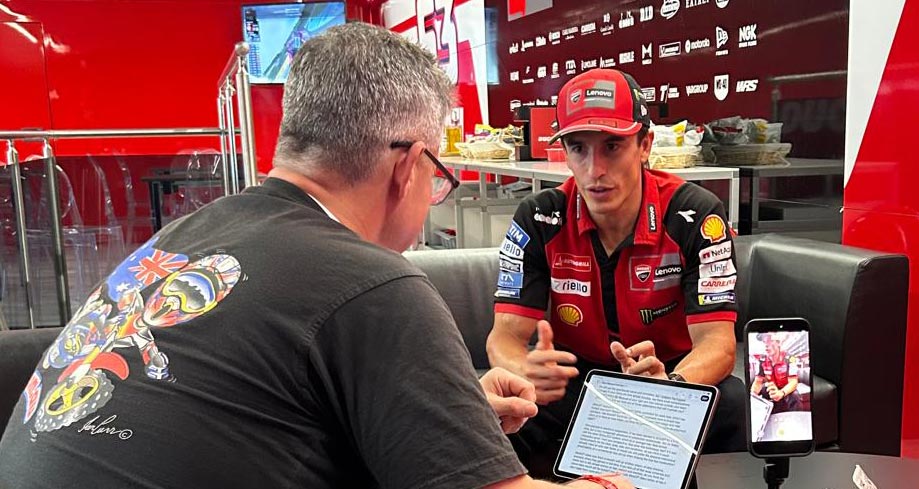
 Marc Márquez speaks with Trevor Hedge inside Ducati hospitality at World Ducati Week, where the discussion turned to MotoGP’s 2027 rules, electronic suspension and rider data.
Phillip Island
Trevor Hedge: Modern MotoGP keeps evolving. New venues join the calendar, others disappear. If you had the power to guarantee one classic circuit could never leave the championship, would Phillip Island be one of those tracks?
Marc Márquez: “Yes. Yes, it is true. But in the end, we need to prioritise rider safety. It is not unsafe as such, but it is a very fast track, and now we normally need some runoff areas with asphalt zones. They are limited in what they can do there.
“For example, we were in Assen last week, and it is exactly the same. It has some very fast corners with run-off areas full of gravel, and in the end, how many injuries did we have last weekend? Aldeguer, and my brother… Normally, in fast circuits, if you make a mistake, you are more likely to be injured.
“But Phillip Island is one of my best circuits, and one of my favourite tracks.”
Trevor Hedge: Which turn is your favourite? Turn Three? Lukey?
Marc Márquez: “Turn Three. Yes. Stoner Corner is amazing.”
Doohan and Stoner
Trevor Hedge: This is a bit out of the box, but you’re obviously a student of motorcycle racing history. If you could spend a full day riding with a champion from another era — not racing them, just spending a day enjoying a race circuit and motorcycles, and talking about how they approached riding — who would it be?
Marc Márquez: “Mick Doohan. I mean, Stoner maybe, but I had the chance to compare the data because when I jumped into MotoGP in 2013, he was riding in 2012, and I was able to compare the data a bit and understand. But if you say another era, I would choose Mick Doohan.”
Trevor Hedge: Casey used to slide the rear a lot through Turn Three, but Mick used to slide the front a fair bit through there, which looked horrifying but spectacular at the same time…
Marc Márquez: “I prefer that I would copy Stoner, because of the rear now with the electronics. But as I say, with the 500 cc you were not believing in the rear tyre, so you pushed more the front. With MotoGP now, you need to believe in the rear and push less on the front, because you have the extra safety that if you slide too much, you have the TC.”
Marc and bicycles
Trevor Hedge: How was the bicycle ride this week with the famous cyclists? Tadej Pogačar and UAE Team Emirates. When we see you on a bicycle with one of the world’s best cyclists, should we start preparing for a Marc Márquez Masters cycling career after MotoGP?
Marc Márquez: “Not at all, too hard. For fun and a hobby, yes. It is part of my training, but of course they are on another level, another planet. I just follow a bit there in the downhill, but even in the downhill, if they work, they go away.
“It was a big pleasure always to meet some talents, heroes and legends from another sport.”
Life after racing
Trevor Hedge: More seriously, five years after you eventually stop racing motorcycles, what do you think might give you that same sense of challenge or competition? Where would you like to see Marc five years after racing finishes?
Marc Márquez: “It is a difficult question, because a rider always wants to stop and escape for a while after his career. What I see, and what I discuss with some colleagues, is that it is difficult. They want to disappear for one year. But then everybody comes back to the MotoGP world.
“For example, I spoke with Dani, Lorenzo, Casey in a similar situation. They disappear for a year, then return to the MotoGP world. In the end, it is our passion. Let’s see if I can be more involved here, in MotoGP.
Trevor Hedge: Thank you. I don’t do selfies, but for you I will make an exception (laughing)
Marc Márquez: “Pleasure, pleasure. Thank you very much. Great interview, good questions.”
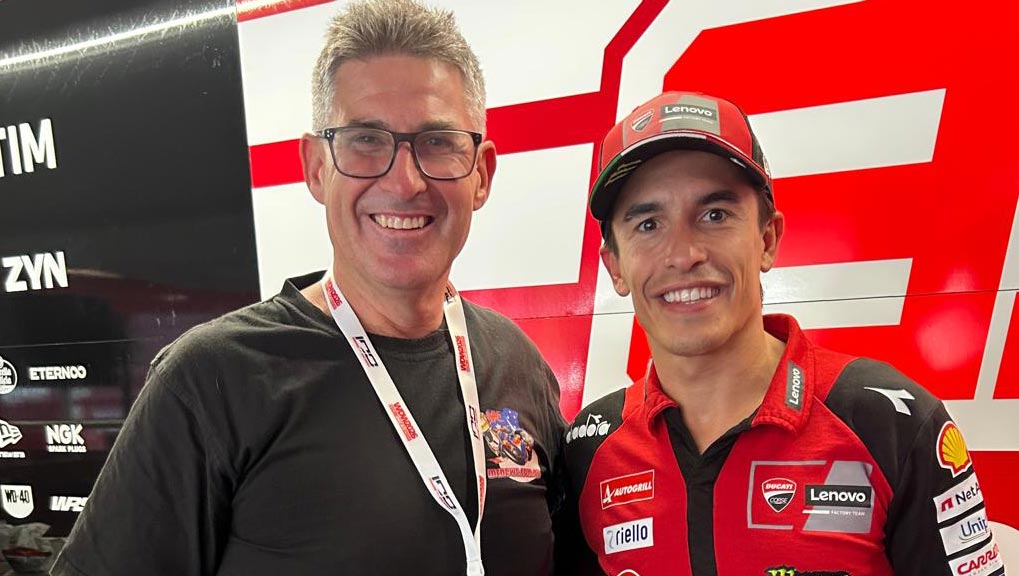 MCNews.com.au editor Trevor Hedge with Marc Márquez after their one-on-one interview at World Ducati Week.