
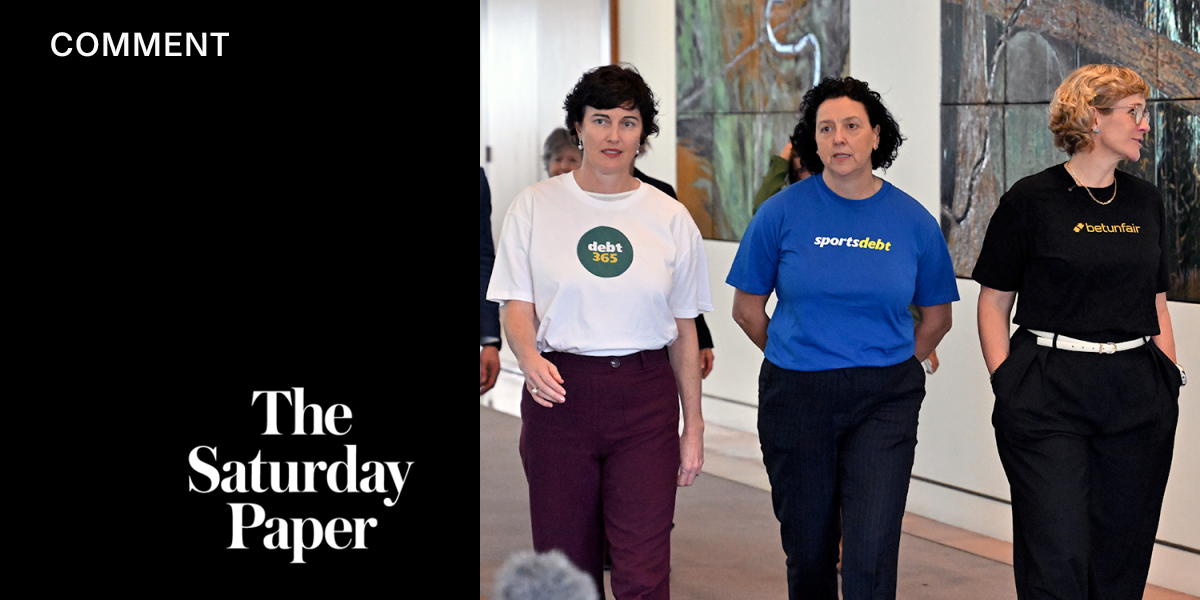
Government intervention to address the significant economic and social impacts of gambling addiction, particularly on our children, is both justified and essential. The consequences of addiction are now well understood: the debt, the shame, the broken families, the suicides. In terms of money, Australian gamblers lose some $31.5 billion each year – the highest per capita in the world. Appropriate legislation is needed to protect us and our children. The plan recently announced by the Albanese government is a very modest step in the right direction, but it’s not enough to effect real change.
The government has proposed restrictions on advertising. Caps on the number of gambling ads would limit them to no more than three an hour on television between 6am and 8.30pm, with a total ban during live sporting events in that window, and bans on radio ads during school pick-up and drop-off times. The bill also aims to ban gambling ads online – unless users are over 18 and have an opt-out option – and veto the use of celebrity or influencer endorsements. No ads would be allowed inside sporting venues and on player uniforms. But such a regimen might still allow early-rising kids watching cartoons to be hit with up to nine gambling ads in a few hours – hardly a positive step.
The government was obviously panicked by the possible electoral consequences of a tough stand. It’s noteworthy, however, that last weekend’s New South Wales Labor Conference endorsed stronger laws to tackle gambling. The proposals were introduced by Darcy Byrne, Inner West Council mayor, specifically to limit pokies by removing some 45,000 from venues across the state over the next decade. The motion gained the support of both right and left factions. An obvious challenge for the NSW government, given the lucrative tax revenues gambling represents for the state, the popularity of these proposals among the rank and file should inspire federal Labor to rethink and sharpen their position on the harm of gambling addiction. The pressure is all the stronger with Labor’s National Conference coming up in Adelaide this month and a five-week Senate inquiry of their current plan looming.
The Albanese government’s proposals on gambling advertising must be considered against the benchmark of the 2023 report of the House of Representatives Standing Committee on Social Policy and Legal Affairs, titled “You win some, you lose more”, widely referred to as the Murphy report after its Labor chair, the late MP Peta Murphy. The essence of this report was a public health approach to reducing gambling harm that shifted the focus from individual responsibility to systemic regulation. It rejected the notion of gambling as an individual failing, with responsibility placed on the gambler to control their behaviour.
The report saw this framing as insufficient because it ignored the role of the gambling industry’s aggressive marketing in creating and exacerbating harm. Instead, Murphy’s inquiry saw a need for systemic interventions to protect the whole community, especially children, who are particularly vulnerable to advertising influences. The report claims this is consistent with global best practice – as adopted by the World Health Organization – of prevention rather than cure. This approach clearly justifies stronger regulatory powers and the creation of a national regulator to set and enforce standards consistently across the whole country.
The Murphy report identified the root cause of problem gambling as overexposure to gambling promotion, and sought to address both that prevalence and the associated social and economic costs.
The report made 31 unanimously agreed recommendations including, importantly, a total ban on all gambling advertising across broadcast and digital platforms, to be phased in over three years. It also proposed a ban on inducements, such as bonuses, free bets and other promotional offers; the establishment of a national gambling regulator to replace the current fragmented system; and a harm-reduction levy on gambling operators to fund prevention and treatment programs.
Murphy identified the total ban as the “centrepiece” of the report, “intended to eliminate the primary driver of gambling harm – marketing that normalises and encourages betting”.
I find it particularly difficult to accept that a Labor government, traditionally defined by a focus on the welfare of individuals, can allow itself to be swayed on gambling by vested interests that knowingly take advantage of the vulnerable.
It is nearly impossible these days to watch a major sporting event in this country without being swamped by aggressive marketing for the gambling industry. There are numerous references to betting odds and gambling organisations not only sponsor teams and players and place advertising at venues but even do deals for naming rights.
Of course, there is a marked similarity to the previous debates about cigarette and alcohol advertising, when it was argued that removing this financial support for the sport, players and TV networks would severely threaten their capacity to participate in and broadcast the games, as well as to sponsor junior and community levels of sport. However, as was the case with those advertising bans, other revenue sources and sponsors will be found.
The Albanese government’s piecemeal response in its proposed legislation suggests they were, disappointingly, rolled by the gambling industry lobby. The inadequacy of the bill leaves Australians, and particularly children, at risk. The Coalition, the Greens and the crossbenchers are unhappy with the proposals, and understandably so, emphasising that they fall “tragically short” of what is required. They succeeded in pushing the package to a five-week Senate inquiry, which is due to report in August.
Guardian Australia has pointed out that the government’s own modelling suggests its package will only reduce gambling-related harm by a mere 0.8 per cent – just $62.7 million in saved losses. That’s obviously well short of what Murphy would have hoped for and what Australians would have expected of a government committed to solutions. In addition, it took more than 1000 days from the tabling of the Murphy report for the government to respond, and that response addressed fewer than a fifth of the recommendations.
Of course, the government’s inadequate response risks pushing advertising and betting activity further offshore, beyond regulation. It has at least done some rudimentary thinking on this issue, foreshadowing bans on online Keno and international lotteries.
This has certainly been the global experience with bans. Australia already loses about $4 billion a year to offshore gambling operators. Murphy drew attention to reforms in Italy, which implemented a total ban on gambling advertising in 2019, and Spain, which brought in a near-total ban in 2020. In Italy, onshore advertising dropped dramatically, but online gambling surged, much of it shifting to unregulated offshore sites. Spain’s experience has been similar. These examples reinforce the point that a comprehensive approach is fundamental – a full ban, plus a regulatory framework with strong enforcement.
I find it particularly difficult to accept that a Labor government, traditionally defined by a focus on the welfare of individuals, can allow itself to be swayed on gambling by vested interests that knowingly take advantage of the vulnerable. It seems the government has taken the view that the public will easily settle for a weak and delayed response – one clearly at odds with the advice of its parliament.
This is beyond disappointing. I would love to hear a vigorous response from the Coalition, and I hope one is forthcoming. I give a huge shout-out to the ACT’s Senator David Pocock, to whom once again the heavy lifting has fallen. I imagine the government has made an assessment that they can tick a box on this issue, hoping they can dodge any serious electoral fallout and never have to directly face the human consequences. This is not good political leadership, it is simply ducking their duty of care. Labor can no longer argue that their governing strategy is to give priority to the things that matter, and to provide the most effective policies to set them right, in our national interest.
Despite all the soothing, reassuring language by Prime Minister Anthony Albanese and his key ministers, Anika Wells and Tanya Plibersek, about how they understand the harmful impact of gambling on families and communities, it will be devastating if they reject the heavily evidence-based Murphy report and squib the challenge to improve this legislation.
The gambling lobby, supported by some influential media personalities, has tried to entrench the idea that you simply can’t enjoy the game without financial investment in the outcome, just as once you couldn’t expect to enjoy it without a beer or, in days gone by, a smoke. “Anyhow, have a Winfield” has become “Anyhow, have a punt”. Our kids deserve better than this.