
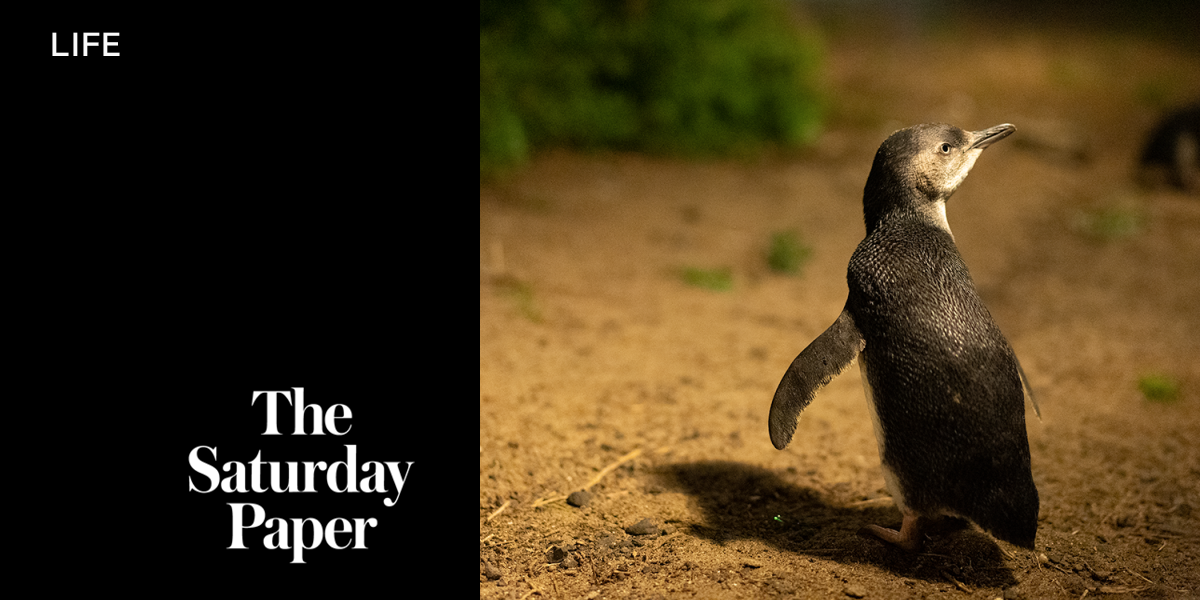
As I crouch to peek into a nesting box, it looks like the shrubbed conservation site goes beyond the horizon – an endless scattering of wooden cubbies where Phillip Island’s little penguin colony comes in from the sea to breed.
Phillip Island Nature Parks research officer Kat McNamara pries open the slatted wooden lid, and a swish of metallic blue says someone’s home. The penguins turn a more vibrant colour after moulting when, over the course of a few weeks on land, their 10,000 feathers are replaced for waterproofing.
The padded rod end of a scanner pokes into box number 200-and-something, and a beep tells us the penguin’s microchipped. Replacing the roof, Kat enters its identification code, weight, number of eggs (or clutch) and other notes into a machine.
Some penguins squeak at the rod, some peck and push. I ask McNamara if they ever get used to the technology. She says they’re “always very protective”, especially in pairs. She shows me little nicks and scars on her fingers from when she’s needed to handle them. “Because we are working with wild animals … the least amount of handling is better for them in order for us to collect information that’s accurate,” McNamara says.
In the 1980s, in response to a study predicting the smallest species of penguin in the world would be extinct by the end of the following decade, the Victorian government funded efforts to save the last of 10 colonies that once inhabited Phillip Island. Housing estates across the Summerland Peninsula were bought back as Crown land reserve, and the Penguin Protection Program was established. Now, Phillip Island has the largest little penguin colony of its kind – about 40,000 birds by the latest estimates.
Non-invasive, durable and reliable technologies give conservationists more data than ever on the penguins’ habits, needs and survival. At a time when many industries are braced for the impact of advanced technologies on jobs, these devices are enhancing the work at Phillip Island Nature Parks, without replacing it.
According to a 2025 report by Barrenjoey investment bank, only one in 1000 jobs will remain untouched by technology and AI. Last month, the pope called for AI to be “disarmed”, declaring dignity of labour and natural curiosity to be essential to preserve humanity. Ecology is one sector where it’s unlikely that human knowledge, care and expertise can ever be replaced by advanced technologies – rather, they can work together to greater effect.
In their AI transparency statement, the Climate Change Authority says they’ll only use AI in environmental work with “human oversight”, and the World Wildlife Fund says “AI doesn’t replace traditional conservation, it strengthens it”.
McNamara concedes that for meticulous tasks such as analysing hours of footage, AI has replaced human labour at their conservation site. “The difference between having technology and not having technology to do our work is huge,” she says.
It begins to rain, and McNamara and I scatter to protect both her scanner screen and my notebook before moving on to the next box at a brisker pace.
Ecology is one sector where it’s unlikely that human knowledge, care and expertise can ever be replaced by advanced technologies – rather, they can work together to greater effect.
Though the microchip scanner isn’t waterproof (yet), researchers can retrieve data while the animals are at sea via temporary GPS trackers taped beneath the penguins’ interlocking outer layers of feathers. These devices can relay information on how fast and far the birds travel and how often and deep they dive for food. Little penguins spend 80 per cent of their time in the ocean, diving up to 2000 times per day, mostly while the sun is at its peak so they can see farther down.
A specialised sailing drone has also been introduced to the program, thanks to funding from the French National Centre for Scientific Research. The drone takes images of fishing areas and density in deep waters by diffusing the natural mirrored surface of the ocean that prevents the human eye from seeing far beneath. McNamara says the ability to gather such information is especially crucial given the rise in overfishing, water pollution, global warming and coastal degeneration. “Now with so much happening in the ocean, the ability to have the sailing drone out and mapping the fish … it’s going to be able to tell us more,” she says.
Another prompt that flashes on the data entry screen,“Band #”, is a redundant feature from before the introduction of microchipping technology, when each penguin would be fitted with a flipper band. Researchers would have to pick them up to read the identification code, which was inefficient as well as disruptive to the penguins.
Following McNamara on her rounds, though, it becomes apparent that there are clearly limits to how much technology can be relied upon without human involvement.
McNamara remembers some of the penguins’ numbers without the band or scanner. When we get to the cubby that hatched the first albino penguin in the colony, she automatically types in the parents’ codes, to keep tabs on the couple’s future breeding success and check for any reappearance of the albino gene.
A few of the boxes don’t produce a beep, and McNamara tells me an unchipped penguin must have moved in. This can occur for a variety of reasons – such as when the chicks leave, or fledge, before they have been chipped. McNamara types in a code manually to indicate occupancy and track any future breeding.
One burrow has a gap in the native bower spinach between the boxes, where baby penguins have been known to hide. Sometimes, McNamara says, “I’ll have chicks, but I won’t be able to find them”. It’s only her attention to these anomalies that allow for that particular dataset to be accurate; to show there are still chicks here, they’re just playing hide and seek.
Near the penguin parade, where tourists come every evening to watch the birds waddle from the shorefront up to their breeding grounds, is a weighbridge – a tunnel from the sand to the shrubbery with a scale in the middle and a chip scanner above. Because the penguins take the same path in and out of the water, the bridge can gather data by weight, such as how much fish they’ve caught in how long. But McNamara has to manually recalibrate the scale once a week to ensure accuracy.
“I had this really weird stage where [penguins] were dropping bower spinach… really big bits,” she says. The scale was then weighing each penguin as heavier than they were.
Sitting above the sand’s edge and watching McNamara place ascending weights on the scale, I have a childhood recollection of building blocks and that first realisation that there are some tasks where you simply can’t take shortcuts.
Back in the car, wipers on, we make our way along the road overlooking the parade. Driving past, you can’t even see where the boxes are – the land at the very far end of the island becomes a seemingly barren former housing development. You’d never know that beneath the bower spinach, penguins are burrowed along this plateau, life from the sea lapping against us.