
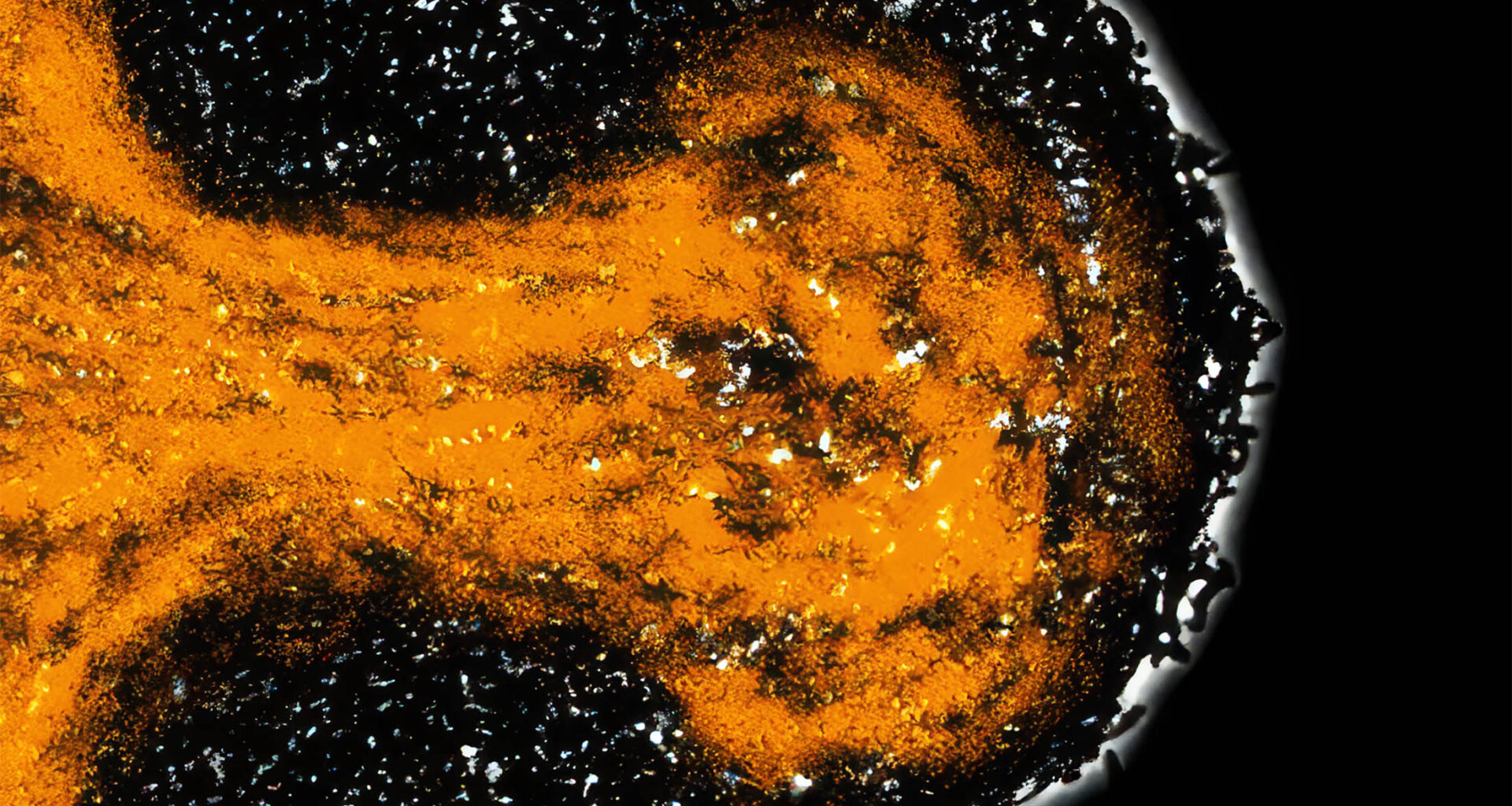
Bacteria living inside slimy biofilms have evolved a remarkable survival trick. When the colony senses it is about to die, it blasts some of its own cells free so they can escape and start new colonies elsewhere.
A new study shows bacteria living in these microscopic communities launch cells like escape pods rather than simply falling apart, overturning a century-old idea about how biofilms spread.

The discovery could also point to a new way of treating chronic bacterial infections.
By turning the same pressure-driven mechanism against the bacteria, researchers were able to make entire biofilms rupture from the inside without relying on antibiotics.
How biofilms really spread
Biofilms are among the most common forms of life on Earth. They coat stream rocks, form the plaque on our teeth, and create the slime inside plumbing.
Wherever bacteria gather, they often surround themselves with a protective coating they produce themselves.
For more than a century, scientists thought stressed biofilms dispersed by slowly dissolving.
Enzymes break down the sticky material holding the colony together, allowing cells to drift away as the entire structure gradually falls apart.
Bacteria launch an escape pod
The new study revealed a very different process. Working with the soil bacterium Bacillus subtilis, researchers grew biofilms containing more than a million cells inside tiny fluid chambers and recorded them for days.
Instead of dissolving, the biofilms expelled cells through a single opening. The cells streamed from deep inside the colony in a narrow, directed flow while the rest of the biofilm remained intact.
The work came out of the lab of Gürol M. Süel, a molecular biology professor at the University of California, San Diego (UCSD). Graduate students Todd Kwang-Tao Chou and Alejandra Dau-Martinez led the experiments.
The mathematical modeling came from collaborators at Pompeu Fabra University (UPF) in Barcelona, Spain.
“The biofilm senses that it is in trouble so it shoots cells out of the community like an escape pod,” said Süel.
The gel that launches cells
What pushed those cells out was not swimming. The dispersing cells were the biofilm’s motile type, the ones built to swim, yet when the researchers deleted the gene for their whip-like tails, the cells still shot out of the colony. Something else was pushing them.
The force came from a gel the bacteria produce called poly-gamma-glutamic acid.
This stringy molecule forms a hydrogel, a water-absorbing mesh that can soak up roughly 1,000 times its own weight in water.
As the gel swells, it builds pressure inside the colony, forcing cells from the interior through the densely packed outer layers until they break free.
A built-in escape plan
The researchers confirmed the gel’s role by taking it away. When they deleted the genes needed to make poly-gamma-glutamic acid, the biofilms grew normally but never ejected a single cell.
The same thing happened when they added a sugar alcohol that competed for water and prevented the gel from swelling.
The behavior appears to be a survival strategy. By launching a handful of mobile cells to colonize new territory while the rest of the colony remains behind, the biofilm increases its chances of surviving when conditions become hostile.
“The biofilm knows it is going to die, so it ejects some of its cells so they can survive and live to fight another day,” said Süel.
 A community of hay bacillus bacteria ejects a group of mobile cells (shown in orange) with the potential to swim away and colonize in a new location. Credit: Süel lab, UC San Diego. Click image to enlarge.Bacteria escape mimics jellyfish
Using a swelling gel to fire something outward is almost unheard of in nature. When the researchers searched the animal kingdom for anything similar, they found only one match: jellyfish and their close relatives.
Jellyfish and hydra, tiny freshwater relatives, both sting their prey. They fire microscopic capsules called nematocysts, each containing a tightly coiled thread.
Like the bacteria, the capsules use a swelling gel that absorbs water until the built-up pressure launches the thread outward.
A recent study of these stinging capsules traced their explosive firing to exactly this build-up of water pressure.
Bacteria and jellyfish sit on wildly distant branches of life, yet both landed on the same molecule to force cells or threads out under pressure.
To test the gel, the researchers borrowed a detail from jellyfish. In the animals’ capsules, the gel stays tightly packed in acidic conditions and springs apart when the surroundings turn neutral, as its building blocks take on a charge and push each other away.
Switching the bacteria’s growth fluid back and forth between acidic and neutral made their biofilms contract and swell in step.
The gel behaved just as its chemistry predicted, tightening in acid and loosening once the acid was gone.
Forcing biofilms to break apart
After identifying the gel as the force behind cell ejection, the researchers tested whether it could destroy an entire biofilm.
A mathematical model predicted that increasing production of the gel would cause the colony to rupture.
When the bacteria were engineered to produce nearly four times the normal amount of poly-gamma-glutamic acid, the biofilms repeatedly broke into small clumps that washed away, while normal colonies remained intact.
The ruptured biofilms were left full of gaps, making them much easier for drugs to penetrate.
This is important because biofilms protect bacteria from antibiotics, allowing them to survive in chronic wounds, infected implants, and damaged lungs.
A new treatment strategy
Forcing a biofilm to burst from the inside could provide a new way to defeat these protective structures.
Rather than relying on antibiotics or harsh chemicals, the approach physically breaks the colony apart, leaving the remaining bacteria exposed to treatments that previously could not reach them.
The discovery may also have broader implications. Tumors share several features with biofilms, and some of the gel-like material surrounding cancer cells behaves similarly to the bacterial hydrogel.
The findings also revealed that bacteria can actively eject cells from biofilms using a gel they produce themselves, a mechanical escape mechanism previously seen only in jellyfish.
By controlling production of this gel, researchers may eventually be able to determine whether a biofilm stays intact or falls apart, opening the door to new treatments for persistent bacterial infections.
The study is published in the journal Nature Microbiology.
—–
Like what you read? Subscribe to our newsletter for engaging articles, exclusive content, and the latest updates.
Check us out on EarthSnap, a free app brought to you by Eric Ralls and Earth.com.
—–