
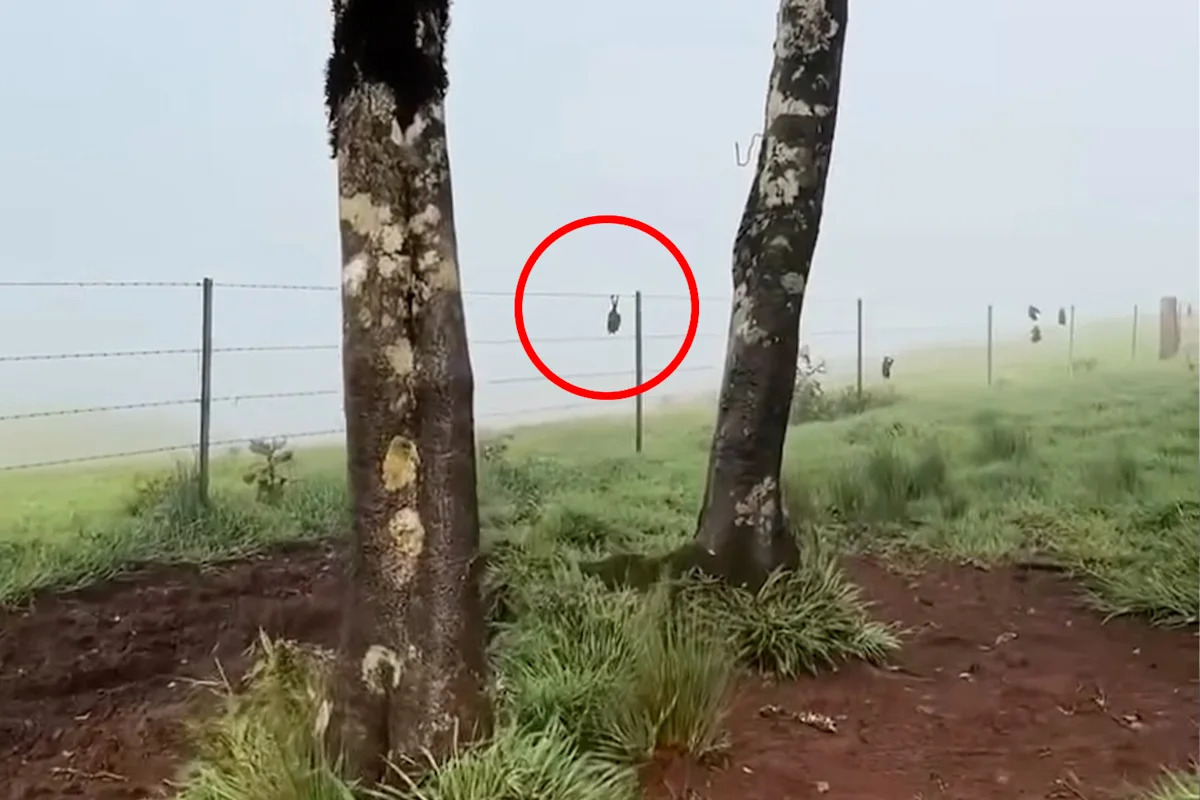
While most Aussies are looking forward to the end of winter, a dedicated group of animal rescuers is dreading a problem that occurs every spring.
When the blossoms emerge across Queensland’s Atherton Tablelands in September and October, the flying foxes that feed on them are regularly snared by barbed-wire fences.
Jenny Mclean, the director of Tolga Bat Hospital, explained that there are a handful of hotspots where large numbers become entangled in a single event.
“Some years we might get three hundred in a week or two,” she told Yahoo News.
While mass entanglements are a regular occurrence, they spike every three to four years when bad weather makes flying difficult.
The Atherton Tablelands are on a fertile plateau inland from Cairns. And when the winds become strong and fog settles through the hills, it can make it difficult for the bats to navigate the wires.
“It’s largely a visibility issue,” Mclean said.

White strips were placed along this barbed wire fence in Queensland after five flying foxes were caught and died.
(Supplied)Simple solution to ongoing bat deaths
The worst-affected are the little red flying foxes, because their camps are much larger than those of other species, such as spectacled flying foxes.
All species play an important role in the ecosystem, as they are Australia’s only long-range pollinators.
The problem of entanglement can be substantially mitigated if farmers agree to put white electric fence tape along any strands with barbs.
A local volunteer group, Wildlife Friendly Fencing and Netting, will even install it for free, and they’re asking landholders to contact them if they need help protecting wildlife.

Flying foxes can take months to recover from barbed-wire fence injuries.
(Save Our Flying Foxes, Cairns)
While many of the larger farmers have already taken them up on the offer, a handful of landowners have refused.
“If they were koalas getting caught, I’m sure they’d agree to do it, but bats aren’t the most popular Australian mammals,” Mclean said.
“You’d think they wouldn’t want hundreds of dead bats on their fences.”
Landholder’s odd excuse for refusing to fix fence
It’s the hotspots where these mass entanglements regularly occur that Mclean and her colleagues want to tackle.
Often, they’re close to flowering or fruiting trees, which attract large numbers of bats.
RELATED:
Rescuers are perplexed by the excuses some farmers have given for not altering their fences, and they hope they’ll reconsider as the countdown to spring continues.
“One told me he wouldn’t look like a real farmer if he had white tape on his fence,” Mclean said.
Others have simply not wanted anyone on their land.
Do you have a story about a wildlife encounter? Contact newsroomau@yahoonews.com
Barbed wire injuries to flying foxes explained
Animals can take months to heal after an entanglement because of the damage to their wings.
They get severe tears and holes in their membranes,” Mclean said.
“A lot of them also have mouth damage trying to bite themselves off [the wire], or broken bones.
“And of course it depends on how long they’re on the fence for. With the last mass event, we didn’t find out until two days later, and so we had to euthanise a huge percentage of them.”
You can also follow us on Facebook, Instagram, TikTok, X and YouTube.