
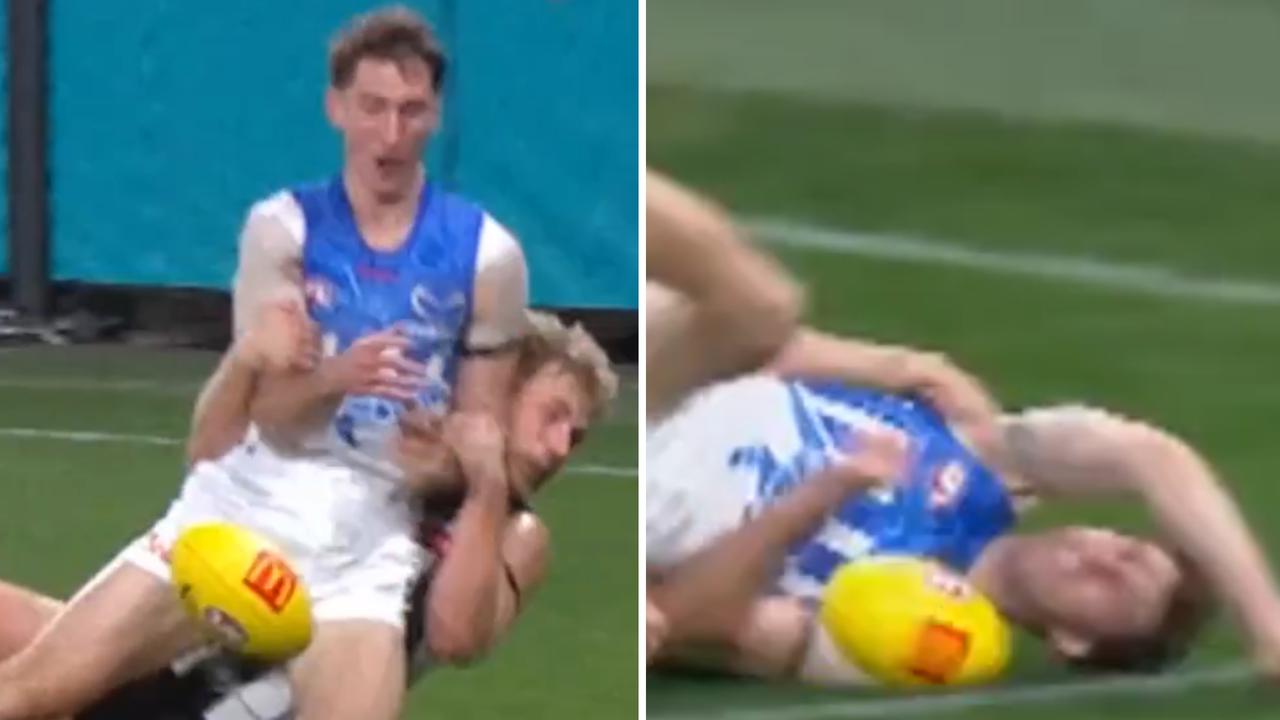
Collingwood’s Billy Frampton is defending a dangerous tackle at the AFL Tribunal for the second time this year, after copping a one-game ban from last week’s win over North Melbourne. Live updates below!
Frampton was charged with rough conduct for his tackle on Matt Whitlock, the incident graded as careless with medium impact and high contact. The Pies argued it was not careless (trying to get it thrown out) and low impact (trying to get it downgraded, if not thrown out entirely).
Watch every match of every round of the AFL Premiership Season LIVE and ad-break free during play on FOX FOOTY, available on Kayo Sports | New to Kayo? Join now and get your first month for just $1.

The Pies backman will be unavailable for Saturday night’s blockbuster against Carlton if he can’t downgrade or overturn it.
Frampton pinned the arms of the Kangaroos youngster in a rundown tackle, with Whitlock’s head then making contact with the Marvel Stadium turf.
It was initially called holding the ball on the night but overturned due to the dangerous nature of the tackle.
Frampton was previously successful in escaping a sanction for the tackle which broke ex-teammate Brody Mihocek’s neck on King’s Birthday.
In that case, the Tribunal found Mihocek was primarily to blame for the incident, not Frampton.
Follow David Zita’s live coverage below! If you can’t see the blog, tap here.
Tribunal updates
Albert Dinelli represented the AFL with Nicholas Baum representing Collingwood, in front of Tribunal chair Renee Enbom and jurors Darren Gaspar and Scott Stevens.
The Magpies disputed the conduct was careless (trying to get it thrown out) and said the impact grading should be low, not medium (downgrading it to a fine if upheld as careless).
The medical report found there were no symptoms nor signs of concussion from Whitlock.
Frampton argued he had no other option than diving forward to stop Whitlock, given the score of the game and location in front of goal.
“(With) how his arms were positioned along his body, it didn’t give me much of a choice than to wrap him up that way,” Frampton said.
“And then obviously to try and impede him from being able to drop the ball onto his boot.
“I don’t think I could have maneuvered my hands in there (around his hips) with how his arms were positioned.”
Frampton said he tried to release his left arm, the one closest to the ground, as he felt Whitlock lose control.
The AFL made clear it didn’t believe he shouldn’t have tackled Whitlock at all.
They argued the tackle increased in momentum after the point Frampton felt Whitlock lose his balance as his knees hit the ground, rather than decreased, but Frampton argued his motion didn’t increase the pace.
Frampton conceded he released Whitlock’s arm “towards the end” of the tackle, without enough time to protect himself, saying “the tackle sped up a little bit more than anticipated due to the motion we were both in”.
Could Merrett be off to the Cats | 02:46
Frampton also said he felt the tackle was completed whenever he knew his opponent couldn’t kick the ball, which would be the moment his legs were on the ground, given the ability he had to scrounge a kick while falling.
The Magpies submitted several previous tackles as comparable incidents including Hough on Butters.
They also submitted an article saying umpire Jacob Mollison recently had his 400th game, but the AFL said he wasn’t the umpire in proximity and didn’t understand its relevance.
“Mr Mollison had a clear view of the incident, unobstructed. He assessed the tackle to be holding the ball and not a dangerous tackle, and it’s a relevant factor in considering the reasonableness that an umpire of his experience and with his unobstruted view assessed the tackle in that matter,” Baum said for the Magpies.
The AFL said Mollison was 40 metres away and was the non-officiating umpire, whereas the umpire who paid the dangerous tackle was three to four metres away.
Tribnual chair Enbom said it had “very limited utility” but accepted it as evidence.
The AFL said the potential to cause injury must be taken into account, and that while tackling was reasonable, the execution of the tackle itself was unreasonable due to:
– the pinning of Whitlock’s arms and “their release when he couldn’t take any steps to protect himself”, with Frampton’s evidence matching this assessment;
– there was an increase in the momentum midway through the tackle, not a decrease;
– Whitlock’s head hitting the ground.
The AFL argued said it was open to Frampton to execute the tackle more safely, by not pinning the arms or by releasing them earlier, and by not increasing the momentum of the tackle using his right arm.
They said Whitlock’s head making forceful contact with the ground meant it was medium impact and not low, with Whitlock remaining on the ground for some time and looking visibly impacted after it.
Hardwick addresses season gone comments | 01:40
Collingwood argued a player didn’t need to perfectly protect his opponent to act reasonably, and the real test was whether a player “does what he can, and what a reasonable player would regard prudent” in the situation.
They also argued even if there was some force being applied on Whitlock during the tackle, it needed to be proven there was excessive force.
“There was no rotation, slinging or driving into the ground at all,” Baum said for the Magpies.
“Whitlock stumbled or tripped over his own legs to a small degree, which caused him to be off-balance and caused his momentum to be travelling forward with his head first. And that’s a very difficult position for Frampton to lay a tackle”.
Collingwood conceded Frampton released Whitlock’s arms late in the tackle, “but he has released them” and “within a frame or two of Whitlock’s knee hitting the ground”.
They argued Frampton did what he has been coached to do, including trying to rotate Whitlock towards him and trying to get under him in order to cushion Whitlock’s fall.
Tribunal chair Enbom asked if Frampton could’ve lowered his arms to around Whitlock’s waist while laying the tackle.
The Pies said Frampton’s evidence was he couldn’t have done that, and even if he could have, it would’ve allowed Whitlock to get a shot on goal – making it was reasonable to tackle the way he did.
They also argued Frampton rotating Whitlock meant his knee hit the ground, then his elbow and shoulder took the brunt of the impact, making it safer.