
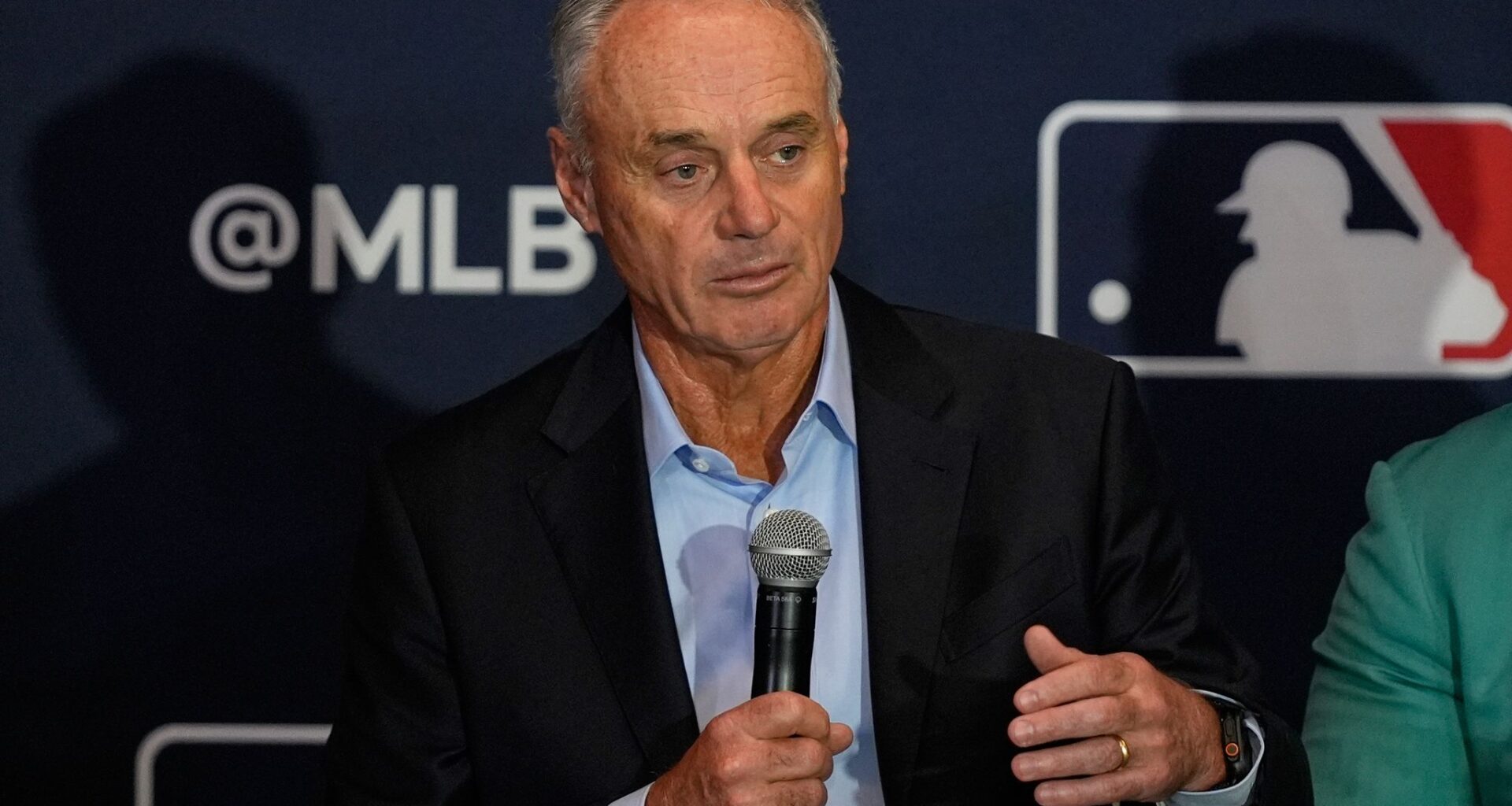
Commissioner Rob Manfred answers questions during a news conference at MLB’s winter meetings, Dec. 8, 2025, in Orlando, Fla.
John Raoux/Associated Press
Bruce Meyer, interim executive director of the Major League Baseball Players Association, speaks at a news conference in New York on March 11, 2022.
Richard Drew/Associated Press
PHILADELPHIA — With Major League Baseball’s collective bargaining agreement with the Players Association expiring after this season, the rhetoric is heating up on both sides as demonstrated during the annual Baseball Writers’ Association of America meeting Tuesday at the Philadelphia Marriott.
Union head Bruce Meyer described the owners as “promoting negativity” with an ad campaign labeled “Level the Field,” calling that “perverse” given that franchises now sell for record amounts and revenues and ratings are healthy.
Commissioner Rob Manfred, speaking after Meyer, quickly acknowledged that attendance is up, ratings are strong and acknowledged, “We’re having another good year, there’s absolutely no question about it.”
Article continues below this ad
Why then does the specter of a work stoppage next year loom over the sport? As in years past, the owners’ support for a salary cap is the primary issue, arguing that smaller-market teams — despite revenue sharing — cannot compete with the bigger market teams and payrolls that, in the case of the Dodgers, are more than $400 million. Los Angeles has won the past two World Series.
“What our fans in a number of our markets are telling us, better than half of them, is there’s a lack of competitive balance in the game and everything we propose is directed at addressing that fan concern,” Manfred said.
San Francisco Chronicle Logo
Make us a Preferred Source to get more of our news when you search.
Add Preferred Source
The counterpoint is that baseball has more parity than the other three major men’s sports, which all have salary caps, andthat franchises in smaller markets, such as Tampa Bay, consistently compete without comparable payrolls. The union also argues that the franchise valuations — including smaller-market teams’ worth — demonstrate the overall financial health for all clubs. Meyer pointed to repeated labor stoppages in the other leagues — even after salary caps are introduced — thanks to attempts to reduce the players’ portion of revenues.
Article continues below this ad
“A salary cap is the ultimate excuse for an owner to say, ‘Gee, I would like to make a team better, but you know, I can’t,’” Meyer said. “Salary caps are bad for fans. Salary caps prevent teams from doing the things that they believe are in their interest to make the team better. We all see what’s going on in the NBA. I won’t belabor the point. Nobody’s happy with that.”
All of MLB’s big-league proposals to date are predicated on the acceptance of a salary cap, which remains a no-go for the players. MLB has also proposed changes to the draft, reducing it to 12 rounds and making high-school players ineligible, essentially turning colleges and junior colleges into development leagues, reducing team development costs substantially. As Meyer pointed out, that would have affected as much of a third of Saturday’s Futures Game players, not to mention a great many of the game’s current stars.
“I think the proposals that they have made have been kind of a joke,” Dodgers player representative Max Muncy said. “Unfortunately, the tactics have always been the same by the owners and they wait until the last second instead of using all this time they have right now to actually discuss things and negotiate. They draw things out, they try to sweat us out to the very end and we never fold.”
Should MLB continue to push for some sort of cap, there undoubtedly will be a work stoppage, most likely a lockout by the owners should no deal be struck before spring training next year.
“We’re going to stay unified in what we believe is right and keep those talks going because the game’s in a great spot right now, and we don’t really want to mess that up,” Giants player rep Logan Webb said.
Article continues below this ad
Future Hall of Famer Justin Verlander, who pitched for the Giants last year and who is retiring after pitching for the Detroit Tigers this season, agreed.
“There are so many reasons why a real work stoppage and losing games would be detrimental, so I hope that doesn’t happen,” he said. “This current system must be working OK if the game is as popular and rising as it is. I don’t see any shortage of people wanting to buy a MLB team, so it must be a decent investment, right? It kind of has to be, I would think. I don’t think anybody wants to make a poor investment at that level. These guys are really smart. People are fighting for the chance to buy an MLB team, so it can’t be that bad.”
Since the last CBA was signed after a shortened spring training in 2022, ever more investment groups have bought stakes in teams, including Sixth Street Sports, which holds 10% of the Giants, and an earlier investment concern, Arctos Partners. Arctos owns a piece of the Warriors and Dodgers, among other franchises, and was recently acquired by a much larger private equity firm, KKR.
There are strict rules on the size of investment groups’ stakes. Manfred said such entities cannot shape MLB policies.
“They don’t even get information, let alone have an opportunity for influence,” Manfred said. “Not only are the rules in place, everyone understands them on the way in. We pay a lot of attention to what is actually going on in terms of the investments. … I also think that, particularly given some of the issues that we’re dealing with right now, people are thinking that a game could be on an upshot in terms of its investment potential.”
Article continues below this ad
The union believes that such investments show that the sport is flourishing but still has concerns about investment ventures and their potential for, say, advocating reduced spending.
“In our view, owners having access to more sources of capital is a good thing,” Meyer said. “Hopefully they use it to pay players and make the team better. But I’ve also heard — we all hear things, so I’m not vouching for the truth — but I’ve heard people say a lot of what’s happening in bargaining is driven by private equity. Private equity gets into a business, they look at it like a widget factory. All due respect to my private equity friends, they look to cut costs, and if you’re looking at baseball that way, the easiest place to look to slash costs is paying players’ salaries. I’ve heard that that’s a lot of what’s going on.”
Many teams, the Giants included, are expanding their holdings to include real-estate and entertainment ventures, which raises concerns about how diversified interests might affect big-league payrolls. The Giants say their real-estate ventures are entirely separate from baseball operations and point to the 50-50 development deal they have with Mission Rock partner Tishman Speyer, but the union has reservations on this front as well.
“People have said baseball is more a real estate play than baseball play,” Meyer said. “I think we have owners of all different types. There are some who love and value baseball and some who may look at it as more of a traditional business.
“I know they’re making a lot of money from around the ballpark. Obviously, the Battery (in Atlanta; the Braves are owned by a publicly traded company) is public, and everybody is trying to replicate that. That’s dependent on playing baseball games — it’s another thing that kind of doesn’t make sense to me. If they’re going to shut everything down, all that stuff around the ballpark goes dark. I’d like to think that’s increased motivation for them to not want to shut down games to get a salary cap, but it remains to be seen.”
Article continues below this ad
After the Giants’ Pride Night controversy — when three players wrote Bible verses on their Pride hats, and another chose to wear the standard Giants hat rather than one that incorporates the Pride flag — Manfred said in a response to Senator Josh Hawley that the Giants had not communicated options adequately with their players.
Asked to expand on that Tuesday, Manfred said that the Giants and Dodgers were grandfathered in when it came to allowing Pride logos on their hats with the understanding “that they would take responsibility for communicating with their players that they had the option to wear their normal uniforms if they were uncomfortable with whatever the logo happened to be. That didn’t happen, end of story.”
The Giants have declined to issue a response and remain under fire from many fans for their refusal to make an apology to the LGBTQ community or to address what was communicated to the players. The Department of Justice had threatened to investigate Major League Baseball for infringing upon the freedom of religious expression, but the protesting pitchers themselves discounted the idea and a league source told the Chronicle that the Giants were not the target of such an investigation.
After the DOJ threat, MLB clarified that no uniform changes of any kind are allowed without express permission, such as that granted to Venezuelan players to add “VZ” to their hats after the double earthquake in the Caracas area devastated the country.