
This week we will mostly be concerning ourselves with the TMO and the Pacific Islands…
Time, gentlemen, please
The phrase above feels more appropriate now we’re all getting used to the major rugby international season running concurrently with Wimbledon, never mind the soccer World Cup and The Open golf, but the length of time TMOs are using to get to their conclusions is beginning to require some form of arbitrary intervention.
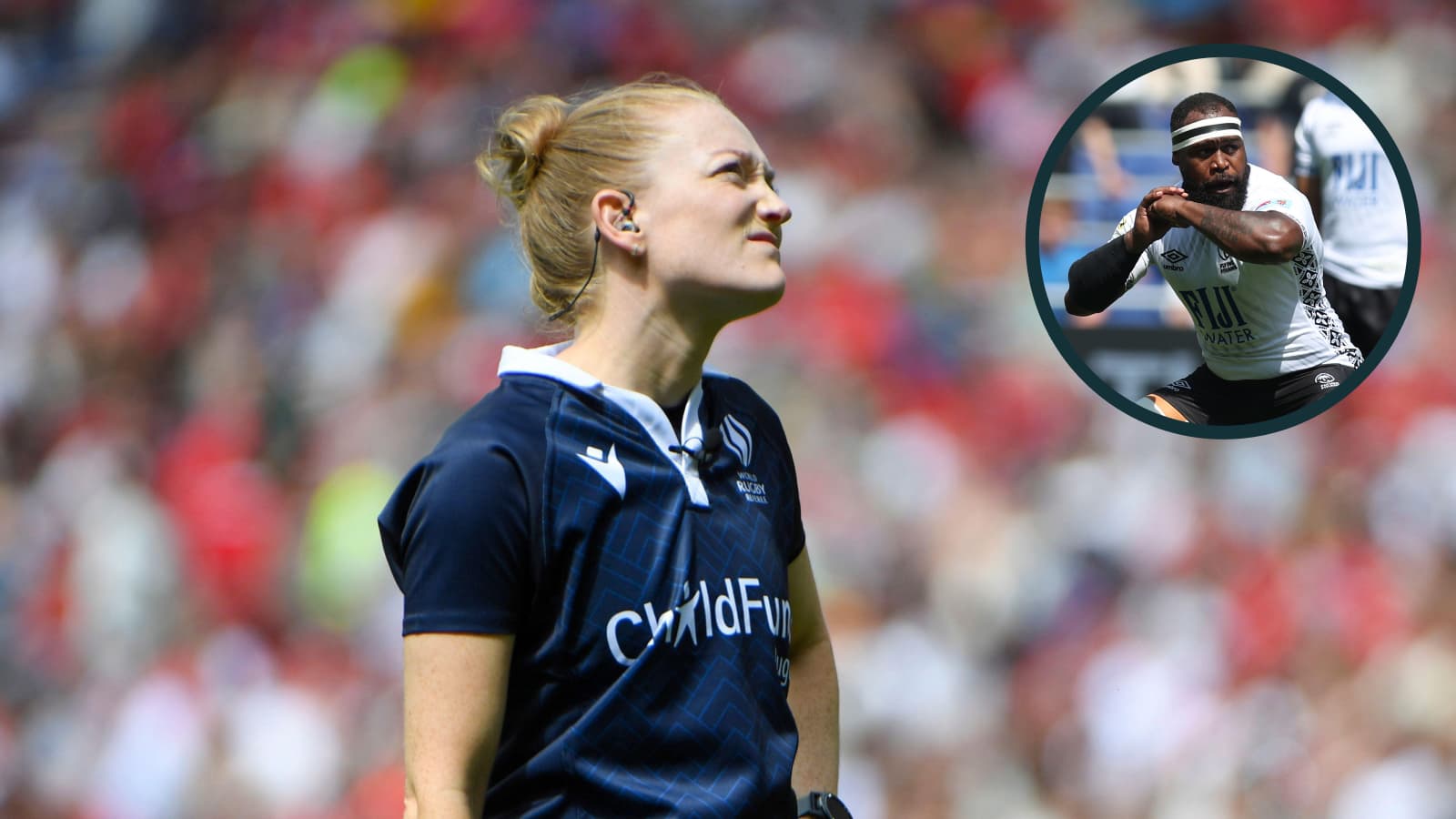
We never know what goes on behind the scenes in terms of technological challenges. But Hollie Davidson was left hanging on the pitch for what seemed like an eternity while TMO Mike Adamson attempted to bring up on screen something that he himself had flagged.
Ultimately, probably the right call, although remarkably Beckham-on-Simeone-esque in the nature and force of the actual contact of Simione Kuruvoli’s donkey kick. But in baking sun, with the outcome of the game already barely in doubt, hanging around for two minutes as the award of the try grew increasingly doubtful because those up in the box were all thumbs, is not how we want the game to be going.
Delays are delays and it happens. But nor do we need the huge number of replays which serve both to incite the crowd towards looking and reacting to the ugly side of the game on one hand, and boring them stiff with the other. Kuruvoli’s act was clear to see on one replay, confirmable with two.
Likewise, the delay for Paul Williams to eventually decide that Jac Morgan was, in fact part of a ruck before he plunged over the Argentina tryline, did very little to warm up the local crowd on a chilly day in San Juan. Two, perhaps three replays would have sufficed here. We were ‘treated’ to what felt, ironically, like a score.
We are, as several pundits went on record saying this week, at a moment where the TMO is more influential to the flow of the game than the players or officials on the pitch, not to mention feeling at a moment when the feel is that officials are actively looking for technical reasons not to allow tries.
How to change it? Using the Super Rugby protocols has been touted, whereby only foul play or something technical in the act of scoring the try can be flagged. But given the number of tries where a baby knock-on or some other sort of technical offence is rightly flagged a couple of phases before, you then run the risk of letting plenty of provably non-tries get scored and having all the fans shout in unison “what’s the point at all then?”
Imposing time limits on the TMOs seems a little rough too, considering the potential for technological challenges to use up the time and it would be nobody’s fault.
But a number of replay limit might be feasible. Two replays for the offence, and one extra at full speed to determine force. It makes the screen-watching official’s job harder but definitely might stop the paralysis of doubt that seems to creep in when all are watching the same replay over and over again.
And the other solution? Allow the TMO perhaps more direction in his recommendation or even an element of decision-making within it? It is dangerous to remove that element from the on-pitch officials, of course, but what we have now is that the TMO replays something over and over which he or she has already seen several times, in order for the referee to see it a similar number of times, upon which the referee makes a decision and then double-checks with the TMO anyway. Might it work faster if the TMO recommends a decision and then the referee acts as check and balance?
Games are starting to stretch past the two-hour mark, which is bonkers, considering we are talking about an 80-minute match, and the TMO is responsible for this in many cases. An improvement is needed.
Island woes
It’s difficult to fathom how different the performance of Fiji was in the defeat to England to that in France three years ago, when the teams were level going into the final quarter of a World Cup quarter-final.
The matchday squads of Fiji were different, but not 59 points different, and lest we forget, this was hardly the team England would put out if it were once again a World Cup quarter-final between the two.
Yet the Pacific Islands are not enjoying this June, playing all their home matches far away from home. As well as Fiji’s implosion, Tonga lost to Spain and Samoa went down to Georgia. Ill-discipline is dogging all three, with none of the teams looking as though it is having fun or even looking as though they care in some instances.
The departure of Mick Byrne has clearly left a hole in Fiji’s team and set-up, but that doesn’t explain the apparent lack of motivation among the teams.
Want more from Planet Rugby? Add us as a preferred source on Google to your favourites list for world-class coverage you can trust.
But perhaps the explanation simply lies in format. Lest we forget, Japan and Fiji have been classed as ‘invitational’ teams to this July festival, meaning that Fiji’s ‘home’ game against Scotland is at Murrayfield while Japan are forced to travel to Australia to play Ireland because the Irish felt that travelling from Australia to Japan to New Zealand would have been a little too much.
It all means Fiji will play six away games in this six-game tournament, Japan four, while Samoa and Tonga will play notional home games in the USA, South America and Canada this summer, before most likely heading to Portugal, Spain, Georgia and Romania this November.
These two tournaments are, perhaps, good for bottom lines and good for the American markets (north and south), but for the Pacific Islands, whose stadia have played host to some of the most enjoyable and raucous events in rugby history, they are far-flung and probably pretty lonely affairs, and it is showing.