
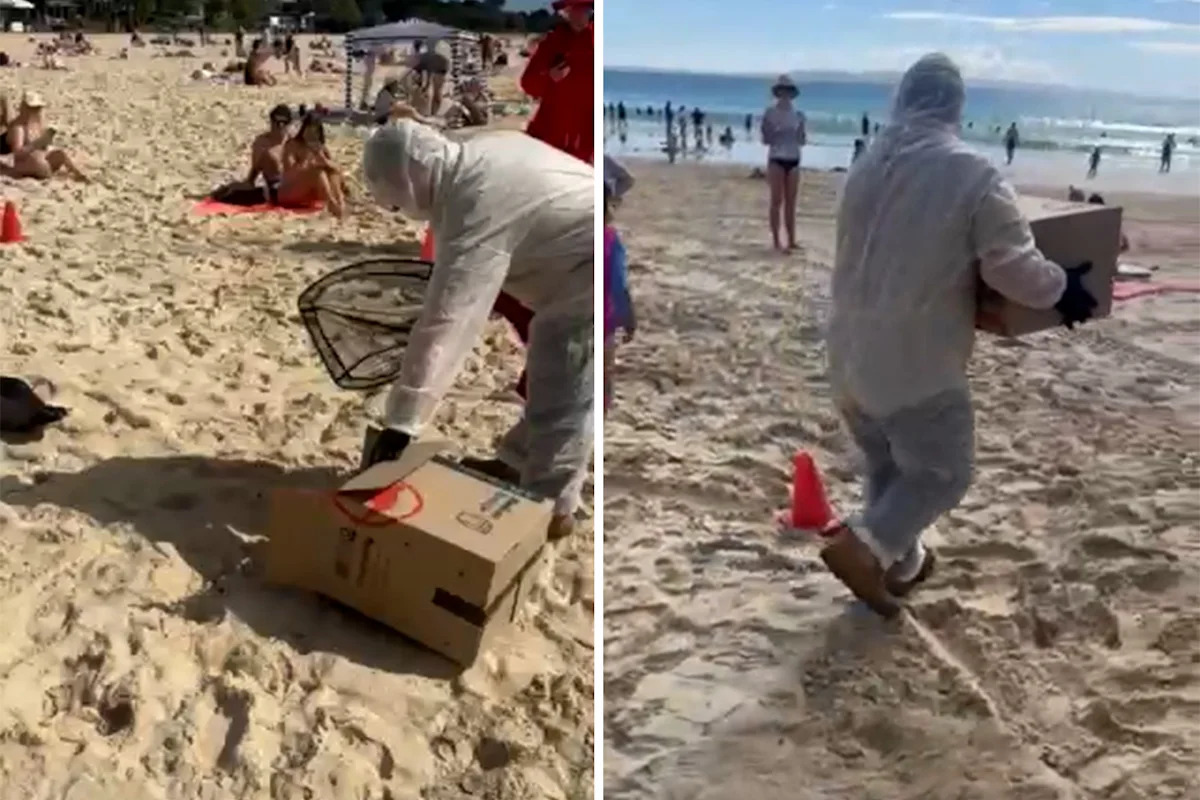
Beachgoers at one of Australia’s most popular tourist destinations were forced back from a five-square-metre exclusion zone after a biosecurity scare on the weekend.
Orange cones were placed around a sick giant petrel, a migratory bird species, due to concerns it could be carrying the deadly H5 avian influenza strain.
Lifeguards at Noosa Heads Beach on Queensland’s Sunshine Coast notified authorities, and a local wildlife rescuer was dispatched to help.
Footage supplied to Yahoo News by Wildlife Noosa shows the group’s founder, William Watson, trudging across the sand in full PPE as dozens of beachgoers watched on.
You can see the video directly below.

“Everyone pretty much stood back and watched,” Watson said.
“I felt a bit stupid, but we’re told to gown up.
“And I was just wearing something I got at Bunnings.”

The giant petrel was caught in a net and then placed inside a Bunnings moving box before being carried away for testing.
(Wildlife Noosa)Rescuers fear mounting costs of PPE and fuel
To minimise the risk of spreading the virus, birds have to be placed in disposable cardboard boxes rather than reusable carriers.
In Queensland, the response is being managed by the Department of Primary Industries (DPI), but all volunteer rescue groups and charities are responsible for buying their own PPE.
Like many, Watson is concerned about the cost of buying PPE, boxes, and fuel, all adding up.
The bird was swabbed for testing by RSPCA Queensland, and is now in care at Twinnies Pelican and Seabird Rescue, a group that crowdfunded $30,000 this month to build quarantine facilities.
Have you spotted a suspected H5 case? Contact newsroomau@yahoonews.com

Twinnies Pelican and Seabird Rescue were forced to conduct a crowdfunding campaign to raise money for PPE and quarantine facilities.
(Twinnies Pelican and Seabird Rescue)Rescuer receives round of applause after removing bird
There have been at least 13 confirmed cases of H5 in three states, NSW, South Australia and Western Australia.
The virus has been introduced to Australia by migratory seabirds. Its detection in a native greater crested tern suggests it may be spreading. And there is a suspected case in a seal in NSW.
On Friday, the federal agriculture department (DAFF) said the risk to people remains low. There have only been around 1,000 human cases globally, but worryingly it’s estimated to have a mortality rate of around 50 per cent.
Watson received a round of applause as he left the beach, helping to keep the public safe.
New problem facing Australia’s birds
Next month, thousands of shearwaters will start migrating to the region’s beaches, and Watson is unsure how the system will cope.
“It’s all unfamiliar territory, the virus has been a big game-changer,” he said.
“A lot of birds are going to be left.”
RELATED:
It’s common for shearwaters to die on beaches after flying thousands of kilometres to breed.
But understanding which ones are simply exhausted, and which could be suffering from H5, will be a challenge.
In Australia, if the public sees sick or dead seabirds, they’re urged to follow this advice:
Report it to the Emergency Animal Disease Hotline on 1800 675 888.
You can also follow us on Facebook, Instagram, TikTok, X and YouTube.