
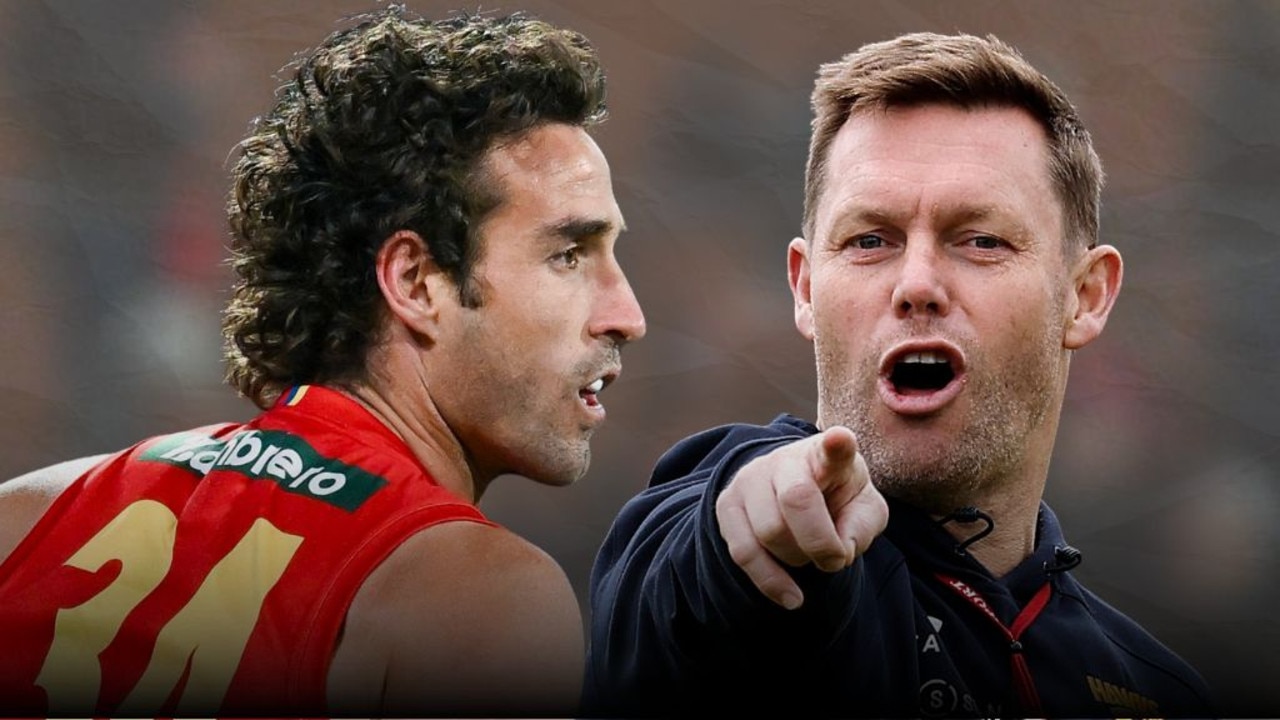
It’s only a rort if you are not in on it.
As Ben King’s move to Hawthorn becomes increasingly likely, a two-club deal between Hawthorn and Gold Coast would be as difficult as last year’s disastrous failed Zach Merrett trade.
For all King’s warts – he has eight tackles in 17 games, he doesn’t chase much, he just kicks goals – what he represents to Hawthorn is monumental.
King only just turned 26 ten days ago and should have eight seasons left including perhaps five of them in his prime.
He might be the anti-Josh Treacy, who is fast becoming everyone’s favourite key forward.
But he has barely missed a game since his 2022 ACL tear, he’s footy’s most accurate player and he perfectly slots into the Jack Gunston role as a ‘disconnected’ key forward leading from the square.
He is about to kick 55 goals or more for the third straight season.
And the Hawks have offered a long-term deal as homesick partner Olivia Carson spends more time in Melbourne as the pair look to resettle in Victoria.
So if the Suns did match a bid and then tried to trade him, they would and should ask for the world.
They would be within their rights to ask for two top 10 picks.
Hawthorn not only doesn’t have any top 10 picks, it is zealously guarding its selections for another play at Merrett.
Its arsenal is its own current first-rounder (pick 16), its two future-first rounders (Tassie-affected so completely devalued) and three 2026 second-rounders which are about to get blown out by the AFL handing four or five clubs early-second-rounders because their top five picks are pushed back by rival bids.
There is a solution which might sail close to the wind.
It is a perfectly legal but slightly dodgy move which could net Ben King for (nearly) free.
Gold Coast’s continued struggles mean they are fifth-last and could simply decide not to match a King bid and secure pick six as AFL free agency compensation.
But could the clubs come to an agreement which means pick six is only part of the total deal?
In theory the AFL asks clubs if separate deals are linked because of this exact scenario.
But could the Suns accept six from the AFL for King, aware the Hawks would sweeten the deal down the line.
Hawthorn has a range of players who are probably going to get squeezed out of their side in coming years.
They include ruck-forward Max Ramsden, versatile defender Jack Scrimshaw, utility Bailey Macdonald and tagger-midfielder Finn Maginness.
Hawthorn has huge faith that 20-year-old key forward Calsher Dear will be a player of the future despite modest form when he finally gets a full pre-season under his belt but if King arrives he might well look around.
None of them would necessarily appeal to Gold Coast, but the Hawks could use one of them in a three-way trade which involved the Suns and boosted that King deal.
So instead of giving up two early picks for King, they allow a fringe player (or even the hugely talented Dear) to depart while using the free agency compensation mechanism.
They could throw in one of those second-rounders depending on which club wanted what.
Would the AFL stop that deal in its tracks?
Maybe, but there are so many loopholes in the AFL rules both clubs could argue a precedent has already been set.
Last year Brisbane could have let star lockdown defender Brandon Starcevich go to West Coast as a free agent.
But with Eagles captain Oscar Allen incoming they would have got nothing as the rules of free agency compensation mean they would have received no net gain or loss (Allen’s FA arrival neutralised Starcevich’s FA departure).
So they traded Starcevich to the Eagles, who in turn benefited because it didn’t off-set the loss of Allen (West Coast got pick 3 overall as FA compo).
The Eagles got Starcevich, 12, 33 and 52, Brisbane got 16, 22, 44 and 50 (more points to match a bid for academy mid Dan Annable) and Fremantle got 19, 23 and 46 as the third club in the trade.
Both West Coast and Brisbane used a legal loophole to advance their own gains.
And the AFL did nothing about it.
Clubs often use a late pick to secure a free agent instead of bringing him in for nothing using the proper FA mechanism because it would affect their compensation for another departing player.
The Hawks could also argue that bringing in King and Merrett stretches their salary cap given they won’t get much change out of $2.5 million from that pair.
So any move to push out a fringe or mid-tier player – even for less than a normal return – could be portrayed as a cap dump.
Gold Coast gave up pick seven and Jack Bowes to Geelong and received the ridiculous return of a future third-rounder so the Cats could absorb $1.6 million of Suns cap space that his deal represented.
If Hawthorn handed over a player and got little in return (simultaneously advantaging Gold Coast) how is that any different?
Three years ago St Kilda and Essendon tried to pull off a cheeky deal to create a first-round pick out of thin air.
Jade Gresham was to go to Essendon as a free agent (creating first-round free agency compensation for St Kilda) then Dylan Shiel would have been separately traded to St Kilda for a later pick.
The gig was up when Shiel’s child fell across his knee in trade week, damaging his meniscus.
Gresham still ended up going on a more modest deal as St Kilda secured end-of-first-round compensation as Shiel stayed.
So as King ponders his future and the Hawks try not to get left at the altar again 12 months after the Merrett trade, footy’s arcane and complicated rules could help all parties get their way this time around.