
Check the weather, because it seems hell has frozen over.
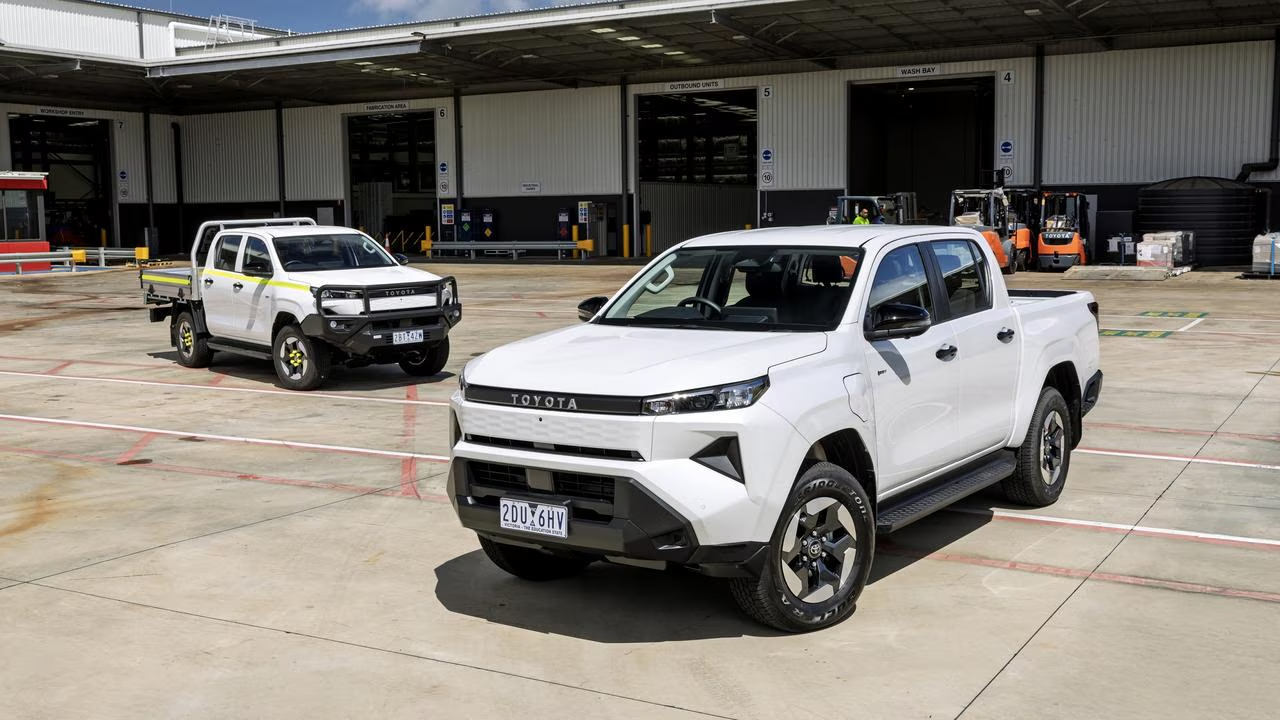
There’s an electric Toyota HiLux, and it’s available for anyone to buy.
But this is definitely not an appealing mainstream option.
And Toyota itself freely admits that, claiming the HiLux BEV is aimed specifically at businesses with fleets, including mining and energy companies.
MORE: Shock reason Aus drivers cop speeding fines
The appeal is clear. A HiLux that doesn’t need diesel means very low running costs, and also no gruff engine to contend with either.
The brand has two different versions: a work-spec SR grade with either a cab-chassis trayback ($74,990 plus on-roads), or a pick-up ($76,490 plus on-roads), with rubber floors, cloth seats and halogen running lights; or a high-spec SR5 with carpet, leather-accented trim, better lights, and more creature comforts ($82,990 plus on-roads).

That’s a premium of about $17,000 over diesel versions.
Inside you’ll find a 12.3-inch driver info screen and a 12.3-inch touchscreen in both grades, with fewer manual controls than older gen models. But there are still drive mode dials and buttons for some of the off-road features, meaning access to controls isn’t completely limited if you’re wearing gloves on the worksite.
There are no changes to the cabin beyond that, with a somewhat cramped back seat, and less flexibility in the back because you can’t fold-up the larger portion of the seatbase for additional storage – that’s where the 1500W inverter for the vehicle-to-load port in between the front seats lives.
There’s also nowhere on-board to store your charging cables. I guess you just chuck them in the tray and hope no-one nicks them?
Speaking of the tray, there are – again – no changes there, apart from the fact that the fuel filler cap doesn’t exist there anymore. And unlike options such as the plug-in hybrid BYD Shark 6, the HiLux BEV doesn’t have any vehicle-to-load charging power outlets in the tub area. You don’t get a tub-liner, or cargo cover, either, and the tray doesn’t fit an Aussie pallet between the arches.
MORE: ‘Bravest’ Aussie buys Chinese flying car
Payload? Not as good as other HiLuxes (nor the BYD Shark for that matter …) at as little as 715kg for the SR5.
Towing? Rated at 750kg for an unbraked trailer, and 2000kg for a braked trailer. Again, not as good as the BYD.
The charge port is on the passenger-side front quarter panel, and it has 10kW AC charging (6.5 hours to charge from 10-100 per cent) and 150kW DC charging (30 mins 10-80 per cent). The battery pack sandwiched in between the chassis rails is a 59.2kWh NMC unit, and remember, that is the one that’s been shown to degrade more if you’re constantly recharging it to completely full.
The range may prove a sticking point for a small business ready to electro-lux its livelihood.
The claim for the cab-chassis is just 245km on the lenient, or unrealistic, NEDC cycle. The pick-up has a claimed 315km (NEDC) range, or a probably closer to reality WLTP figure of 245km.
The electric HiLux has two motors – one at the front (with 82kW/205Nm) and one at the rear (129kW/286Nm) – and the maximum combined output is 144kW. Toyota doesn’t state a combined torque figure, but the thing about this Lux is that it’s smooth from the step-off.
Instant torque to all wheels means progress is rapid, and it builds pace well. To a diesel HiLux owner, it’ll feel like a dramatically different situation that you’re encountering.
MORE: ‘Bravest’ Aussie buys Chinese flying car
It has electronic-assisted power steering which is generally predictable and weighted well, but the suspension is fiercely firm, picking up almost all the inconsistencies in the road and pummelling passengers in the cabin.
It’s a very different experience to the diesel HiLux in the new-generation range, but reminiscent of the bad old days of the rough-as-guts previous version.
There is regenerative braking, and it makes it hard to judge the feel of the pedal when you get on the brakes. That’s not uncommon in electrified models, but I found it particularly hard to acclimate to.
At least the safety tech is well mannered.
The dual-motor electric powertrain doesn’t have the same off-road intent as a diesel HiLux, though there are a number of off-road modes to choose from.
Our launch drive included a softcore course of unsealed stuff, and again, the punishing ride and inconsistent brake pedal meant progress was nowhere near as smooth as the powertrain was.
You might be buying one of the best-known brands, and the ownership promise could be boosted by Toyota’s massive service network. But the intervals are pitifully short for an EV at six months/10,000km, and it costs $220 per visit, too. That works out more expensive than some diesels on an annual basis.
You have to pay extra for roadside assistance too, and while connected coverage is included for 12 months, Toyota will sting you with an annual fee thereafter.
VERDICT
3.5
It is clear this electric ute is not going to be for everyone, but based on how it stacks up in the market, there’s an argument that it’s going to be bought by hardly anyone, too.
Read related topics:Weather