
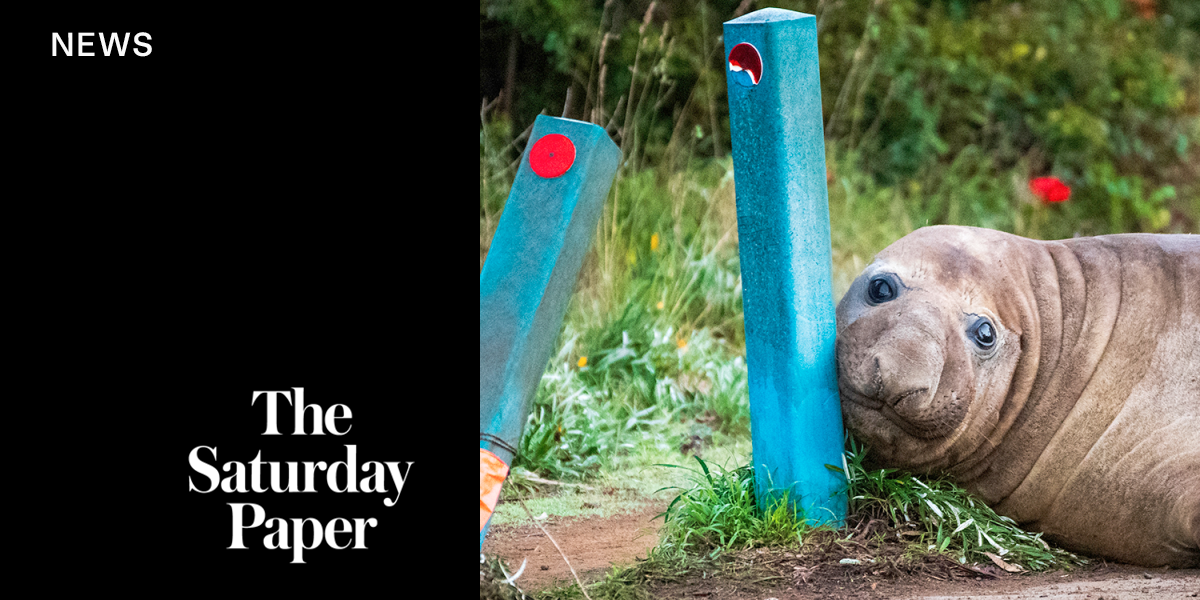
There is a particular sound a wooden fence makes when a creature the size of a small car decides, without malice, that he no longer wishes to be on the far side of it. A creak, a crack, then a kind of collapse. On video, he looks almost gentle. He is simply moving through the world as though the world were built to his scale. “Naughty boy,” someone says off camera, the way you’d scold a dog for stealing a sausage from a picnic. Then 1000 kilograms of blubber and momentum lands in the sand on the other side, and a second voice, delighted, calls out: “You got it, Neil.”
This is how most people have come to know the five-year-old pinniped known as Neil the Seal. What is unusual is the context – a small Tasmanian town – and the number of people watching. Videos of the seal demolishing infrastructure and blocking traffic have been viewed tens of millions of times. Neil has provided a nation with a reliable source of joy, and an urgent lesson in wildlife ethics.
Marine mammal expert Mary-Anne Lea agreed to talk about Neil with visible reluctance. “I think there’s enough Neil clickbait out there already,” she said, “and it’s not really doing Neil any favours. You can totally understand the curiosity – elephant seals are such fascinating animals – but there is a risk here. I think each and every person who wants to visit Neil needs to reflect first and ask themselves, ‘Do I want to be part of a situation that contributes to the demise of an animal like this?’ ”
Neil was born on the Tasman Peninsula, which means that, twice a year, when he hauls himself onto a southern Tasmanian beach, he is returning home. By the mid 1800s, sealers had wiped out Tasmania’s elephant seal colonies, and few have returned since, which makes him unusual. Elephant seals come ashore either for a catastrophic annual moult, in which they shed skin and fur in ragged sheets, or to haul out, when they rest and interact with other seals. Neil’s most recent visit was the latter.
“Young male southern elephant seals interact with one another almost from the day they are weaned,” says Lea. “They’re learning the social and combative skills they will need to enable the opportunity to breed. Many of Neil’s behaviours reflect his need to interact with other members of his species in order to hone these skills.”
“Do we want to live in a society where threatened and endangered species, and individuals like Neil, have a right to live their wild lives parallel and in concert with humans?”
In October 2020, wildlife officers found Neil, then a stranded 40-kilogram pup, on a tidal sandbar and moved him to safety. He has returned to the same stretch of coast twice a year ever since. According to a Clarence City Council ranger, who did not wish to be identified, Neil has been finding his way into town for years without anyone much minding. In 2023, he was photographed on a boat ramp and outside a local real estate agency, small enough then to be a novelty.
For the first three weeks of this year’s haul-out, the council took advice from the Department of Natural Resources and Environment’s Marine Conservation Program and did nothing at all.
“People knew there was a seal in the state, but they didn’t know where he was,” says the ranger. “But then, at the end of the third week, Pulse Tasmania and The Mercury had done enough reporting on him that his location was obvious to both locals and tourists.”
Soon, some 200 people were arriving every hour. “If there was no reporting on Neil, he would have spent four weeks sitting in a small seaside town with the locals wandering past to see him, and that wouldn’t have caused any trouble.”
The attention that made Neil famous was also changing the conditions in which he could safely come ashore. Gemma Blackwood, a media lecturer at the University of Tasmania, argued that Neil’s popularity owes much to the way people have embraced him as an anti-establishment figure. “Maybe we love Neil because we’re jealous of his freedom,” she wrote in The Conversation. Across social media, Neil has been referred to as “a rebel”, “a rascal”, “a folk hero” and “a typical teenager”.
Neil is not the first marine mammal whose online fame has had unintended consequences. In 2022, Freya, a 600-kilogram walrus who became famous for clambering onto boats across the Netherlands, Denmark, Sweden, England and Scotland, settled in Norway’s Oslofjord. Videos drew crowds that repeatedly ignored advice to stay away, leading Norwegian authorities to euthanise the walrus on the grounds of public safety.
Lea says conversations about humans coexisting with large animals are already being had elsewhere in the world. “As there are more stressors in the environment, we may see animals having to make choices that they wouldn’t necessarily have made before,” she says. “I think it comes down to the question: Do we want to live in a society where threatened and endangered species, and individuals like Neil, have a right to live their wild lives parallel and in concert with humans? We’re coexisting in a shared habitat. We’re not just watching. By being there, you alter the context, and when you’re there en masse, you alter it even further.”
Clarence deputy mayor Allison Ritchie is reluctant to assign blame. “Now Neil is physically more challenging, and when he does play, it’s very noticeable in the community,” she says. “There are a lot more people filming and uploading videos and more people wanting to see him.”
Once Neil moved off the beach and through fences, onto roads and into car parks, council rangers were called. “That’s when you started seeing photos and videos of him knocking down bollards and street signs,” the ranger says. “That’s when people started ignoring the witch’s hats and ignoring the exclusion area.”
The council deployed teams to manage the crowds and traffic. Yet while fines can be given to people coming too close, nobody was cautioned. “Our presence was enough,” the ranger says. “Before, people were going up to a couple of metres from Neil, sometimes with their kids, just to get a selfie. Now they were staying back.”
The state supplied a 24-hour security guard for Neil, as long as he stayed. Then, on the night of July 9, he swam back out. Neil is expected to return in October.
Before Neil left, and anticipating his return, local resident Natasha Young started a petition, “Implement a non-lethal management plan for Neil the elephant seal”, pushing for protected zones and fines around Neil’s habitats. It has since gathered more than 86,000 signatures.
Ritchie says she isn’t aware of any current government discussion of euthanasia, and that council has agreed to help build a formal, joint framework with the state government to avoid such an outcome.
“We had to be on the front foot and get people to follow the rules,” the deputy mayor says. “Tourists were coming in minivans and locals started to worry about Neil’s future because some people weren’t doing the right thing.”
Neil’s celebrity has also exposed disagreement about whether Tasmania’s wildlife laws are equipped for animals that become public attractions. State premier Jeremy Rockliff ruled out introducing any new laws or updating regulations. “Common sense is what is key here,” he said. “We don’t need to legislate for common sense.”
Emma Goyne, a Clarence City councillor, finds the sentiment difficult to accept from a government that is happy to use the seal to promote itself. “Common sense doesn’t prevail a lot of the time,” she says. “It’s unfortunate when you see people like our premier sharing videos of Neil while he’s done nothing to protect him.”
Ritchie points to interstate examples as possible models for change. In Victoria, she says, the public must stay 30 metres from a seal or face a maximum fine of $3700. In Tasmania, the equivalent is 20 metres and $500. “We need to rethink the penalty of disturbing the animal,” she says, “and remove any confusion around enforcing them. There is no guarantee he will return to the same beach or community, so any framework we have would need to be flexible.”
Goyne, Ritchie and other locals are already in discussion to form a volunteer group to work alongside environmental groups with a view to safeguarding Neil. Ritchie also points to a new local council agreement being put to the state government to coordinate future responses to marine wildlife, with an eye to Neil’s future visits, when he will be even bigger, and possibly more territorial.
Ritchie says “no one is grumbling” over the as yet uncalculated cost of Neil’s visit, which includes the cost of temporary staff and replacement infrastructure. Goyne agrees: “I mean, we probably have teenage kids do more damage on a weekend.”
Of greater concern is the cost that might be paid by Neil himself. H5N1 avian flu has been gradually spreading across mainland Australia over the past two months. Late last year, it wiped out 76 per cent of the population of elephant seal pups on Heard Island, leading the International Union for the Conservation of Nature to list the species as “at risk of extinction”.
Lea says Neil’s return to populated areas is “a double-edged sword”.
“We would certainly like to see populations of animals such as elephant seals doing better in our latitudes,” she says. “But also, we need to protect them, because they are very susceptible to bird flu and interactions with humans and pets. Similarly with polar bears in Arctic nations, serious conversations about how to coexist with these animals are necessary now. We have to find and resource solutions if we want these species to continue to survive alongside expanding human populations.”