
In 2021, at the height of the Covid-19 pandemic, pollster Roy Morgan ran a survey about how different professions were viewed by the Australian public. It revealed, perhaps unsurprisingly, that Australians trusted nurses and doctors above all other professionals. Close behind them were pharmacists.
“Pharmacists are very highly trusted and valued for good reason, and patients interact with them more than they do any other kind of clinician in the healthcare system,” says Peter Breadon, health program director at independent think tank the Grattan Institute. Australians visit a community-based pharmacist on average 18 times a year, compared to six visits to their GP.
Community pharmacies – those not in hospitals – are privately owned businesses that must be owned by a pharmacist, although that isn’t necessarily the white-coated individual behind the counter. Each year the federal government pays those businesses about $3.8 billion for their services, most of which is a variety of fees paid to pharmacy owners for dispensing medications subsidised under the Pharmaceutical Benefits Scheme – including administration, handling and infrastructure, and dispensing of “dangerous medicines”.
These are highly profitable businesses, with data suggesting that the before-tax and inflation-adjusted profits of community pharmacies have more than doubled over the past decade.
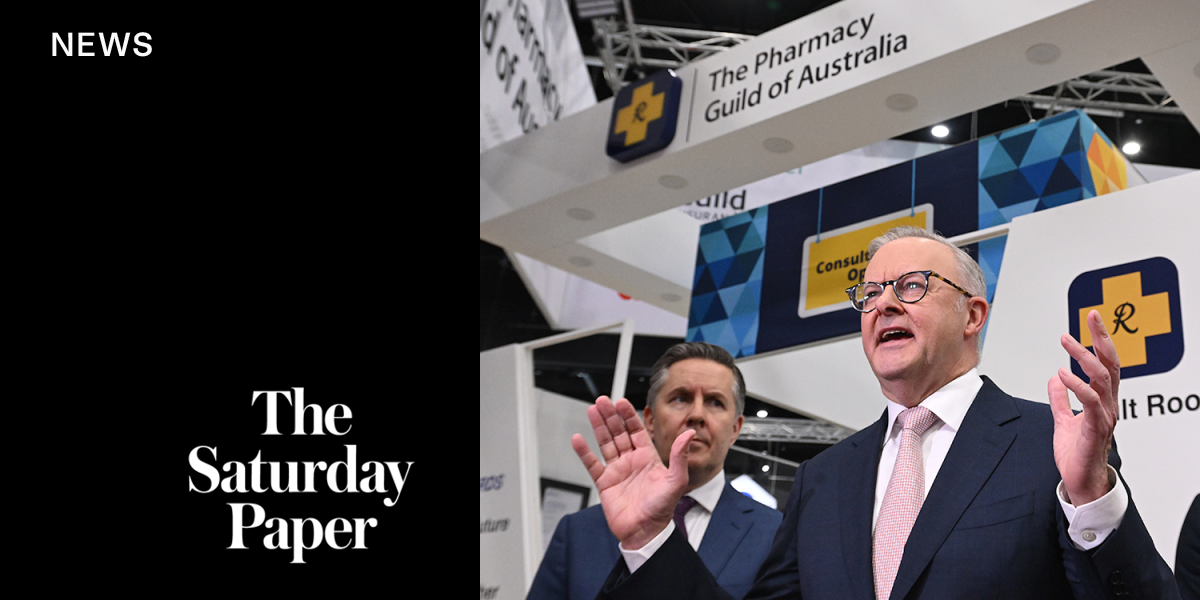
The peak body for community pharmacy owners – as distinct from pharmacists themselves – is the Pharmacy Guild, which in the past five years donated more to political parties than any other healthcare operator, making it the 15th most extravagant political donor overall, outspending even the Minerals Council of Australia. It is also one of three principal partners of Patients Australia, whose website states it is an “independent not-for-profit organisation dedicated to championing and protecting the rights and interests of patients and improving patient experiences and health systems”.
According to a report released by the Grattan Institute this week, the Pharmacy Guild has long maintained a powerful hold over the pharmacy sector. It wields such influence that the details of that $3.8 billion government healthcare spend, spelt out in the five-yearly Community Pharmacy Agreement (CPA), are negotiated behind closed doors and exclude those most affected by those decisions: patients and even working pharmacists themselves.
“Pharmacy policy affects almost everyone: it affects what your medicine costs, it affects where you can get them, what other services might be available, and how these billions of dollars are spent,” says Dr Elizabeth Deveny, chief executive of the Consumers Health Forum of Australia, the national peak body for health consumers. “And when large amounts of public money are involved, people expect transparency, they expect good evidence, and they expect accountability.”
“Usually when you see an area of policy where policy is not working for consumers and for taxpayers … that often points to a problem with vested interests having too much influence over policy, and I think that’s the case here.”
The CPA even dictates the discounts that individual pharmacies can offer to patients on their PBS medications. The most recent agreement reduces that discount from $1 per script to zero for most patients from this year. “One dollar may not sound like much, but if you’re on multiple medications and on a tight income, every dollar counts,” says Dr Danielle McMullen, GP and federal president of the Australian Medical Association, the peak body for Australian doctors. “I have seen patients who do forgo medicines, even pensioners where they’ve got the concession price.”
Nine years ago, a federal government review of pharmacy remuneration and regulation recommended that CPA negotiations include a range of stakeholders, including the Consumers Health Forum and the Pharmaceutical Society of Australia, which represents Australia’s more than 40,000 pharmacists.
That hasn’t happened on the consumer side, says Deveny. “There is not much involvement. We’re told that it is a commercial process and that we can’t be involved on that basis.”
The Pharmaceutical Society of Australia – which declined to comment for this story – was a signatory to certain parts of the seventh CPA in 2020, not including the section on remuneration and funding. However, the society was completely left out of the eighth and current CPA in 2025. That agreement was signed exclusively by federal Minister for Health and Aged Care Mark Butler and the Pharmacy Guild.
In nearly 10 years, it appears little has changed to make CPA negotiations more inclusive, nor to increase transparency and accountability for the billions of federal health dollars spent on the pharmacy sector. “Usually when you see an area of policy where policy is not working for consumers and for taxpayers, and where that persists over decades despite many evidence-based independent reviews recommending change, that often points to a problem with vested interests having too much influence over policy, and I think that’s the case here,” Breadon says.
The authors of the Grattan Institute report recommend that the CPA be scrapped and replaced with a more transparent process whereby pharmacy remuneration is set by an independent body such as the Independent Health and Aged Care Pricing Authority, which exists specifically to give evidence-based pricing advice for health and aged care to the government.
Pharmacy Guild spokesperson and national vice-president Simon Blacker said in a statement to The Saturday Paper that the guild has been a leading advocate for affordable medicine.
However, the guild also fought a furious but ultimately unsuccessful public campaign against the introduction of 60-day prescribing in 2023, an initiative that meant patients with certain chronic diseases enjoyed a dramatic reduction in the cost of their medications and needed fewer visits to their doctor and pharmacist. While the guild claimed at the time the move would lead to the closure of between 200 and 600 community pharmacies due to financial pressures, the health minister’s office tells The Saturday Paper that 54 new pharmacies have opened nationwide since the change.
The Grattan Institute report also found the guild exerts extraordinary control over pharmacy ownership and location, preventing new pharmacies from opening too close to existing ones and steadfastly resisting efforts to open up the sector to supermarkets, as is common in other countries.
The Pharmacy Location Rules mean any pharmacist wanting to open a new pharmacy or relocate an existing one must apply to the Australian Community Pharmacy Authority. These rules dictate, for example, that in some settings the new premises must be at least 1.5 kilometres, as the crow flies, from any other pharmacy, and must be within 500 metres of a supermarket and/or – depending on the size of the supermarket – a full-time prescribing medical practitioner. The rules vary according to the context, such as a greater number of nearby doctors or a new pharmacy in a shopping centre.
Breadon says the location rules were originally developed to address an oversupply of small pharmacies in the 1980s, but “it’s pretty clear that constricting where businesses can open and who can own them, by definition, limits competition”.
A lack of competition could benefit pharmacy owners, who are able to charge whatever they like for non-PBS medications on private prescriptions, including big-selling items such as the new GLP-1 RA weight-loss drugs. “Patients don’t always understand that medicines might be different prices at different pharmacies and to shop around, so particularly if they’re non-PBS or if they’re below the PBS price,” the AMA’s Danielle McMullen says.
The guild defends the location rules as vital to ensure that Australians have equitable access to medicines and pharmacy services. “Removing these patient protections would not create more access to care – it would risk concentrating pharmacies in the most commercially attractive locations while leaving vulnerable communities with fewer healthcare options,” Simon Blacker says.
One subject that the Grattan Institute report’s authors and the guild might agree on is pharmacist prescribing. Both the guild and the Pharmaceutical Society of Australia have pushed for pharmacists to be allowed to independently prescribe medications for certain minor conditions, such as uncomplicated urinary tract infections. Unsurprisingly, the medical establishment is against it.
“There is very little evidence to support this autonomous pharmacy prescribing,” says Dr Michael Wright, Sydney GP and president-elect of the Royal Australian College of General Practitioners. He argues the evidence that has come from pilot trials of pharmacist prescribing focuses on whether a patient received a prescription, not clinical outcomes or cost-effectiveness, “which are all the things that are important to us, which there just isn’t the evidence for”.
However, there is a strong appetite for the “integrated pharmacists” who work within general practices not to dispense medication but to manage it, which is also recommended in the Grattan Institute report. “Pharmacists are the experts in medication management, and having a pharmacist working with you and your practice is an amazing way to identify medication issues, make sure people are on the right medication, get them off unnecessary or the wrong medication,” Wright says.
While the political heft of the Pharmacy Guild looms large over the Australian pharmacy landscape, Breadon thinks it may soon face challenges. That’s partly because of the rise of non-guild entities such as Chemist Warehouse, which merged with Sigma Healthcare. The company now operates about 9 per cent of pharmacies.
Breadon also suggests the guild didn’t win many friends in government with their aggressive campaign against 60-day prescribing. “The other change is the government’s facing a lot of pressure in terms of healthcare spending, so there’s fiscal challenges,” he says. “They’ve got more reason than ever to try and get value for the healthcare spend.”