
The chill of the winter break has jolted presumptions about the way the country works, forcing the government to urgently rethink the framework of telecommunications, the need to proactively deal with the profound impact of artificial intelligence and, no less challenging, the realignment of the political right.
Telstra, the country’s biggest legacy telecommunications company, has squandered its reputation as the reliable bedrock of the way we connect with each other, particularly in times of emergency.
Meanwhile, the pervasiveness of computers is hardly a novelty but the ability of algorithms powering machines to think and the demands this makes on expanding data centres and energy consumption can no longer be allowed to develop unchecked.
At least, this is a conclusion the Albanese government has finally made.
While all of this is happening, the very values of inclusiveness and tolerance that underpin the Australian multicultural way of life are being trashed by Pauline Hanson. In a defiant trip to Britain, she has accepted the accolades of that country’s most notorious racist, Tommy Robinson, and returned his compliments.
Anthony Albanese is confident his government has settled on a way to harness the expansion of the brave new world of artificial intelligence, fraught as it is with dangers but just as heavy with immense possibilities for the national benefit.
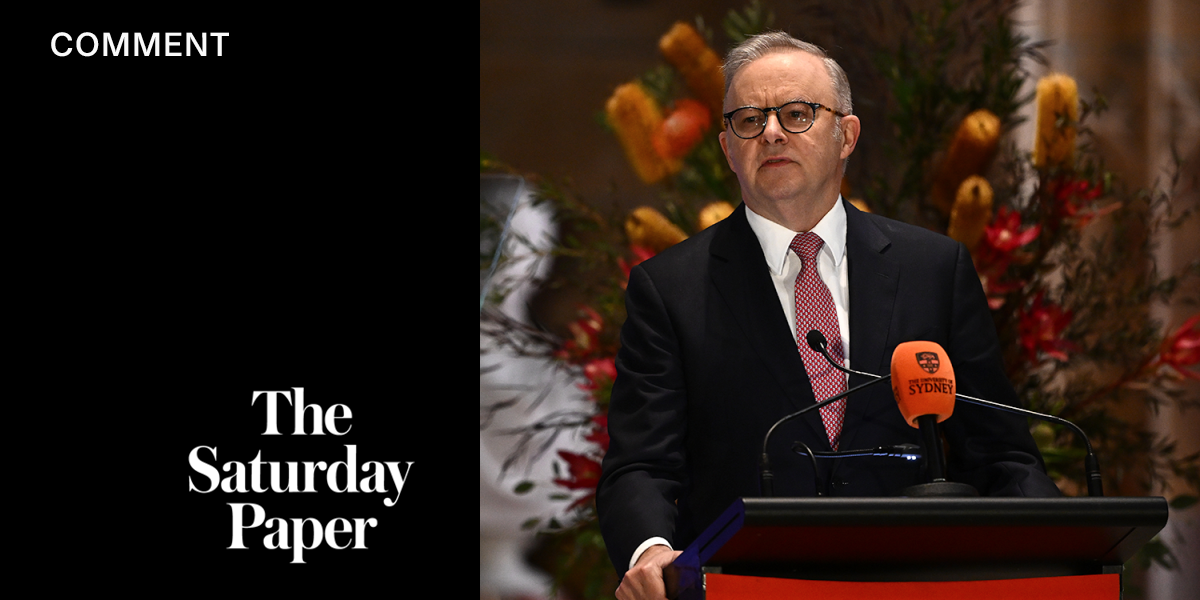
Midweek, after months of debate across the government, the prime minister announced a framework to deal with the inescapable reality of AI. “No government can turn back the clock or press pause on all of this,” Albanese explained as he announced what he said was a world-leading framework “to ensure Australia can capture the opportunity, share the benefits and keep Australians safe”.
The New York Times helped set the scene, reporting a statement by 200 economists and scientists, including 15 Nobel laureates, with the message: “We must act now.” The impetus for the statement was a somewhat belated acceptance that artificial intelligence was spreading through the economy more quickly and more broadly than past technologies.
AI, the statement says, could be “larger than the Industrial Revolution, but unfolding over a vastly shorter time frame”.
The prime minister announced a new Office of AI within his own department, to accelerate implementation of Australian standards, which are to be developed with the states and territories.
This, he says, will be welcomed by some of the world’s biggest tech companies, such as Anthropic, giving them a streamlined approval process while at the same time safeguarding community interests.
The government is assuring Australian writers, journalists and artists that they will retain ownership over their work. Albanese says no company should use Australian creative works to train AI without artists’ control.
The government is expecting endorsement of its framework at next week’s Labor Party National Conference, where rank and file delegates and affiliated unions have equal say.
The impetus for the statement was a somewhat belated acceptance that artificial intelligence was spreading through the economy more quickly and more broadly than past technologies. AI, the statement says, could be “larger than the Industrial Revolution, but unfolding over a vastly shorter time frame”.
Outgoing party president Wayne Swan says, “The government and the unions are well aligned on the key issues of industrial relations and cost-of-living issues.”
Australian Council of Trade Unions secretary Sally McManus endorses this view, saying the proposed Australian standards are a useful mechanism to create secure jobs and develop sovereign AI capability. “Unions don’t want to veto technology use, only to veto the harm it could cause,” she says.
Business Council of Australia chief executive Bran Black was similarly supportive of the priority Albanese was giving to developing AI policy “at the very heart of government”.
This is the big challenge facing the government, but at the same time it must deal with the old technology of Australia’s telecommunications system, especially in light of the Telstra outage this month.
The chair of the Senate inquiry that began taking evidence about the outage on Friday, Greens Senator Sarah Hanson-Young, says “our telecommunications system is in crisis”. She says there were “plenty of warning signs” about the stability of the networks after Optus’s major outage in 2023, which was followed by the 2025 triple-O disaster caused by a scheduled upgrade that resulted in at least three deaths.
Despite the opposition claiming one death resulted from the latest outage, a police and Telstra investigation established this not to be the case.
Hanson-Young says Telstra, with 25 million customers, is an “effective monopoly”. Last financial year, the company posted a profit of $2.3 billion off $23.6 billion in revenue. In the past 18 months there have been multiple rounds of job cuts and price rises, as chief executive Vicki Brady tries to achieve more value for shareholders.
Brady was out of the country on holidays when the outage struck – but offered an abject apology to customers on her return 54 hours later.
Senator Hanson-Young says: “For too long Telstra and other telcos have put their profits ahead of their customers’ safety, and both the government and the regulator, ACMA [Australian Communications and Media Authority], have failed to hold them to account.”
Minister for Communications Anika Wells was also on holidays when the crisis broke, but she was in the country and was able to hold a Canberra news conference within a couple of hours of being informed.
Wells is still waiting for the findings of a review into the triple-O regulations, being held by the triple-O custodian, which is due to report in March next year.
In March this year, when she announced the review, Wells acknowledged there were gaps in the laws. Regulations were designed when a majority of customers were using fixed-line phones, but now 85 per cent of users are on mobiles.
On Tuesday, the minister faced probing questions about compensation for the many businesses that lost money because of the outage. There is criticism of Telstra for putting the onus on the victims to establish their claims.
Wells said she reiterated to the company that she expects it to provide “an expedited triage process”. She said Telstra has “an awful lot of work to do here to make up to its customers and to Australians”.
Wells has heavy responsibilities in the communications as well as the sports portfolio. Late last year her travel expenses in the sport area drew heavy criticism and led to the reimbursement of $10,116.11 to the public purse.
She was cleared of wrongdoing, but the controversy has cast something of a shadow and robbed Wells of some confidence as she manages gambling reforms and social media regulation, as well as carrying the can for telecommunication arrangements that have been allowed to become obsolete.
Hanson-Young and some stakeholders are suggesting the Telstra contract for triple-O should not be renewed and that the system should be returned to public ownership.
More welcome for Labor is evidence in the latest opinion polls of the slide in support for Pauline Hanson’s One Nation since her National Press Club speech last month.
Labor is clearly the preferred government in all the polls and has regained a primary-vote lead over One Nation in all but two. The Liberals have improved their position at the expense of One Nation in a couple of polls, which suggests Angus Taylor’s decision to attack the Hanson party’s economic credibility could be paying dividends.
A Liberal source says Taylor has got the message that he has to fight on two fronts – against Labor and against One Nation – with both intent on taking seats from the Liberals. In that regard, the source said, One Nation is more menacing.
Interviewed on the ABC’s 7.30 this week, Taylor was emphatic in ruling out forming a coalition with One Nation: “There is no plan to form any kind of coalition.”
The Liberal leader repeated his “eternity of pain” description of what would happen to the Australian economy should One Nation form government or have a significant say in one. He said they have a grab bag of policies and “even just a small subset of them would take this country into a fiscal crisis, higher inflation, higher interest rates, higher mortgage costs”.
Inexplicably, in a separate radio interview on 2GB, he said his comments on One Nation were made with a “heavy heart”.
In Britain, news of Taylor’s change of heart infuriated Hanson. She posted a video telling Taylor she was not happy. She told him to “listen to the people” and with considerable gall said, “You know, Angus, I am not your enemy. We both need to get rid of Labor.”
Hanson’s trip to Britain has even some of her admirers shaking their heads. Sky News commentator Andrew Bolt wrote a scathing column in the News Corp tabloids, headed “Dumb move for Hanson to meet British right-wing thug”.
Bolt itemised the rap sheet against the convicted criminal Tommy Robinson, who she travelled with to his home town of Luton. Hanson agreed that the ethnically diverse streets, where whites are in a minority and Muslims account for almost 33 per cent of the population, did not “look like Britain” to her.
Why Hanson, who bristles at being called a racist, would seek endorsement from a notorious racial-hate merchant is baffling, unless she believes she is politically bulletproof.
Bolt asked whether Hanson was “really that deaf or incurious or … good heavens, tell me it’s not so: did she in fact check his history and decide she truly does admire Robinson?”
Bolt believes this episode could “cost her plenty”. The polls suggest the scepticism is beginning to bite, although RedBridge Group pollster Tony Barry says her primary support is sustainably three or four times higher than it was at the last election.
That’s a problem for Labor and the Coalition.