
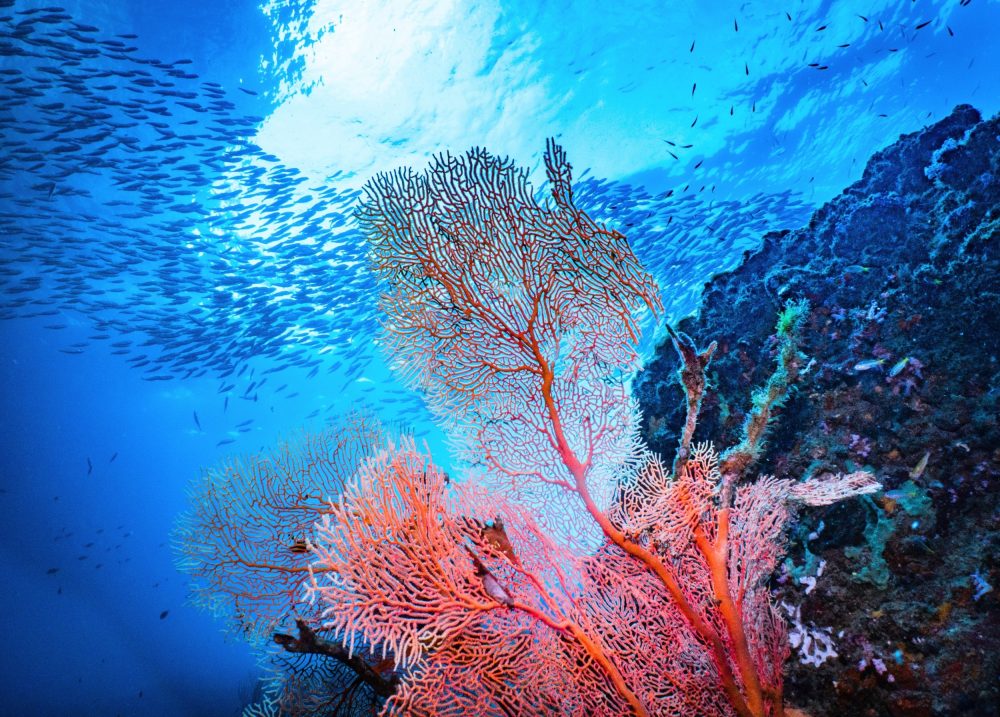
Coral reefs may look pristine from the surface, but they are constantly absorbing the effects of the world around them.
The reefs off Maui sit within reach of farms, towns, and resorts. Whatever runs off the land eventually reaches the water they live in.

A new study along the Maui coastline shows that human activity leaves a chemical signature inside coral tissue. It was led by researchers at the University of Hawai‘i at Mānoa (UH Mānoa).
The team sampled 380 corals from 16 sites across roughly 43 miles (70 km) of west and south Maui shoreline. Then they read the chemistry packed inside each colony.
Analyzing the chemistry of coral
Every living thing carries a pool of small molecules known as a metabolome. It reflects what a body is doing, how healthy it is, and what it has met in its surroundings.
The researchers picked two coral species with very different ways of living. One was the lobe coral, Porites lobata, and the other the rice coral, Montipora capitata.
“It was extremely surprising that the metabolomes of both coral species had almost identical trends,” said Zach Quinlan at the Hawai‘i Institute of Marine Biology (HIMB).
“These corals have very different life strategies, and we wouldn’t normally expect them to accumulate contaminants the same or even necessarily respond the same to disturbances.”
“This demonstrates how strong of a forcing these anthropogenic activities really are.”
Chemical signature of disturbance
The sites ran from lightly touched shores to reefs beside wastewater plants and old plantation runoff. On chemistry alone, the corals fell into three natural groups.
Those groups tracked the level of human disturbance on land and in the water. More development and pollution meant more altered coral chemistry.
Each colony sampled averaged about ten inches (26 cm) across, taken from reefs that looked healthy at a glance. The chemistry told a different story than the eye did.
Much of the analysis ran through the School of Ocean and Earth Science and Technology (SOEST). The same campus is home to the marine biology institute behind the work.
Land reaches the reef
Water ties the land and the reef together. Rain washes farm chemicals, nutrients, and waste from the hills down toward the sea, dumping the whole mix onto the reef.
Groundwater carries its own load beneath the surface. Septic systems and treatment plants seep nitrogen into the shallows where corals grow.
Heavy tourism and coastal building pile on still more pressure. The reefs closest to all that activity carried the strongest chemical marks.
Old plantation land still leaks nutrients decades on. That runoff feeds algae and tips the whole reef off balance.
Draining energy reserves
At the busier sites, the corals looked chemically stretched thin. Their tissues held less nitrogen and carried fewer of the easy-to-use energy molecules that keep a coral running.
The pattern suggests corals burning through reserves just to cope. Fighting off local stress leaves fewer reserves available for bigger threats like marine heatwaves.
Stress chemicals stacked up in these same corals. Harder-to-break compounds grew more common, which traps energy instead of releasing it.
That trade-off matters because reserves are finite. A coral spending its nitrogen on daily pollution has little left for a heatwave.
Lessons from bleaching
Five of the sites had coral cover records reaching back nearly two decades. That let the team match present-day chemistry against real reef history.
In 2016, a worldwide bleaching event driven by a strong El Niño struck Hawaiian reefs hard. The sites with the most disturbed chemistry lost the most coral afterward.
One reef at Kahekili continued to decline despite fishing protections. A herbivore management area there banned certain fishing years earlier, yet the coral kept fading.
The link was hard to miss across the five sites. Cleaner chemistry lined up with reefs that held their ground.
Contaminants in coral tissue
The team also pulled 25 contaminants out of the coral tissue. They traced back to farms, factories, household products, and medicine cabinets.
These compounds built up most at the crowded, developed sites. Corals soak up such chemicals straight from the water, and also from the tiny prey they trap and eat.
Sitting still their whole lives, corals gather whatever drifts past. That habit turns their tissue into a slow, honest archive of local pollution.
“This response to anthropogenic pressure makes the coral less resilient to stressors,” said Quinlan.
A new reef warning sign
Because corals cannot move, their tissues keep a running log of pollution. That makes them a steadier gauge than a water sample collected on a single day.
“Together, our findings suggest a direct relationship between anthropogenic disturbance, accumulation of dangerous contaminants within corals, and coral health that is consistent across species,” said Quinlan.
“Our findings suggest that monitoring the pool of chemicals within the coral tissues, called metabolomes, can serve as a powerful tool for tracking the hidden impacts of anthropogenic disturbance on marine life.”
That idea could reshape how coastal waters get watched. A single tissue sample would capture months of exposure, not one passing moment.
Danger in the exposure
The reach of these contaminants goes beyond the corals themselves. People who fish and eat from these reefs share the same exposure.
“Beyond the implications for coral health and resilience, this study demonstrates how many anthropogenic contaminants are escaping into marine ecosystems,” said Megan Donahue at the Hawai‘i Institute of Marine Biology.
Next, the researchers hope to restore those depleted reserves experimentally. The goal is to learn whether better-stocked corals recover faster.
The study is published in the journal Nature Communications.
—–
Like what you read? Subscribe to our newsletter for engaging articles, exclusive content, and the latest updates.
Check us out on EarthSnap, a free app brought to you by Eric Ralls and Earth.com.
—–