
Worries about war and AI stock valuations saw Wall Street extend its decline on Friday.
S&P 500: -1.0%Dow: -0.8%Nasdaq: -1.5%
Over the week, the S&P 500 fell 1.6%, compared to a 0.7% decline in Europe and an even more modest 0.1% fall on the ASX.
It’s still too early to call the listing AI sector a chip-wreck, given the pullback is relatively small to the substantial gains the sector has made in the past year. However, a trend is developing.
The broadest measure of the chip/data memory sector valuations, Philadelphia SE Semiconductor Index, logged its steepest weekly loss in over a year and has tumbled over 18% so far in July.
Add some pre-July losses into the equation and technically the sector is now in “bear market” territory.
Even so, the index remains up nearly 65% year-to-date, compared with the S&P 500’s nearly 9% gain over the same time frame.
Many investors in the artificial intelligence space have begun positioning for a slowdown in the nearly trillion-dollar spending boom, with some active managers already scaling back their exposure.
“It’s like the market has chip fatigue,” chief market strategist at Carson Group Ryan Detrick told Reuters.
“Chip stocks are down three of the last four weeks, and it’s the same worries, the same concerns; those stocks got way ahead of themselves, and now they’re coming back to earth.”
Among the Magnificent Seven group of AI-related megacaps, all but Apple dipped, with Meta and Alphabet suffering the worst of it, down 2.7% and 3.2%, respectively.
Outside the tech sector, things seem to be going swimmingly, rather than floundering.
Second-quarter earnings season is still in its early days, with 49 of the companies in the S&P 500 having reported.
Of those, 90% have delivered better-than-expected results, according to LSEG.
Analysts now see year-on-year S&P 500 earnings growth of 26%, in aggregate, up from the 19% expectations three months ago.
“It’s early in earnings season, but we’re off to a tremendous start,” Mr Detrick said.
“Over the next several weeks, we’re going to get a lot more sectors and industries reporting. But so far, the banks have really started us off on the right foot.”
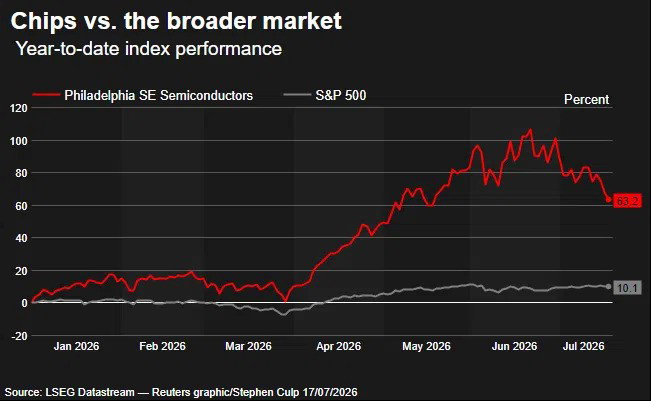 Chips vs S&P 500 (LSEG, Datastream)
European stocks also slipped, although the UK’s FTSE made a modest gain.
ASX 200 futures are priced for a gain this morning, but trading closed before news of the deaths of at least two US servicemen filtered through and the missile and drone attacks intensified.
Oil prices continued to climb in step with growing tensions in the Gulf region.
Brent futures: +4.6% to $US88.10/barrelWTI futures: +4.5% to $US82.49/barrel
For the week, both key benchmarks gained around 16%.
“The market is reacting to the increasing hostilities between Iran and the United States that have culminated this week with nightly attacks on Iranian infrastructure and retaliation by Iran on its neighbours’ infrastructure,” President of Lipow Oil Associates, Andrew Lipow said.
“If more tankers come under fire and become damaged, we’re going to see oil prices continue to move up as shipowners simply refuse to enter the Persian Gulf.”
The heightened tensions helped support the US dollar, thanks to its “safe haven” reputation.
However, the Aussie dollar still managed to end the week higher overall at just under 70 US cents, capping a third successive week of gains.
With Reuters