
Australia’s next generation of women’s basketball talent has announced itself on the world stage, with the Sapphires returning from the FIBA Under-17 Women’s World Cup in Czechia with the nation’s first medal at the tournament since 2018.
Watch the biggest Aussie sports & the best from overseas LIVE on Kayo Sports | New to Kayo? Join now and get your first month for just $1.

The bronze medal capped an impressive campaign in which Australia lost just two games, both to eventual finalists, highlighting the strength of a group that could shape the future of the Opals program.
Held in Czechia from July 11 to July 19, the tournament featured 16 of the world’s best junior nations. Australia was drawn into a challenging Group A alongside eventual champions the United States, Latvia and Côte d’Ivoire.
READ MORE: Crocs claim first medal since 2014 at the FIBA U17 World Cup In Türkiye
It was the Sapphires’ eighth appearance at the tournament since its inception in 2010. Entering ranked sixth in the world, Australia added another bronze medal to its growing legacy after previously claiming gold in 2016 and bronze in 2018.
Future stars emerge
Several Australians enhanced their reputations throughout the tournament, led by Madison Ryan, who was named in the tournament’s All-Star Five.
The 17-year-old averaged 14.1 points, 6.0 rebounds and 1.3 blocks per game while shooting 47.2 per cent from the field, establishing herself as one of the competition’s standout performers.
Highly touted guard Isabel Smith also showed why she is regarded as one of Australia’s brightest young prospects.
While she may not have reached the heights she displayed with the Centre of Excellence in NBL1 this season, Smith still averaged 11.9 points and 1.4 steals per game. She opened the tournament with seven steals against Latvia before producing her best offensive display against eventual champions USA, finishing with 20 points in a narrow two-point defeat.
Isabel Smith of Australia drives to the basket during the FIBA Women’s U17 World Cup 2026 semi-final between Australia and Spain at Starez Arena Vodova on July 18, 2026 in Brno, Czech Republic. (Photo by Yaroslava Nemesh/FIBA via Getty Images)Source: Getty Images
The biggest breakout performer, however, was Olivia Olechnowicz.
The 17-year-old guard enjoyed a remarkable tournament, earning the FIBA Under-17 Women’s World Cup Best Defensive Player award and a place in the Second All-Star Five.
Olechnowicz averaged 12.1 points, 4.7 rebounds and 3.3 steals per game, finishing second in the tournament for steals while consistently making game-changing plays at both ends of the floor.
The bronze medal was also a team effort, with Matilda Trout, Sophie Richardson, Jade Sherrington, Jemyma Manyok, Jamesin Jones, Daisy Hocking, Lily Mapp, Jay Sebasio and Eliza Ashby all making valuable contributions throughout the campaign.
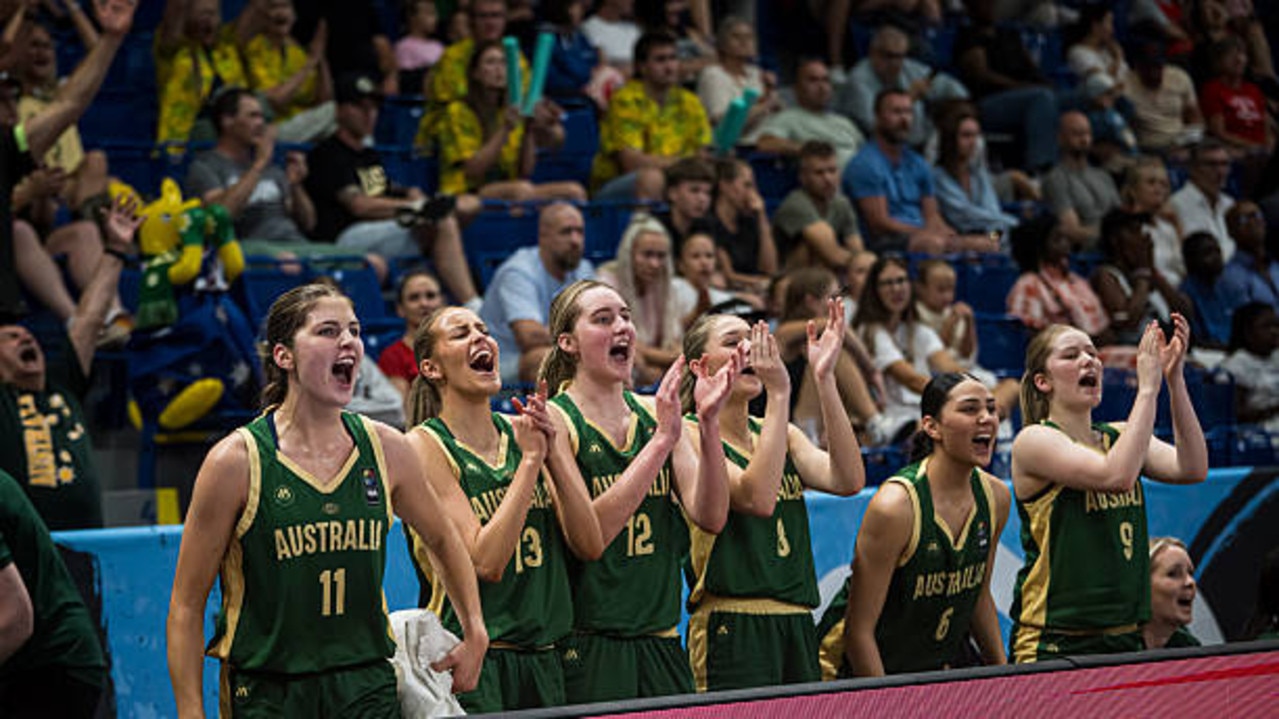
BRNO, CZECH REPUBLIC – JULY 12: Players of Australia cheers passionately from the bench during the FIBA Women’s U17 World Cup 2026 Group A game between USA and Australia at Starez Arena Vodova on July 12, 2026 in Brno, Czech Republic. (Photo by Yaroslava Nemesh/FIBA via Getty Images)Source: Getty Images
The road to bronze
Australia began the tournament in dominant fashion, defeating Latvia in its opening game.
Smith and Olechnowicz each recorded seven steals, setting a new Sapphires single-game record.
The Sapphires then pushed eventual champions the United States to the limit in one of the tournament’s best contests.
Trailing by double digits entering the final quarter, Australia stormed home with a 22-16 final period, sparked by back-to-back three-pointers from Sophie Richardson, before ultimately falling just 74-72.
Despite the loss, the performance proved Australia could match it with the world’s best.
The Sapphires quickly responded by winning their next three games to book a place in the semi-finals.
Group Stage
Australia def. Côte d’Ivoire 89-37
Round of 16
Australia def. Germany 71-45
Quarter-final
Australia def. Japan 70-64
Semi-final heartbreak
Australia’s title hopes were ended by Spain in a physical semi-final.
Spain entered the contest as one of the tournament’s premier three-point shooting teams and repeatedly punished Australia’s defence with timely long-range baskets.
Although Spain shot just 9-of-32 (28.1%) from beyond the arc, the shots they did make came at crucial moments.
Australia struggled from long range, converting only 4-of-24 (16.7%), making the comeback task increasingly difficult.
Sophie Richardson of Australia goes up for a shot against player of Spain during the FIBA Women’s U17 World Cup 2026 semi-final between Australia and Spain at Starez Arena Vodova on July 18, 2026 in Brno, Czech Republic. (Photo by Yaroslava Nemesh/FIBA via Getty Images)Source: Getty Images
Spain advanced with a 58-51 victory, but the Sapphires quickly regrouped for one final opportunity to leave Czechia with a medal.
Bronze secured
Australia responded in the perfect fashion, defeating Canada 64-57 to claim the bronze medal.
The Sapphires controlled much of the contest, leading for 33 minutes and opening an 11-point advantage midway through the third quarter.
Canada mounted a late charge, but Australia maintained its composure when the game was on the line.
Jemyma Manyok of Australia drives to the basket during the FIBA Women’s U17 World Cup 2026 3rd place game between Canada and Australia at Starez Arena Vodova on July 19, 2026 in Brno, Czech Republic. (Photo by Yaroslava Nemesh/FIBA via Getty Images)Source: Getty Images
Olechnowicz delivered several clutch plays down the stretch, knocking down a crucial three-pointer before calmly making two late free throws to help seal the result.
Alongside Ryan’s consistent leadership, Australia’s poise in the closing minutes proved the difference as the Sapphires secured a hard-earned bronze medal through resilience, teamwork and composure under pressure.
With both the Australian Crocs and Sapphires returning home with bronze medals from their respective FIBA Under-17 World Cups, the future of Australian basketball looks exceptionally bright.
For the Sapphires, the tournament served as a glimpse of the next generation of talent preparing to make its mark at senior level.