
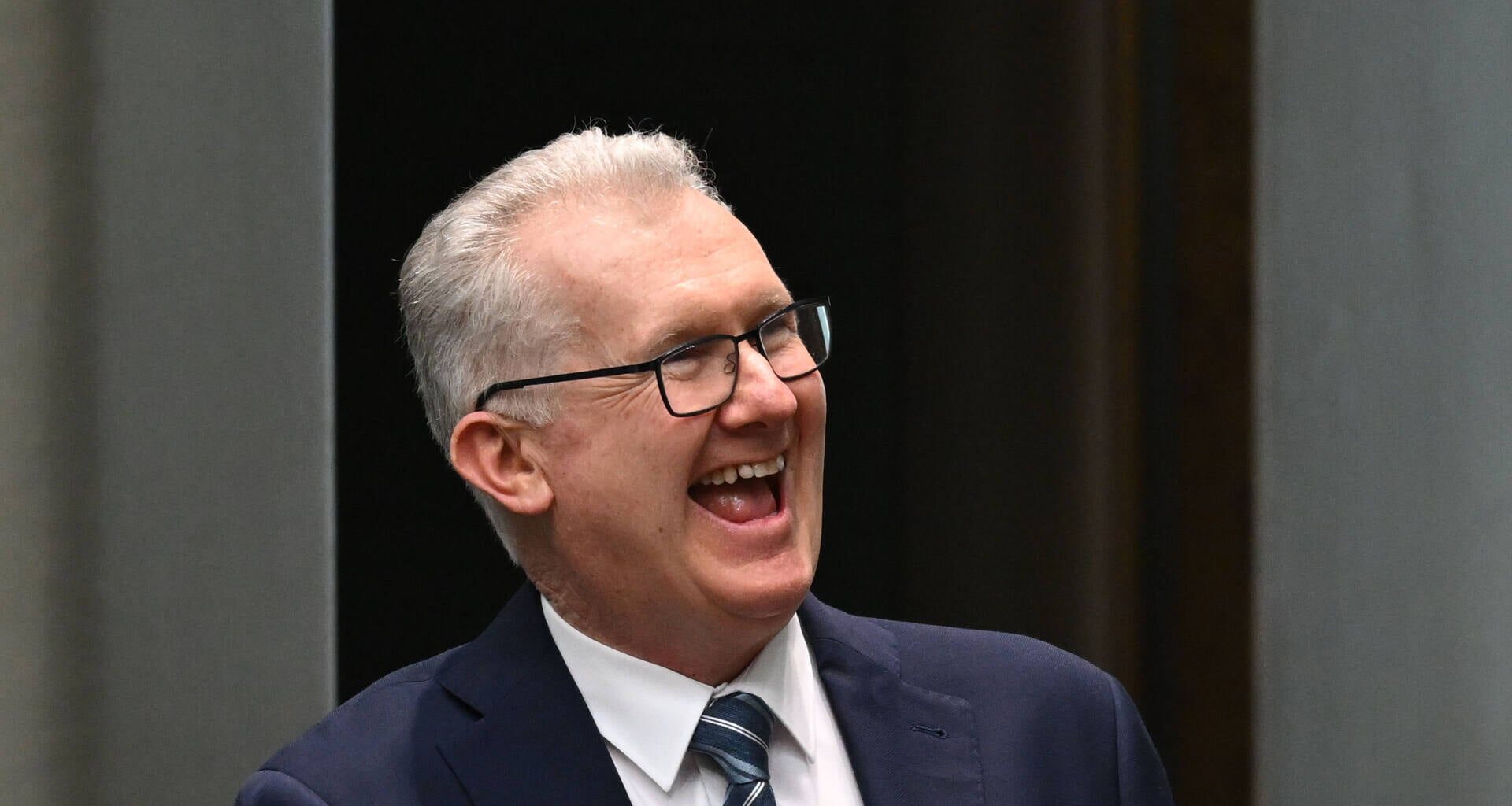
“Multicultural Australia and modern Australia are the exact same thing,” Tony Burke says to Neos Kosmos. That is the argument at the heart of the Government’s position on multiculturalism. As Minister for Home Affairs, Immigration and Citizenship, the Arts and Cyber Security, Burke sits at the centre of some of the most urgent questions facing Australia: the fraying of social cohesion, the rise of the political right, the aftermath of the antisemitic Bondi terror attack, the Royal Commission into Antisemitism and Social Cohesion, and the rise of an extreme left whose politics can also challenge national unity.
A framework for the Australia we have become
Together, these pressures have placed multiculturalism, and the idea of a shared Australian identity, under renewed strain. Burke carries the weighty responsibility of confronting those tensions as Australia debates what kind of country it wants to be. The policy question was examined through the Government’s 2024 Multicultural Framework Review, led by Hass Dellal AO.
The hope is that Australia might once again define multiculturalism not as a program for minorities, nor as a space for competing identities, nor as a bureaucratic category, but as a national framework for a country transformed by migration
The hard right, represented by One Nation, presents multiculturalism as a failed experiment. On the left, the idea has become colonised by competing identities and grievances, leaving the original migrant communities that built multicultural Australia feeling sidelined. The political centre, meanwhile, has become increasingly uncertain about how to defend multiculturalism, or even how to define it.
The Dellal review confronted a question larger than the administration of multicultural programs: can multiculturalism once again become a unifying national project? Can it provide a civic framework in which people retain their language, culture, faith, and history while fully participating in a shared Australian democracy?
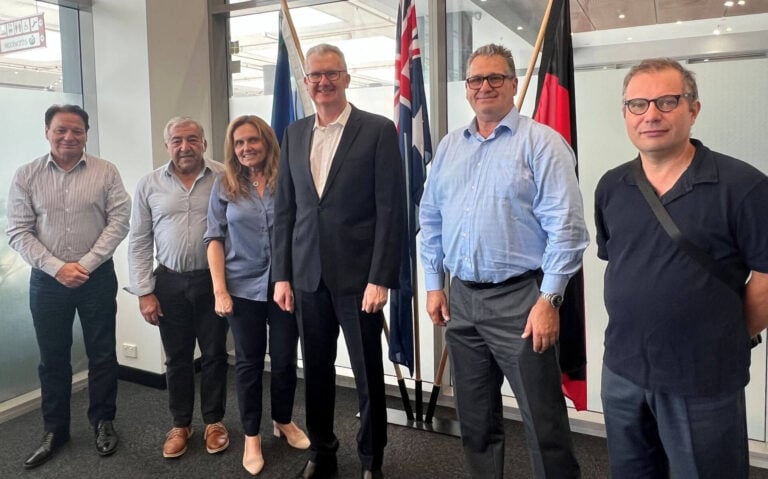 Minister Tony Burke with members of the Greek Orthodox Community of NSW. Photo: Social Media
Burke believes it can, though he is cautious about grand announcements.
“We’re still working things through,” he said in response to the Review.
“I’m coming to the view that it’s not a single big announcement. The biggest thing is that we start to integrate multiculturalism into everything,” Burke said.
Multiculturalism needs to become, in the minister’s view, a principle applied across government: immigration, citizenship, education, the arts, employment, national security and the public service. The question is whether the Government will take on the recommendations of the Review and give that principle enough definition to become meaningful.
Burke points to citizenship ceremonies as one example of where that national idea can be made tangible.
“My view is that we need to be unequivocal: people making a lifelong commitment to Australia is a patriotic moment. We should celebrate it. It should be above politics. Everyone should be invited. It should be a joyous, great moment for the country.”
Loving Australia as it is
Burke believes multiculturalism needs to be connected to national belonging. It must be confident enough to say that the Australia created by migration is not a lesser version of the nation. He sees
“I think it is really important, and I’ve tried to make sure I do this in all the language I use—that we should never be hesitant to say we love Australia,” Burke said.
“We should always talk about loving Australia. But we should also talk about loving Australia as it is, and as it has always been—not some pretend version of Australia that never actually existed.”
“Multicultural Australia and modern Australia are the same thing.”
The minister’s electorate of Watson is itself a real demonstration of the proposition.
The electorate is a palimpsest of multicultural Australia. Seven in 10 residents have two parents born overseas. Lebanese, Chinese, Greek, Vietnamese, Bangladeshi and Indian Australians live alongside one another in an electorate that is a map of modern Australia.
It is also a frontline in the battle over what that Australia means.
The nation is more diverse, globally connected and more exposed to international conflicts than at any previous point in the history of multicultural policy. The children and grandchildren of post-war migrants — Greeks, Italians, Serbians, North Macedonians and others — are part of the mainstream. New communities have arrived from Asia, Africa and the Middle East.
Global conflicts are being imported through social media, while economic anxiety, housing pressures, stagnant wages and distrust of institutions provide fertile ground for populism.
For Greek Australians, multiculturalism was never a theory. It was a deal. You could arrive from Greece with little English, work hard, open a café or a shop, build a church, join a football club, send your children to university — and become Australian without having to stop being Greek.
The Greek Orthodox Church, the Greek language, the community newspaper, the festival and the football club were not evidence of failed integration. They were the infrastructure through which integration happened.
Burke puts the argument in personal terms.
“It’s not,” he says, when I suggest that multicultural Australia is sometimes treated as a subset of the nation.
“Multicultural Australia is who we are. My Irish heritage and your Greek heritage are part of multicultural Australia.”
It is a deceptively simple proposition, which is also increasingly contested.
“One of the things I think happened over the last 20 years was that we started to drift into multiculturalism being viewed as a subset, rather than as a definition of the whole country. If we reclaim that, we’re back on strong ground.”
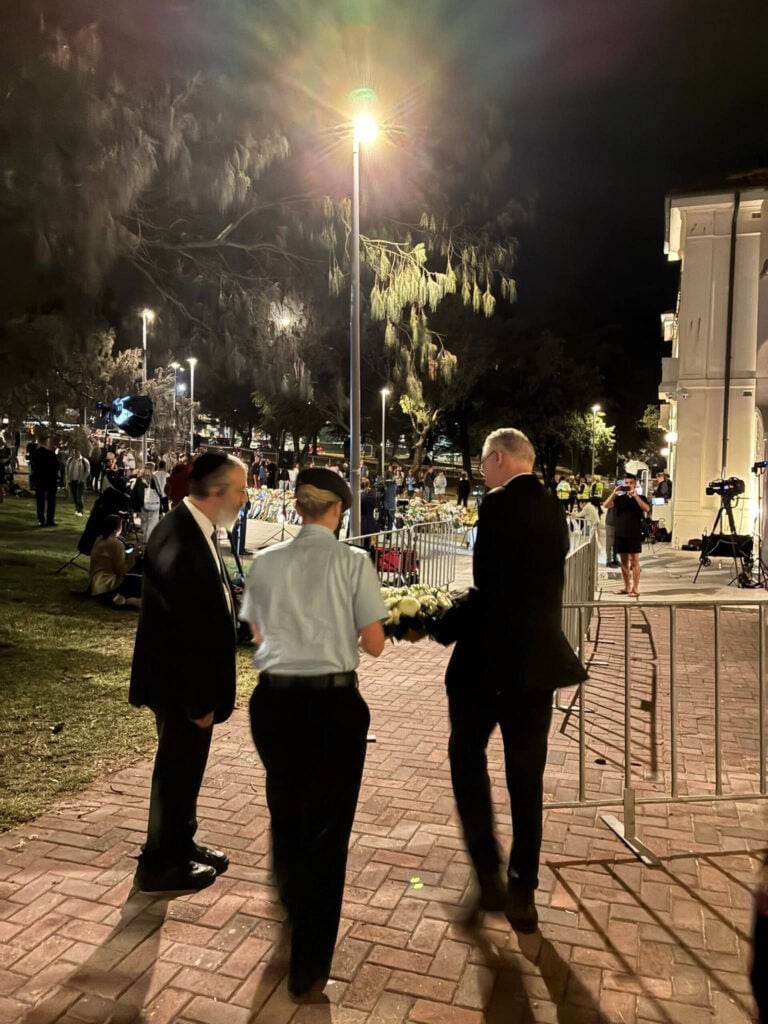 Minister Tony Burke laying a wreath for the victims of Australia’s worst terrorist attack when two Islamic State-influenced Australians murdered 15 Jewish Australians at the 2025 Hanukkah celebrations in Bondi Beach. Photo: Social Media
The migrant communities that built multicultural Australia
The post-war Greek migrant arrived as a person: a young man from a village or city; a woman who had left family behind; a worker with limited English; someone who might spend years in a factory, restaurant, shop or small business before buying a house and sending children to university. They built institutions because they needed them. Then those institutions became part of Australia. That process is in danger of being forgotten.
Some of these older migrant communities, Greeks, Italians and others, feel left out of contemporary narratives about identity, even though they were among the original champions and architects of Australian multiculturalism. They can find themselves described simply as “white” or “privileged”, while watching a political language of identity develop that no longer seems to include their history or experience.
Any new approach by government will have to confront that political reality.
“My view is that we need to be unequivocal: people making a lifelong commitment to Australia is a patriotic moment. We should celebrate it. It should be above politics. Everyone should be invited. It should be a joyous, great moment for the country.” Tony Burke, Home Affairs Minister
Multiculturalism needs to reinclude the migrant communities that built it, the newer communities that have joined them and the generations born in Australia, who increasingly experience their heritage as part of a complex Australian identity rather than as a separate ethnic category.
One Nation leader Pauline Hanson has travelled overseas to meet neo-fascist figures, flirted with notions of mass deportations (which she has since walked back) and lamented the end of the ‘White Australia policy’. On the extreme left, the Israel-Hamas war has become a vehicle for a politics of rage that has contributed to an unprecedented wave of antisemitism in Australia.
The challenge became a horrific reality on December 14, 2025, when an antisemitic, Islamic State-inspired terrorist attack targeted a Hanukkah celebration at Bondi Beach. Fifteen people were killed.
The attack was not an argument against multiculturalism. But it was a reminder that multiculturalism cannot survive on good intentions alone; it needs policy, money and energy. For Burke, the damage to social cohesion caused by the conflict in Gaza has been experienced in countries around the world.
“When we talk about Bondi, we’re talking about the most horrific antisemitic terrorist attack and the horror of that happening on our own shores,” Burke says.
“The Royal Commission is looking into the two individuals and the specific circumstances. As Minister for Home Affairs, I’m fully briefed, including on material that is classified,” he adds
“The concept of blaming people here for what is happening there is completely unacceptable.”
And when the temperature rises, the possibility of violence rises with it, he says.
“Whenever the temperature is high, it becomes more likely that there will be a violent act.”
Reclaiming the flag
Burke says multiculturalism must reclaim the national symbols of belonging. He is keen to “celebrate who we are as a country”.
“The moment you fall into that trap, you effectively give the angriest voices access to our national symbols. It stops me in my tracks when I see an anti-immigration rally wrapping itself in the Australian flag. I think, ‘No. The flag, the anthem and our national symbols belong to all of us.’”
He adds that One Nation’s views are “un-Australian”.
“We’ve got to be careful because most Australians are in the middle, just wanting to get along with each other. You’ve got to be careful not to mistake volume for numbers—the angry, shouting person who doesn’t represent the rest of the country.”
For Burke, patriotism is not the enemy of multiculturalism. It is part of its future.
Burke says a multicultural society requires three things.
“You need the big events where we all celebrate everything together. They might be sporting events, big festivals or whatever they are.”
The flag, the anthem and our national symbols belong to all of us.” Tony Burke, Home Affairs Minister
“You then need places where people can celebrate and preserve their heritage and the story that brought them to Australia. We need to celebrate that.”
“The third bit, which I don’t think we do well enough yet, is the sharing of backgrounds and heritage, making sure we have a better understanding of each other so those traditions aren’t something that lives in a silo but can fully enrich Australia.”
“People are pretty good at talking about that when it comes to food, but it starts to thin out beyond food.”
Every city and town in Australia has ethnic festivals and cultural events that contribute to tourism, the services economy and local identity.
Creative Australia has often failed to recognise this broader cultural ecology. So, as Arts Minister, does Burke believe Australia needs to rethink its cultural institutions — perhaps even consider a larger, more comprehensive institution, something akin to the Smithsonian Institution, that could reflect the full breadth of Australian cultures and histories? More broadly, if Australia can celebrate Puccini, why are Italian communities not more fully part of the cultural conversation?
That’s true,” Burke said, “but when you talk of Creative Australia as an organisation it would never have the capacity to get across all that” He then shifted to the National Maritime Museum’s immigration wall, where the names of migrants are added in ceremonies attended by their families.
“The National Maritime Museum now has an immigration wall. Every month, when they add names to the wall of people who immigrated from overseas, they have a big ceremony, and family members tell those stories.”
“I got the shock of my life when I went to one of these a few months ago. I had no idea that one of the women whose name was being added—she came from Germany—had studied at teachers’ college at what is now Western Sydney University with my mum.”
“I was so excited to see her. I hadn’t seen her and her husband, Leon, since I was a kid.”
“Those names going on the wall at the Maritime Museum are being recorded forever. Why are they there? Because the fact that they migrated to Australia means they are a building block in this country.”
“The decision to come here is a significant enough gift to Australia—to give your future to the country—that it warrants being part of an official national memorial. I think that’s really powerful.”
Burke also points to Melbourne’s The Cat Empire whose music draws on multiple cultural traditions.
“What I do want them to do is support things like Melbourne’s The Cat Empire, which has so many cultural influences in its music. They’re creating something new using all those different ethnic backgrounds and musical traditions, creating something that probably couldn’t be created in any other country in the world.”
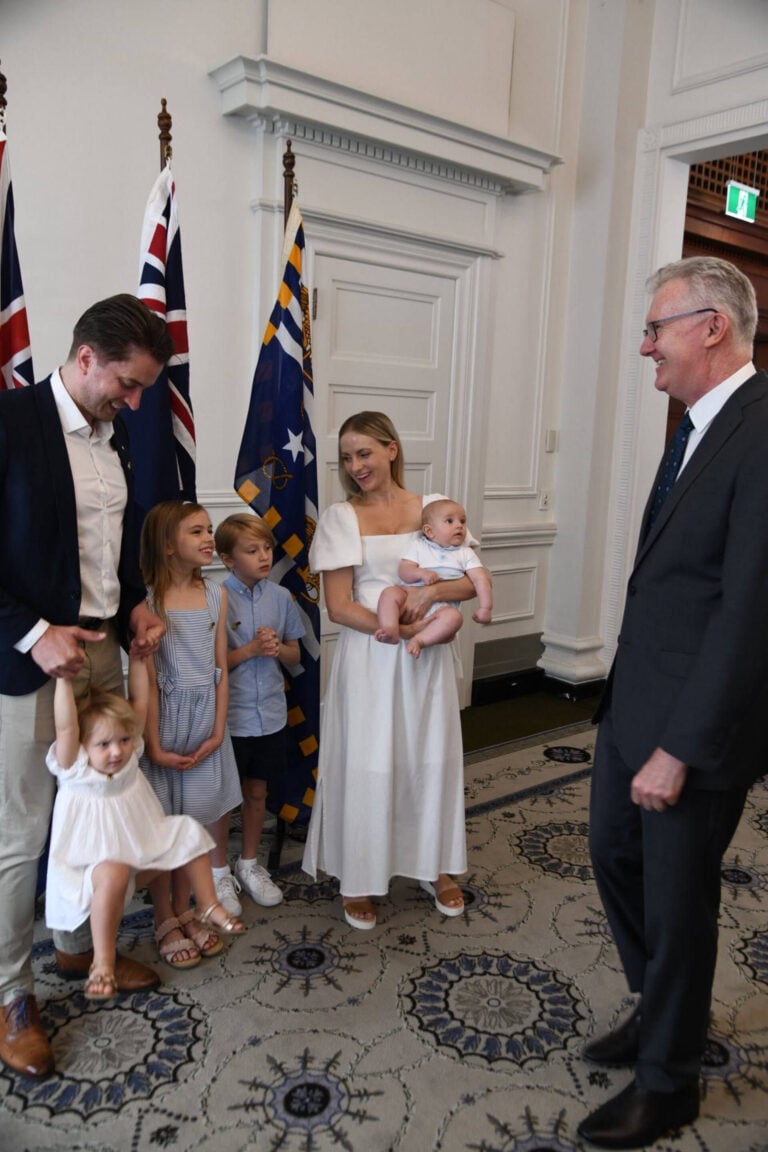 Tony Burke is doing what he loves most: welcoming new citizens into Australia. Photo: Social Media
From managing difference to building belonging
Multiculturalism is at its best for Burke when cultures meet, change and create something new.
But how does multiculturalism respond when overseas conflicts become domestic political conflicts? How does it protect Jewish and Muslim Australians from being held responsible for the actions of foreign governments or terrorist organisations?
How does it ensure that established migrant communities do not feel their contribution has been forgotten? How does it prevent young Australians from being recruited into a politics of racial resentment or religious extremism? And how does it make the case that patriotism belongs equally to the descendants of migrants?
These are central questions of multicultural Australia.
Burke answers that multiculturalism must once again become part of the national mainstream. Not something done for communities but by the whole country.
The 2024 Multicultural Framework Review provides the Government with an opportunity to define that promise for a new generation. Once, it was possible to be conservative and multicultural. Multiculturalism was not a left-wing possession. It was a national settlement.
Burke says he is trying to leave space for the Opposition to return to that common ground.
“I’m trying to make sure they’ve got space to walk back.”
There is no immediate political advantage for him in doing so.
“But your first job in jobs like mine isn’t political advantage. It’s the country.”
That may be the most important thing Burke says.
Because the argument over multiculturalism has become too political to be useful.
The right wants to turn it into a synonym for uncontrolled migration.
The left risks turning it into a language of endless identity and grievance.
The centre has become too nervous to explain what it believes.
Yet the country has already answered the question. Australia is multicultural. The children of migrants became teachers, doctors, lawyers, academics, politicians and business leaders. And, in our case, we did not cease to be Greek. The hyphen in Greek-Australian does not divide the nation.
The multiculturalism of Fraser, Hawke, Keating and Howard understood something that has since become difficult to say. People can retain their histories without refusing a common future. They can love where they came from and love Australia.
Burke dismisses Pauline Hanson’s notion of “monoculturalism” as “nonsense”.
“The reality of modern Australia is that it is and has always been multicultural. And we should never be hesitant to say we love Australia,” Burke says.
As Burke puts it, “Multicultural Australia is who we are.”