
From blind sessions to walking tennis, an award-winning tennis club is breaking down barriers and helping more people get on court.
In one week at Highgate Cricket & Lawn Tennis Club, I played tennis but only walked, watched people play without seeing the ball and met a group of juniors, who all had different needs but learned together.
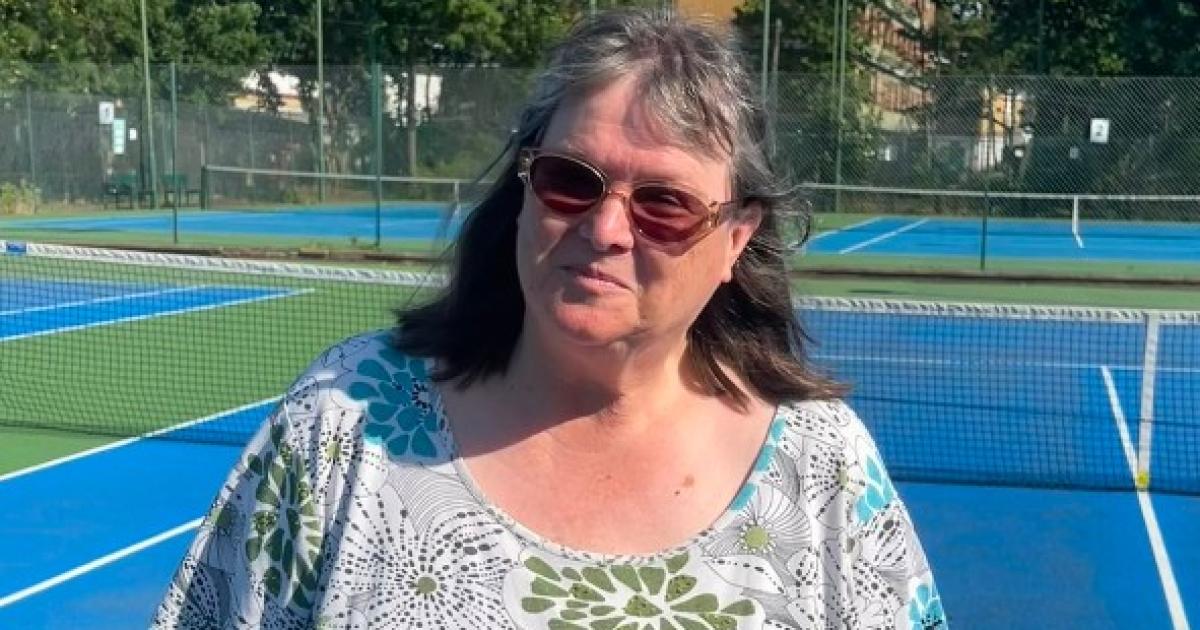
“It’s a proper part of the club,” Linda Almond, Highgate Tennis inclusion co-ordinator, says when I meet her at the club in Shepherds Cot/Crouch End.
She tells me it all started in 2010 when she spotted a notice about a blind tennis tournament at the National Tennis Centre.
She offered to help and the year after, they moved the national tournament to the Islington Tennis Centre.
From there, the club expanded its inclusive programme and was recently recognised with the John James Disability Award.
“Tennis should be everywhere for everybody,” Linda says.
Ready? Yes. Play.
My first session of the week takes me to Islington Tennis Centre, where Highgate Tennis provides volunteers for Metro Blind Sport’s weekly sessions.
When I step on the courts, the volunteers are measuring the court and putting down tactile lines fixed with double tape.
I’m told the players use their feet to find their way around the court and sound balls to know where the ball is.
Linda tells me: “It used to be just me and a coach, but now we try and get a volunteer for every player.”
I keep hearing ‘Ready? Yes. Play’ – I realise that’s how the server tells the returner the next point is starting.
Linda recalls one woman who started losing her sight and hadn’t left the house.
“Her son brought her to tennis, and she burst into tears halfway through, and I thought she was upset.
“But it was because she was so happy,” she says.
Eros Adamides, who travels over an hour to the sessions, struggles to find a closer venue where he can play.
“No one really knows much about how blind tennis works or if they can coach it,” he tells me.
No running allowed
When I walk up to the courts for my next session, at first glance it looks just like a normal doubles match.
Upon closer inspection, however, I notice the ball bounces twice and the players are not running – in fact, they are not allowed to.
It’s called ‘walking tennis’.
Linda tells me it was started because they saw members in their 70s leaving the club.
She says: “The population is changing, so London is going to be a lot more over 55, 65 coming up, and a lot less youngsters.
“So, clubs need to think about their provision.”
The sessions attract older adults as well as players returning from injury.
I join in and quickly realise it’s harder than it sounds; you need to anticipate whether the second bounce would go out.
Afterwards, I speak to Tricia Peel, 79, who tells me: “It’s one of the highlights of my week.
“I live on my own now so it’s easy to spend too much time alone.”
Another player, Colin Parker, 81, had a hip replacement so he hadn’t played tennis in four years.
“I had sort of given up hoping to play tennis again.”
He smiles at me: “I have dreams now of playing proper tennis again.”
Open to all
I arrive at the junior inclusive session and notice the engagement of the two coaches – taking their time with each player, making sure everyone is involved.
For U10s, the parents are part of the session.
Between high fives and encouraging words, they also guide the kids around the court.
The Saturday lessons are open to anyone but are targeted at young people with additional needs and/or disabilities.
Linda tells me: “They come from all over.
“And quite a few come from different clubs who don’t provide anything.”
James, 18, has been coming to the Saturday sessions since he was seven.
His mum, Rachel Aldighieri, says the sessions are about more than the social side – they help James build confidence.
“That’s something that to James doesn’t happen that often – that he has something that he actually feels like he’s good at.”
She says: “The challenge is that there’s so little on your doorstep to do that.
“So, when you find something like this, it’s like a real gem.”
Opportunities remain limited
While clubs like Highgate Tennis are expanding their inclusive offering, opportunities remain limited.
Disabled people are about 30 per cent less likely to feel that they have the opportunity to be as active as they would like, Activity Alliance found.
Martin Etheridge from Middlesex Tennis tells me that only 29 of the 120 tennis clubs across north/west London they support, deliver any inclusive activity.
And of those, only four deliver two or more inclusion strands – one of them is Highgate Tennis Club.
Andrew Lewandowski from Middlesex Tennis says: “Clubs such as Highgate, who’ve been involved in offering inclusive and disability tennis now for many, many years, really are the role models of what can be achieved.”
“I think the barriers are really about education and a fear of not putting on something that they think is going to be good enough because they’re not experienced in it,” he adds.
‘A proper part of the club’
Highgate Tennis also offers disability or low-income discounts which for head coach Jaidyn Murry, is important.
He grew up playing at Highgate and says he was only able to get this far in his career because of reduced fees.
“I think everyone should have the opportunity to come to this club and love the sport the same way that I did,” he tells me.
The club is offering its first fully inclusive holiday junior camp this month – open to all.
Linda, who has been lobbying for more inclusive sessions since 2011, tells me her vision has now become reality.
“I can retire now and just leave them all to it, and, if a coach can’t do a Saturday session, it’s up to Jaidyn to find somebody else, because it’s a proper part of the club.
“That was my vision, really.
“So that’s been achieved.”