
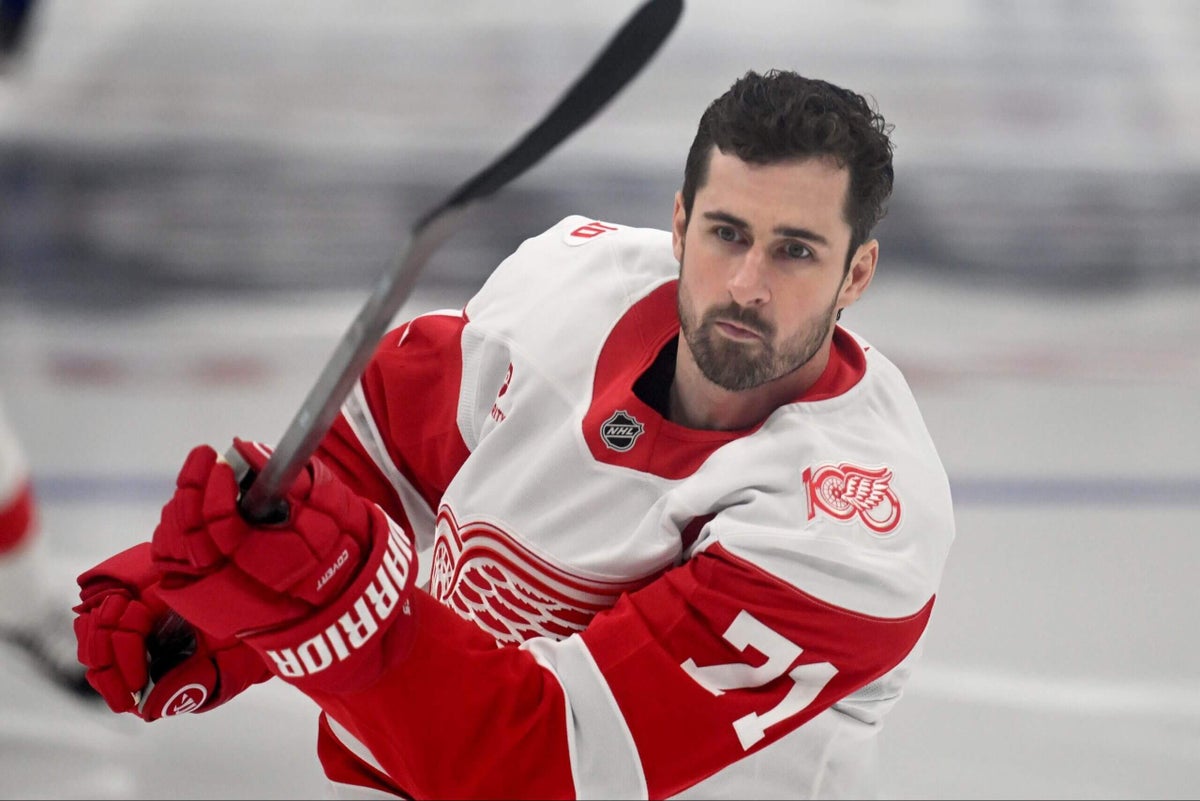
Before the surprise had worn off from last week’s news that Steve Yzerman is out as Detroit Red Wings general manager, one of the key next dominoes quickly rose to the surface: what does this all mean for Dylan Larkin’s trade request?
It has been nearly seven weeks since the Red Wings captain’s request got out and changed everything for the organization. And while we have yet to hear from Yzerman or ownership on the decision to transition him from general manager to a senior adviser serving governor and CEO Chris Ilitch, it’s easy to draw a line between the two major storylines of Detroit’s offseason.
Larkin and Yzerman had clashed, including at times publicly, and the mere fact a hometown captain wanted out speaks to the state of the franchise — stuck, stagnant and perhaps in need of a reset.
With Yzerman out, the immediate next question was whether Larkin might now reconsider his request. And it makes sense: while the Red Wings’ 10-year playoff drought (all of which Larkin has endured) was surely a key motivating factor as well, a change at the top at least offers the possibility for a fresh path forward.
Did the Panthers and Lightning fleece the Leafs?
Sean McIndoe and Jonas Siegel
But for now, without knowing who the next head of hockey operations will be, it’s still too early — and too hypothetical — to say for sure. And that’s just the first of a long list of reasons a reconciliation would be complicated.
Start with the fans, because the reaction to Larkin’s request within the market has been highly charged. And it goes beyond the obvious rejection of a long-tenured player wanting out.
Larkin was the centerpiece of the Red Wings’ rebuild when Yzerman arrived, the one true top-of-the-lineup piece he inherited. And for the early years of that rebuild, it was clear what the Red Wings were in for: a lot of losing, no matter what any one player did out there.
In that time, Larkin came into his own, becoming an underrated player league-wide, whose point totals didn’t match his overall value as a competitive, all-situations center. As he reached his prime, he hovered around a point-per-game offensively, and consistently took on tough matchups.
But as the team’s captain, he was also the one trotted out to answer for a lot of losses. He was a rare common thread across three coaching regimes. And by the final years of Yzerman’s tenure, as the team started to seriously compete for the playoffs with a stronger supporting cast around Larkin — led by Moritz Seider, Lucas Raymond and Alex DeBrincat — Larkin came under more scrutiny individually.
When he called out Yzerman a year ago for inaction at the 2025 trade deadline, even Yzerman seemed to turn it back around at his captain, noting that the Montreal Canadiens and St. Louis Blues had made the playoffs without splashy deadline additions that season, “led by their best players.”
This past season, his underwhelming five-on-five production became a hot topic, and a fair one. His leadership came under fire from fans and talk radio during the team’s latest March collapse, although Larkin was injured for much of that in 2026, and scored more than a point per game after returning.
Still, when Larkin’s request got out, many saw it through the lens of those same leadership questions, as a captain abandoning his team. Fair or not, for a player who stuck around through the full bottom-out rebuild for his entire 20s, that’s a hard sentiment to come back from. Maybe an impossible one. Boos on home ice on opening night would seem like an inevitability.
In terms of Larkin’s teammates, NHL players tend to back each other, and given all the losing and Yzerman’s grinding management style, it’s not a stretch to think some would understand and perhaps sympathize with Larkin’s situation. But it’s another level to walk back a request like this and return to a locker room as the team’s captain.
The saying that “winning fixes everything” may apply here, but that would assume the Red Wings are actually positioned to win. They missed the playoffs last season, for a 10th straight year, and have seen division powerhouse Florida get healthy and reload, the Toronto Maple Leafs make some aggressive moves to improve, and other Eastern Conference foes such as Washington do the same.
Meanwhile, the Red Wings made some targeted additions in Viktor Arvidsson and Keegan Kolesar, but appear to be losing veteran scorers Patrick Kane and James van Riemsdyk. They look like they’ll mainly be relying on internal improvement to compete for a wild-card spot.
In other words, even if Larkin does stay, it’s entirely possible the Red Wings are looking at another year outside the playoffs. Is that worth all the boos?
From the Red Wings’ standpoint, it may well be. Larkin is a No. 1 center, and it’s likely they’ll “lose” any trade for him. That’s what tends to happen when you’re giving up the best player in a deal. Even if they miss the playoffs again, having him would mean a chance to compete.
But only Larkin can answer that question for himself, and the premise also assumes that’s what the Red Wings’ next general manager wants — which is not a given.
The Red Wings have Seider, Raymond and DeBrincat in their primes, and Simon Edvinsson, Marco Kasper and Emmitt Finnie all getting set to enter theirs. They also have a wave of young players on the way. For that reason, a new general manager doesn’t need to blow it all up.
But a short-term re-tool for the next year (or maybe two) feels like an entirely real possibility for the Red Wings. In fact, it may be the smartest approach, painful as it may be for a franchise with the league’s longest active playoff drought.
If that’s the case, consider this alternative impact of a new general manager: even if it doesn’t convince Larkin to stay, a new voice in charge has the potential to change the outlook on this trade standoff by turning down the temperature. Whereas Yzerman appeared to take a hard line in such talks, even implying he may not honor Larkin’s request, a new manager could come in and strike a more constructive, collaborative tone to get a deal done.
Would that get Larkin to expand his trade list to open up more destinations? Would it bring a new perspective to existing talks, making a futures deal — which would have been a hard sell for a general manager seven years in — easier to pull off? It’s not hard to imagine.
Right now, without knowing who that new manager will be, imagine is the operative word. It’s simply too soon to say.
But while the specific impact on Larkin’s future remains to be seen, the change in leadership absolutely opens up new possibilities — and opportunities — in how the Red Wings resolve this tricky situation.