
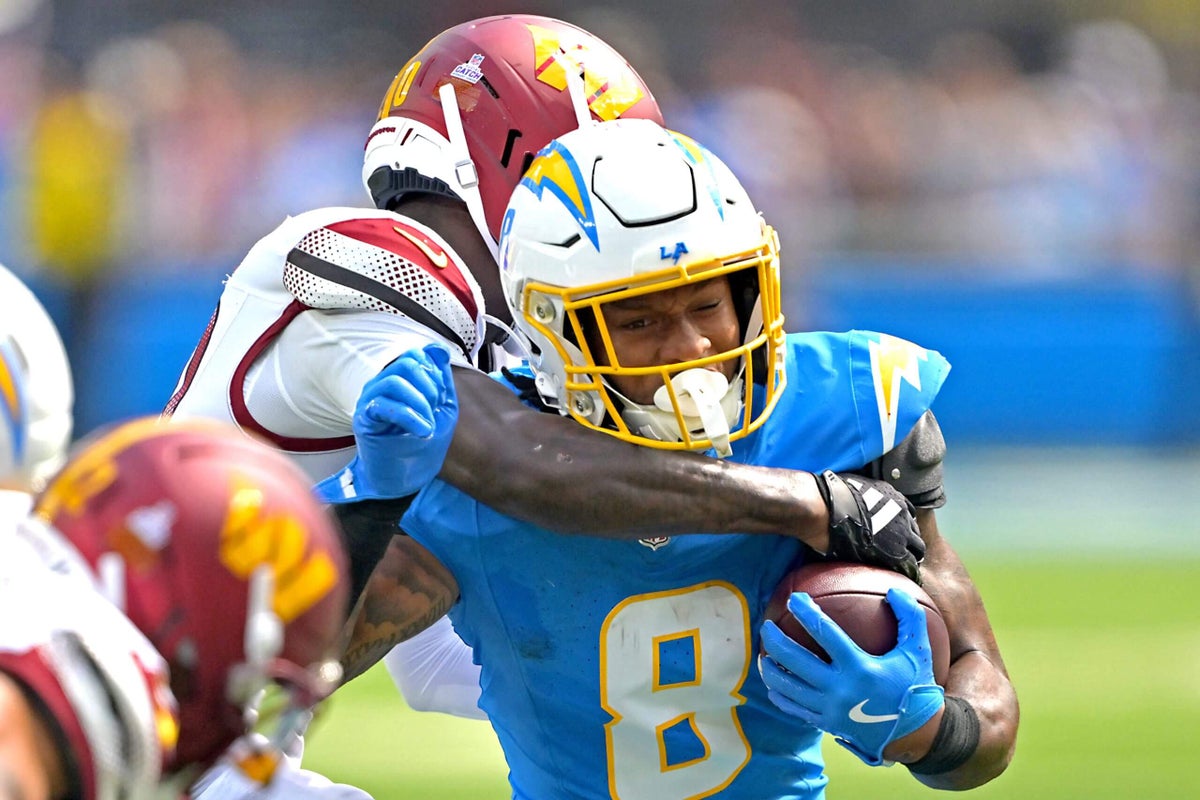
Omarion Hampton, coming off a rookie season in which he missed eight games and averaged 3.7 yards per carry when not facing the New York Giants, is being drafted as the overall RB8.
We love this guy. He might be a steal at his second-round average draft position (ADP), too. It can’t be ruled out. More bizarre things have happened in the NFL.
In fact, it’s not difficult to imagine a world in which the Los Angeles Chargers offense is an absolute Death Star, one of the right answers in fantasy football. Let’s remember that Justin Herbert received early MVP buzz last year before his offensive line crumbled. We should be open to the possibility that Rashawn Slater and Joe Alt might both remain healthy and upright in 2026, anchoring an impenetrable wall behind which Herbert and Hampton will thrive.
However, it’s also not difficult to imagine a world in which the Chargers are once again a pretty good 10-or-11-win team with a middle-of-the-pack offense that can’t quite reach the divisional round. Coming up short in unfun ways has become this franchise’s identity.
If the Chargers stay on brand in 2026 — never quite achieving Death Star status on offense — Hampton will have a difficult time delivering on his ADP and preseason rank. Look at where (and around whom) he’s being drafted in NFFC leagues these days:
James Cook, RB6, ADP 11.6
De’Von Achane, RB7, ADP 13.6
Omarion Hampton, RB8, ADP 14.7
Chase Brown, RB9, ADP 15.9
Saquon Barkley, RB10, ADP 18.1
Kenneth Walker III, RB11, ADP 20.0
One of those players is very much not like the others. Hampton’s ADP seems aspirational if not wildly reckless. We are drafting him squarely in the middle of a group of backs who range in age from 24 (Achane) to 29 (Barkley), each of whom has produced multiple high-value fantasy seasons. Four of those five backs are attached to healthy offensive environments, and the fifth (Achane again) has demonstrated an ability to thrive in an unhealthy ecosystem.
Hampton appears to be valued closer to his ceiling, with no consideration of floor. Drafting him with the expectation that he should outproduce Barkley, Brown, Walker, Derrick Henry and Kyren Williams is … um … aggressive. This situation has the strongest possible Ryan Mathews vibes.
(If you did not personally fight the Mathews wars, ask an elder.)
To support my not-totally-enthusiastic opinion of Hampton (he’s my RB15), I will give you an abridged version after watching last season’s 156 touches. Let’s stack a few positives right at the top:
This is a power back who, to his credit, understands very well that he is a power back. When he wins, it’s often with brute force. He will embarrass any smallish defender. If you give him a free run through the line of scrimmage, someone will pay a price. Hampton commonly gains an additional 2-3 yards while being tackled. It’s possible he enjoys contact too much.
Unlike many other bulldozing runners, he’s a smooth receiver with reliable hands. This much should be evident just from the box scores, because he caught 32 of 35 targets. Again, it’s a dimension we don’t see from every thumping 220-pound back. In a healthy season, he can catch 50-plus passes.
When Hampton is forced to change direction, things can get messy. It’s like watching a barge change its course on the water. If he’s inconvenienced behind the line of scrimmage, the play is often dead. He’s not one of those rare power backs who can teleport themselves away from trouble in a blink, like vintage Josh Jacobs. And hey, that’s just fine. Not everyone is a marvel among marvels.
I don’t think he’s unusually inventive or adaptive, which won’t matter if this year’s offensive line is consistently bullying opposing defenses. Maybe the designs of new offensive coordinator Mike McDaniel will solve this problem, if it’s a problem at all. Maybe the Chargers will be an irresistible force.
Hampton has clearly demonstrated that he can crush a favorable matchup, as he did against that hilariously poor New York defense in Week 4 last season. He carried the ball a dozen times against the Giants for 128 yards, leaving a trail of broken, shamed men in his wake. It was awesome. Everyone loves a run like this:
Omarion Hampton could not be tackled 😤
LACvsNYG on CBS/Paramount+https://t.co/HkKw7uXnxV pic.twitter.com/tQLrvATbGU
— NFL (@NFL) September 28, 2025
While that single-game performance against a dreadful opponent is doing a lot of the heavy lifting in Hampton’s full-season rookie stats, we also shouldn’t dismiss it entirely. We want our second-round running backs to terrorize the worst defenses on their schedules. If he’d faceplanted against New York, it would have been a red flag.
Overall, I can’t describe Hampton as a big play waiting to happen so much as a pretty solid play waiting to happen. A respectable play. He’s hitting plenty of singles and doubles. He’s drawing walks. (Not intended as derogatory but also not fully a compliment.) However, Hampton has not yet displayed the sort of field-flipping, game-swinging potential of the five or six running backs who are taken immediately after him in early drafts.
Also, I’m not willing to assume Hampton is headed for an every-down featured workload — not after the Chargers added Keaton Mitchell to the backfield at the urgent behest of McDaniel. Mitchell is an undersized blur of a runner (5-foot-8, 190), a man who had the highest average speed of any NFL back last season. He’s built to deliver big plays in a McDaniel offense. In our imagined scenario in which the Chargers are an unstoppable fantasy machine in 2026, Mitchell will be cartoonishly good. We will flex him each week, no question. He likely wouldn’t play more than 20% of the snaps, given his dimensions and medical history, but he’d be a nightmare to defend and a joy to roster in fantasy.
Hampton can obviously coexist with another back or two, because that’s life in the modern NFL. Almost everyone does it. One must account for the presence of Mitchell and Kimani Vidal when setting expectations for Hampton, a run-to-contact player who perhaps should not be asked to handle old-school LaDainian Tomlinson/Natrone Means-style volume.
Ultimately, if consensus is correct on Hampton, and he’s an easy top-10 back, then my fantasy season could be pre-wrecked. I’ll be the ghost team rattling around the draft room, not knowing it’s dead. Five months from now, when it’s Championship Week and Hampton is scoring the 18th, 19th and 20th touchdowns of his magnificent second season as the Chargers clinch home-field advantage, feel free to resurface this article in my mentions. I’ll have earned it.
Until then, you may consider yourself sufficiently warned about the perils of wishcasting in the second round of fantasy drafts.