
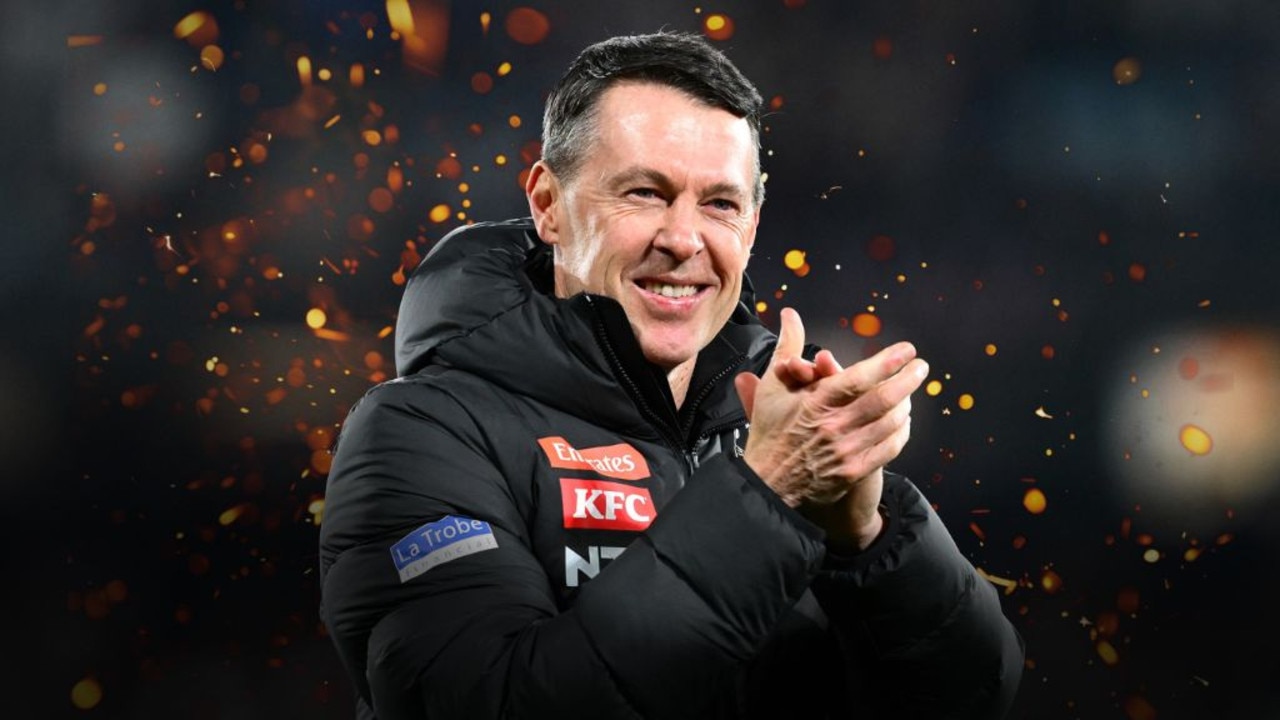
What is behind this stunning turnaround at Collingwood?
To answer that question, the Magpies’ soft draw since their round 14 bye needs to be part of the discussion, as you have to acknowledge they have won their last five games against teams placed 12th and lower on the ladder.
Those were all games the Pies simply had to win to be able to seriously consider themselves a legitimate finals contender.
But the way they have played in those victories has impressed me.
I’ve always felt Collingwood under Craig McRae has played its best footy when the team has been aligned to the mantra of “no time, no space” when the opposition have the ball.
The Magpies at their best have a high collective work rate without the ball, and show an intent to hunt and pressure the opposition ball carrier and tackle with effectiveness and hardness.
That is what I have seen in these five games – opposition players are being forced into hurried decisions with the ball and coughing it up into “Fly’s Trap” – the Pies’ defensive system which is as difficult to penetrate as any team in the competition.
Since round 14, Collingwood has scored 58.8 points per game from turnovers and given up only 37.6 points from turnovers.
That is a strong differential from this all-important scoring source, and shows a great balance in their game at the moment.
The Pies have been able to hurt the opposition when they gain the ball, but are so well organised structurally that when they lose it themselves, they can stop the opposition from scoring.
Brayden Maynard, Billy Frampton, Jeremy Howe, Isaac Quaynor and Dan Houston are all working well within their rolling defensive system, but they can only play their parts strongly if their teammates further afield are applying pressure to the opposition ball-carrier.
And the Pies’ pressure has been elite in their last four wins: a +24 tackle differential against Richmond in round 16, +32 against Gold Coast, +22 against North Melbourne and +19 against Carlton which means they have laid 102 more tackles than their opponent over those games.
It’s the Magpies’ third-best four-week period of tackling on record.
This team attitude has been crucial to underpin the offensive part of their game and helped them gain much needed momentum heading into the pointy end of the season.
The Pies have rediscovered their capacity to win the ball back and score, ranking second in the competition for intercept to score over the last six rounds, fourth for scores per inside 50, and first for successful ball movement chains from defensive 50 to inside 50.
But will that ball movement and efficiency hold up against the Crows tonight, who have been the second-best side this season at defending defensive 50 to forward 50 transition?
How Collingwood handles the ball under intense heat from Adelaide will help us determine whether the current form line is real.
Let’s look at six Magpies who can be sloppy with their ball use at times – Ned Long, Ed Allan, Angus Anderson, Brayden Maynard, Isaac Quaynor and Jack Crisp – and see whether they can make good decisions and execute under fierce opposition pressure.
Because mistakes from those players can fuel the Crows’ turnover game and would also play into the hands of Collingwood’s subsequent opponents in Brisbane, Geelong and Hawthorn.
There’s no doubt the Pies have greatly pleased McRae with their form since the bye, but the coach is a realist, and knows that the genuine test of his team will come over the next few weeks.
Collingwood’s stoppage game remains a vulnerability – the Pies are on track for their worst season on record for total points from clearance.
They sit at the foot of the ladder in that metric, and are also 16th for clearance differential.
It’s on the likes of Darcy Cameron, Nick Daicos, Jordan De Goey and Scott Pendlebury to take responsibility for improving in that crucial part of the ground in the last five games.
Winning the ball at the source is what stands up in finals footy against the best sides.
Collingwood cannot afford to leak from stoppages in finals, when territory is crucial and losing clearances allows the best teams time to set up their defensive systems behind the ball.
HOW TO STOP DAICOS
Collingwood does not necessarily need Nick Daicos firing to win games of football, but opposition sides are risking a lot by not paying him enough attention.
If you are saying he is “untaggable” or not damaging enough to clamp down on, you are doing that at your own peril.
He reads the play so well, races from contest to contest and not many can match his decision-making and execution by hand and foot when he has the ball in his hands.
If Nick Daicos is waltzing through an open field with no pressure on him, he’ll cut you to shreds.
From Adelaide’s perspective, I would expect Matthew Nicks to use Sam Berry to try to derail his influence at stoppages, and then use someone sacrificially like James Peatling to run with him in general play.
You must try to take away his time and space, and there has to be a specific match-up if he moves forward.
Max Michalanney would be the obvious option to pick up Daicos in Collingwood’s forward line, but communication is paramount to ensure there is a clean handover so he cannot use the move to gain a tactical advantage.
If you’re responsible for Daicos in the midfield, you must stand the mark when the Pies magician takes kick-ins.
So often, he kicks to a teammate and takes off at full speed to receive the handball and kick again.
It creates a 100m play in an instant, and his opponent must be able to react immediately off the mark to check his run and stop him being used again.
Daicos has been the No. 1 ranked player in the competition since round 13.
The Crows must try to take away from his 500m gained and his six clearances, which would go along way to exploiting the Pies’ current vulnerability at stoppage – don’t get beaten by what you know!
THE KIDS STANDING UP
After some good exposure over the last six weeks, some of the young Pies look better than perhaps we first thought.
A key example is Ed Allan – McRae has moved him from an outside winger who ran north-south patterns on the ground to now become an inside player, who is almost performing the role that Jack Crisp played for many years when he arrived from Brisbane.
Allan will go to the opposition’s best midfielder, and has been asked to use his strong athleticism to apply fierce defensive intent and blunt their impact.
Tonight I expect we will see him go with Jordan Dawson or Izak Rankine – he’ll find himself on both at various stages because he may hand them over to a defender if and when they rotate forward.
But what I’ve enjoyed on top of Allan’s defensive efforts has been his increased willingness to back himself to be part of offensive chains when Collingwood has the ball.
He’s testing his opponent to see whether they will come with him when he uses his running power to get involved in attack.
Allan is giving the Pies a bit of what James Rowbottom brings to Sydney’s midfield and Josh Dunkley to Brisbane’s – a midfielder who buys-in fully defensively and tests their opponent the other way.
Harvey Harrison has also looked really promising over this five-game stretch. It took him time to win a spot back this season returning from a knee reconstruction, but he has shown a strong capacity to apply defensive pressure and be a forward 50 entry player, who the Pies need more of as Daicos and Jordan De Goey currently supply a combined 20 per cent of the entries.
Charlie West received a fantastic opportunity to take on Carlton without Jacob Weitering and performed really strongly with four contested marks and a goal – we’ll find out more about him against Adelaide’s miserly defensive unit.
And second-round draft pick Sam Swadling has interestingly usurped Roan Steele, who had impressed me so far this season, in a wing role.
Swadling’s running power and temperament has left him looking very comfortable at the level, and the Pies have carefully managed his time on ground to give him a great chance for a sustained run into the future.
Liam Puncher’s timing through the mid-season draft has been impeccable as he’s slotted into a backline trying to cope without Darcy Moore and manage the workload of veteran Jeremy Howe.
It’s fair to say he has been exposed to weaker forward lines during his early stint in the team, but that will change when he meets Riley Thilthorpe and Taylor Walker tonight.
Pat Lipinski has played more than 150 games and is 28 years old, but he has elevated his game this season as a lot of opponents give him far too much time and space.
If you give Lipinski an opportunity to use the footy going inside 50, he’ll generally help create a score, with the Pies retaining 61 per cent of his entry kicks, putting him inside the top-10 in the competition.
It’s no coincidence that Daniel McStay has shot at 75 per cent goal accuracy, the best in the league, since round 10.
McStay is getting nice, easy looks at the scoreboard because of conduits like Lipinski.
He is crucial to this side with his ball-use and decision making when scoring was a huge issue for the Pies in the first half of this season.
WHAT’S NEXT FOR THE PIES’ LIST?
The growing consensus is Brisbane champion Lachie Neale will seek to join Collingwood as a free agent at the year’s end.
Perhaps the length of a deal for the dual Brownlow medallist is worthy of debate, but I absolutely agree with the Pies pursuing Neale – they would be derelict in their duty not to bring in a player of his ilk who wants to join despite him being 33 years old.
With their stoppage profile at its worst in years, it’s a no-brainer to bring in a superb stoppage player to work in tandem with Nick Daicos and address an area of great concern.
Collingwood can certainly be part of the conversation for finals, and even premiership contention, with Neale in the middle if he arrives at the club.
He doesn’t look like he is slowing up, and has shown some serious on-field professionalism and mental grit this year to sustain a high level of performance despite the off-field drama he has been at the centre of.
There are big contract decisions to make on other ageing players at the end of this campaign.
Scott Pendlebury is 38, Jeremy Howe is 36 and Steele Sidebottom 35 years old.
Howe is the one most likely to remain on the list despite being the second oldest player.
With the uncertainty around Darcy Moore’s body and whether the captain can string together games when he returns next year, it makes sense to retain Howe, who has been in superb form this season.
Pendlebury and Sidebottom are universally respected and icons, not only at Collingwood, but also of the game.
If the time comes that Collingwood is no longer in mathematical contention for finals this season, Justin Leppitsch and the list management team have some serious decisions to make.
The Pies have 12 players over 30 on their list, plus the likely inclusion of Neale next year, and with a first-round draft pick coming in, it could be time to move in a new direction and farewell two club greats in the right way.
What a send off that would be …
Jamie Elliott will play on next season but whether he can return to his best after an ACL is also unclear, so this will affect the Pies’ thinking about their forward line.
If they do not land the big fish in Ben King or Mitch Lewis, are they really satisfied with Jack Buller and Charlie West as the successors to McStay (31) and Tim Membrey (32)?
That is where the Pies might need to get creative with their recruiting to address a deficiency in their list.
It’s another area of the ground where they will have a clearer picture after this critical five-game stretch, beginning tonight.