
The 19th AFL club took a major step towards reality on Monday, when former Port Adelaide coach Ken Hinkley was named the Tasmania Devils’ inaugural coach.
While their new Macquarie Point stadium remains a work in progress, the Devils are on track to enter the league in 2028, at which point one team will be forced into a bye each week.
Watch every match of every round of the AFL Premiership Season LIVE and ad-break free during play on FOX FOOTY, available on Kayo Sports | New to Kayo? Join now and get your first month for just $1.

For that, and several other reasons, a 20th team shouldn’t be too far away.
New AFL Commission chair Craig Drummond said last month the league wouldn’t rush into the move, telling AFL Media: “The commission is not considering it, and it is not a conversation at the moment.
“We have a lot to do around getting Tassie settled and also what we need to do in Sydney. The Giants have done a very good job around footy and the footy program and the commercial and corporate side, but there is a lot of work to do around the consumer and the fan in that Giants business.”
The ACT government, an interested party in expansion, also believes there’s no rush from the league to find a home for team 20.
“We maintain a productive relationship with the AFL and will engage in discussions about expansion, when the league decides the time is right to explore future licences,” a government spokesperson told Foxfooty.com.au.
“We do not expect that to be in the near term.”
But, realistically, there’s too much money to be made from adding a 10th game each weekend to ignore the option for long (along with the pleasant simplicity of the even number).
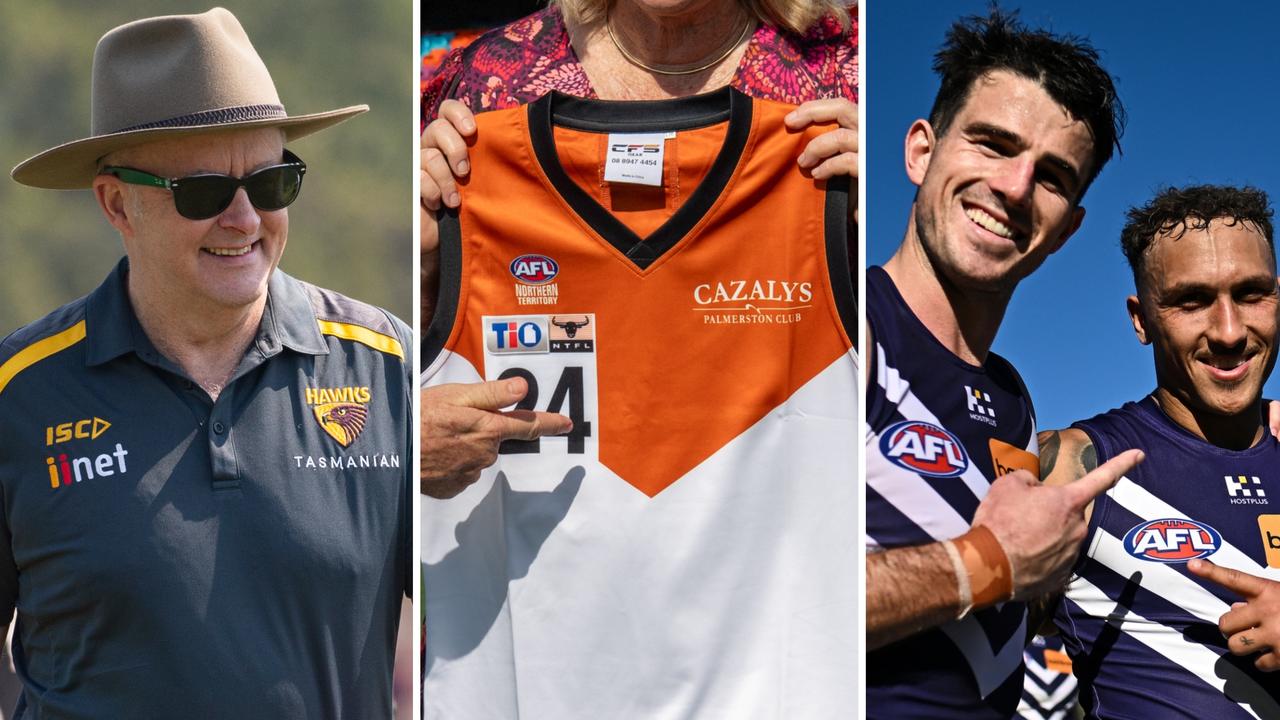
Prime Minister Anthony Albanese weighed into the AFL expansion debate this week.Source: FOX SPORTS
On the day the AFL confirmed Tasmania’s licence, then-CEO Gillon McLachlan said the “most likely” scenario was 20 teams, saying “at some point it will end up with an even number of teams”.
There will be concerns raised about the depth of the talent pool, but that argument doesn’t stack up to deeper analysis.
Australia’s population has expanded massively since we went from 16 to 18 teams, and the success of the mid-season draft shows the best state league players can easily play at AFL level – because the gap between the 300th best player in the AFL, and the theoretical 600th best player, is minimal.
And the NRL certainly hasn’t worried about depth while making its decisions, as the nation’s other winter code is likely to introduce four new teams in less than a decade. The Redcliffe-based Dolphins joined in 2023, with the Perth Bears coming in 2027, then the Papua New Guinea Chiefs in 2028, while a 20th team (potentially a second in New Zealand) is expected to follow.
Below, Foxfooty.com.au analyses the three leading contenders to host the 20th team.
Hinkley speaks on becoming Tassie coach | 06:48
NORTHERN TERRITORY
If you want to complete the national competition, this is the clear No.1 option. It’s the play to the heartstrings, helps the game’s growing problem with Indigenous involvement, and might let the AFL win some hearts and minds for once.
But let’s remember just how small the NT really is, compared to the other leading options and even Tasmania (which was also something of a ‘hearts and minds over pure finances’ play).
Population for AFL expansion markets
Perth (divided by three to represent third team): 795,000
ACT region: 713,000
Tasmania: 576,000
Adelaide (divided by three to represent third team): 490,000
NT: 256,000
Footy participation in AFL expansion markets
Perth (divided by three to represent third team): 42,000
Tasmania: 25,000
Adelaide (divided by three to represent third team): 23,000
ACT region: 18,000
NT: 11,000
Darwin itself is even smaller with the greater region estimated at a population of 160,000 – less than Hobart (233,000), around half of Geelong (314,000) and less than a third of the Canberra-Queanbeyan urban area (521,000).
This matters, not just because you need to draw a crowd to the games, but for the financial support you’re able to draw from the local area. The smaller the base, the more help the AFL will need to provide, and the other clubs already don’t love funding the likes of Gold Coast and GWS.
Jase Burgoyne of the Power runs with the ball during the 2026 AFL Round 10 match between the Gold Coast Suns and Yartapuulti (Port Adelaide Power) at TIO Stadium on May 15, 2026 in Darwin, Australia. (Photo by James Wiltshire/AFL Photos via Getty Images)Source: Getty Images
The numbers really don’t stack up here, but there’s an interesting parallel to be drawn between a top-end team and the NRL’s expansion into Papua New Guinea.
The Chiefs are being funded by just over half of a 10-year, $600 million pact between the Australian and PNG governments, which is also being used to develop rugby league in the broader Pacific region. But, even more than that, it’s about diplomacy as Australia aims to maintain soft power in the region amid China’s growing influence.
The Albanese government does not need to maintain influence in Darwin – though governments sure do love throwing funding at Kardinia Park in election years – so it’s not a perfect comparison. But government support is likely to be the difference between an NT team being feasible and not.
“I’d love to see a team here in the territory, as I’m sure all Territorians would,” Albanese said this past week while visiting the Tiwi Islands.
“It’s a while off, [but] we’ll continue to talk and engage with the AFL as well.”
Asked whether his government would help fund the team, the Prime Minister said: “I don’t run the AFL, so I’ll wait, and certainly any submissions from the AFL (for funding) would be welcome.
“We’ll engage constructively with the AFL as well.
“The Northern Territory has a great history of producing great footballers.”
The Australian PM Anthony Albanese meets Marie Simplicia Tipuamantumini at a new Family Center lands in Wurrumiyanga for the Tiwi Grand Final weekend. Picture: Glenn CampbellSource: News Corp Australia
While business cases should be taken with a grain of salt, in 2024 the NT government said a new stadium could be built in Darwin for around $700 million. We can safely assume two years on, the number will have increased, given the consistent price pressures in the construction sector.
It said a team would be worth $116 million per year for the NT, but conceded there was a near-$19 million annual funding gap which would need to be found elsewhere. This is where the federal government could step in.
“This will complete the AFL, it will make the AFL a truly national competition,” AFLNT chairman Sean Bowden said at the time of the business case’ release.
“Ultimately, the biggest challenges for us are going to be … making sure our talent pathways are strong, the conditioning of players, and just winning the belief of the national competition that this is the right place and that we can take our rightful place in that competition.”
Renders of the proposed AFL Stadium in Darwin.Source: Supplied
It’s worth noting Tasmania’s government is funding the Devils with up to $12 million a year, without which the team is unlikely to be feasible.
Boosting Indigenous participation is a noble goal by itself, too, and something the government would be happy to support.
Per capita, the NT provides a strong rate of AFL players – roughly six per 100,000 people, around the same as Victoria and South Australia – but numbers of First Nations players on lists have declined from 87 in 2020, to just 62 this year.
Gold Coast’s Joel Jeffrey believes a team closer to home for many Indigenous youths could only help.
“It’s just how do we get them (players) out of communities? They get very homesick, so how do we get the support around them?”, Jeffrey said earlier this year.
“They all want to play AFL footy, but it’s not that easy for them leaving family in their communities.
“How do we support them going forward to make it to the big time?
“I reckon (a team in Darwin) would be a good idea, so kids don’t have to travel that far as you would to (clubs in) Melbourne or Perth.
“For the 20th team to be here would be pretty special for all the young kids up here.”
Jeffrey’s Suns have had huge on-field success in Darwin, suggesting the team would have a real home ground advantage, though the Suns have tended to drop off after their mid-season top-end trips – suggesting it’s also harder on bodies.
If the structure of the team was adjusted to become a Northern Australia side, with home games also played in north Queensland, that would only make things more difficult.
It would be another move into NRL heartland, which is both a positive and a negative, but realistically this option doesn’t need any more complexity.
CANBERRA
If you want a team in a new market that’s also financially feasible, the ACT would appear to be the best option on the board.
Canberra has an NRL team, but you can fairly count it as footy heartland, too. It draws bigger crowds to its few AFL games than Darwin or Hobart does, is wealthier per capita, and has a proud footy history with the likes of Alex Jesaulenko and James Hird its most notable products.
If you’re generous, you can also include the Riverina in its local-ish catchment – where some of the game’s greats including Haydn Bunton, Wayne Carey, Paul Kelly, Shane Crawford and the Daniher family have emerged from.
And as we ran through with the numbers above, the ACT absolutely stacks up. There’s one big, orange problem though – it would mean taking the Giants out of Canberra.
While the 18th club battles for relevance in the very difficult Sydney market, splintering its fan base and removing its strong membership base from the nation’s capital would absolutely hurt.
Manuka Oval is also very useful as a host for less-attractive Giants home games. Last year they drew just 8092 and 9231 fans respectively for games against Fremantle and West Coast in Sydney, but 11753 fans for a clash with North Melbourne.
In 2024, the Giants’ six lowest-attended home games were at ENGIE Stadium, followed by the three Canberra games, which were only beaten by the clashes with Collingwood and Sydney (plus the semi-final loss to Brisbane).
Manuka Oval certainly needs an upgrade but compared to the financial strain of building a brand new stadium in somewhere like Darwin, it would take a pittance and could come along with a potential Big Bash League expansion team in Canberra.
Canberra local and debutant Riley Hamilton with fans during the AFL Round 17 match between the GWS Giants and Fremantle Dockers at Manuka Oval on July 4, 2026. Photo by Phil Hillyard.Source: News Corp Australia
You could argue the territory’s love for footy is hurting its chances of getting its own team. The Giants obviously aren’t going to be moved out of Sydney, but their off-field concerns would increase if they were made to focus purely on Sydney. They’d also have serious issues with where to play home games during the six-week Easter Show period.
Should the Giants’ fanbase in Sydney continue to grow, this could become less of a problem; and the ACT government does not believe a decision on the 20th licence is imminent.
“Our current focus is the long-term partnership with the Giants and more premiership games at Manuka Oval,” an ACT government spokesperson told Foxfooty.com.au.
“We maintain a productive relationship with the AFL and will engage in discussions about expansion, when the league decides the time is right to explore future licences.
“We do not expect that to be in the near term.
“Ultimately, we believe Canberra and the surrounding region would be a competitive option when that conversation occurs in the years ahead, however we understand there will be other interested regions.”
THIRD TEAM IN WESTERN AUSTRALIA
On the numbers, this is the obvious option.
WA is cashed up, desperately wants more content at Optus Stadium, and leads all of the key metrics we listed in the NT section.
Neither WA side even won a final last year, and West Coast claimed the wooden spoon, yet the sheer lack of games in a footy-mad state means attendances were massive – an average of 43,612 per game which was behind only the MCG (58,265). The Eagles, who were awful, were sixth for average home attendance with Freo fourth.
Both clubs are also very wealthy, though this is also part of the problem, with the all-powerful WA Football Commission (which owns both West Coast and Fremantle’s licenses) only recently showing a willingness to expand from the successful duopoly.
Yes, it would be tricky to draw fans from the Eagles and Dockers for a brand-new team. But people will absolutely attend the games because WA just loves footy; and if you base the team in a specific region, that would help.
Joondalup in Perth’s northern suburbs and Bunbury in the southwest – where North Melbourne has ‘hosted’ several games in recent years – are the leading contenders though the club would surely play most of its games at Optus Stadium.
Luke Jackson of the Dockers competes in a ruck contest with Tristan Xerri of the Kangaroos during the 2026 AFL Round 13 match between the North Melbourne Kangaroos and the Fremantle Dockers at Hands Oval on June 6, 2026 in Bunbury, Australia. (Photo by Daniel Carson/AFL Photos via Getty Images)Source: Getty Images
Adding more games in WA would assist with the AFL’s ongoing battle with fixture inequality, too.
The draw will never truly be fair with 10 teams based in Victoria – and non-Victorian clubs will never accept the counterargument that their genuine home ground advantage helps make up for the travel burden.
A third WA team would be the biggest step the league can take towards fairness. On a theoretical 24-team fixture, the Eagles, Dockers and Bunbury Sharks (or whoever) could play:
– 9x home games vs interstate sides
– 2x ‘home’ games vs local rivals
– 2x ‘away’ games vs local rivals
– 9x away games vs interstate sides
– 1x Gather Round and 1 x New Neutral Round
One issue with a 10th game each weekend would be finding a timeslot; having a third WA team would help here due to its time zone. That could be a second, later Friday night game rotating between the Perth sides (perhaps with Adelaide chipping in), or a weekly Sunday night clash.
Meanwhile a third team in South Australia basically a non-option, in our view.
It has all of the drawbacks of creating a third WA team from scratch with fewer of the benefits, due to the size of Adelaide as compared to Perth.
Perhaps a SANFL side like Norwood could be elevated, adding an element of history that a completely new club wouldn’t have, but that feels like a long shot.
The only real scenario where SA is selected would involve the NT being impossible financially, the AFL ignoring Canberra due to the Giants factor, and the WAFC outright rejecting the league’s interest.
At which point, they’d have to call them the SA Steven Bradburys.