
 Save
Save
You have reached your maximum number of saved items.
Remove items from your saved list to add more.
AAA
A north-western Sydney council had multiple closed-door meetings with a private rugby club years before expressions of interest to build three playing fields were made public, sparking accusations the club had an unfair advantage to lobby for a facility critics say will benefit only a select few.
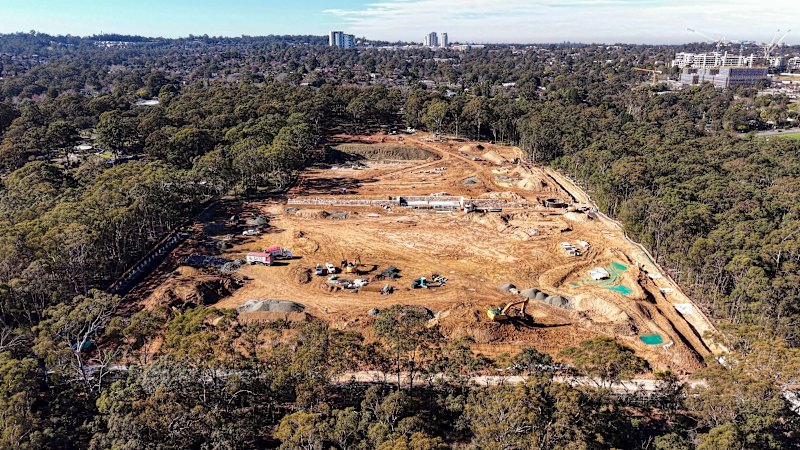
The Hills Shire Council is building three natural turf rugby fields on top of existing public open space at Fred Caterson Reserve, the site of a former pony club in Castle Hill.
Plans for a $16.6 million premier rugby union facility with playing fields, new lighting, an amenities building, and 185 parking spaces have attracted backlash from residents who say the fields should be for the community, not a private club. The facilities will be funded by developer contributions from the neighbouring Showground precinct where 9000 homes will be built.
The tussle over the piece of Crown land managed by the council echoes concerns across Sydney about how green space should be utilised, and how money for infrastructure projects should be spent.
Multiple closed-door meetings
Hills Shire Greens councillor Mila Kasby said there was “clear evidence that Eastwood Rugby was busy lobbying both council and Crown Lands. This is a strategically planned land grab that benefits a niche sporting club, not the local community who are footing the bill.”
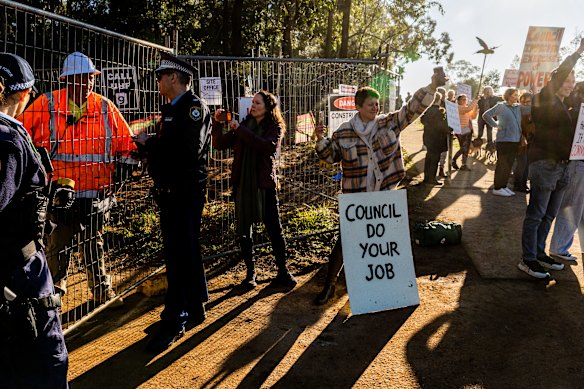 The stoush over the project has also created in-person clashes between residents and the police.Sam Mooy
Internal emails dating from 2017 reveal senior council staff – chief executive Michael Edgar and former head of strategy David Reynolds – and the rugby club’s former general manager Robert Frost held at least four in-person meetings about the reserve between February 2019 and February 2020.
Discussions happened before the council made expressions of interest public in August 2020.
“I thought it was a terrific meeting and I appreciate your indication that we are heading in a direction that will bring benefit to both parties. I’ll get you a draft shortly covering the concepts and the issues we discussed,” Frost wrote in a July 2017 email to Edgar and Reynolds.
Conversations had progressed significantly; by April 2019, Frost sent Reynolds and Edgar high-level renders of what the proposed fields could look like.
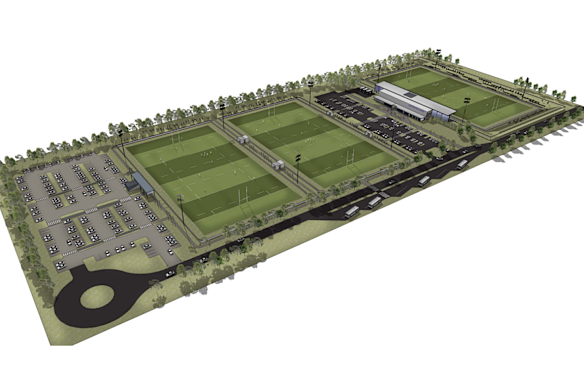 Eastwood Rugby Club commissioned architectural design firm Populous to draw up high-level concept plans of the space in 2017.Populous
Frost wrote in February 2020 that Reynolds’ “suggestion about the EOI timing sounds like a great option – you’ll understand how keen we are to move to the next stage”.
One month before the tender was made public, Frost wrote to Reynolds in July 2020 that “through an unusual set of circumstance, we have an opportunity to potentially direct more funding to the project (assuming of course that we end up as the successful tenderer).”
Frost said he did not want to infringe on any “normal protocols” but asked if he could explain an unspecified opportunity “in advance of any EOI”.
The parties discussed when the council would be briefed about the masterplan, and when the EOI process would be launched. The club also met then-sports minister Stuart Ayres in 2018 to discuss plans and potential funding, and requested the Hills Shire Mayor Michelle Byrne write a letter to Ayres supporting the fields.
Frost said the conversations, which were about making sure what Eastwood was looking for and what the council was looking for were aligned, were all above board. He spent years “talking to every council under the sun” after Eastwood sold their home grounds TG Millner Field in 2017.
“I don’t think there was anything sinister about it. It was the same kinds of conversations that anyone would have when you were trying to work out what might be possible in the future,” Frost said.
The council did not respond to questions about what details were shared with the club before the public tender process was launched, and did not say how many other applicants there were.
The council has maintained that once complete in spring of 2027, the fields would operate like any other in the Hills, with the public able to access them outside training and game times. A spokesperson said the council would deliver the facility for the community even if the ultimate user did not end up being Eastwood, as the memorandum of understanding with the club was non-binding.
Former Hills Shire councillor and now-MP for Hawkesbury Robyn Preston was an early advocate on the council for the rugby club, supporting the plans at a November 2020 council meeting. She, alongside chief executive Edgar and mayor Byrne, met the club at least twice in 2018 to discuss their relocation plans to Fred Caterson Reserve.
Legal battles and physical stand-offs
The council has also been locked in a legal battle with the community group in the Land and Environment Court over claims the development has not complied with environmental laws.
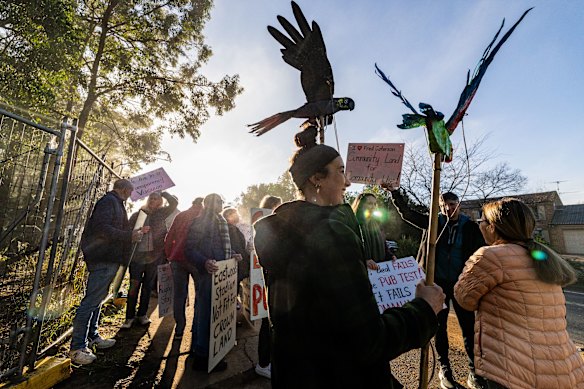 The reserve currently houses facilities for soccer, cricket, baseball, and a BMX track.Sam Mooy
The stoush over the project has also created in-person clashes. NSW Police officers were called to the construction site when the Herald visited, but the residents holding protest placards were on public land, and the officers left shortly after.
One of the council’s central arguments for supporting the three rugby fields has been what it sees as a shortfall of 42 playing grounds to accommodate the area’s booming population – cricket was one of the hardest-hit codes, along with soccer – but rugby was not mentioned.
Related Article
The council cited in the draft masterplan that there were about 12,000 soccer and 10,000 cricket players in the local area, but just 350 rugby union players, plus a high participation rate in private schools.
Susan Sandercock, a representative from the Fred Caterson Action Group, questioned why more cricket or soccer grounds had not been built instead, and said the project was a “blatant land grab”.
“This will never pass the pub test … We do not think it is appropriate that mates get access to decision-makers in council and then hold meetings behind closed doors to design a land grab to benefit an elite club.”
Start the day with a summary of the day’s most important and interesting stories, analysis and insights. Sign up for our Morning Edition newsletter.
Save
You have reached your maximum number of saved items.
Remove items from your saved list to add more.
 Cindy Yin is an urban affairs reporter at The Sydney Morning Herald.Connect via email.From our partners