
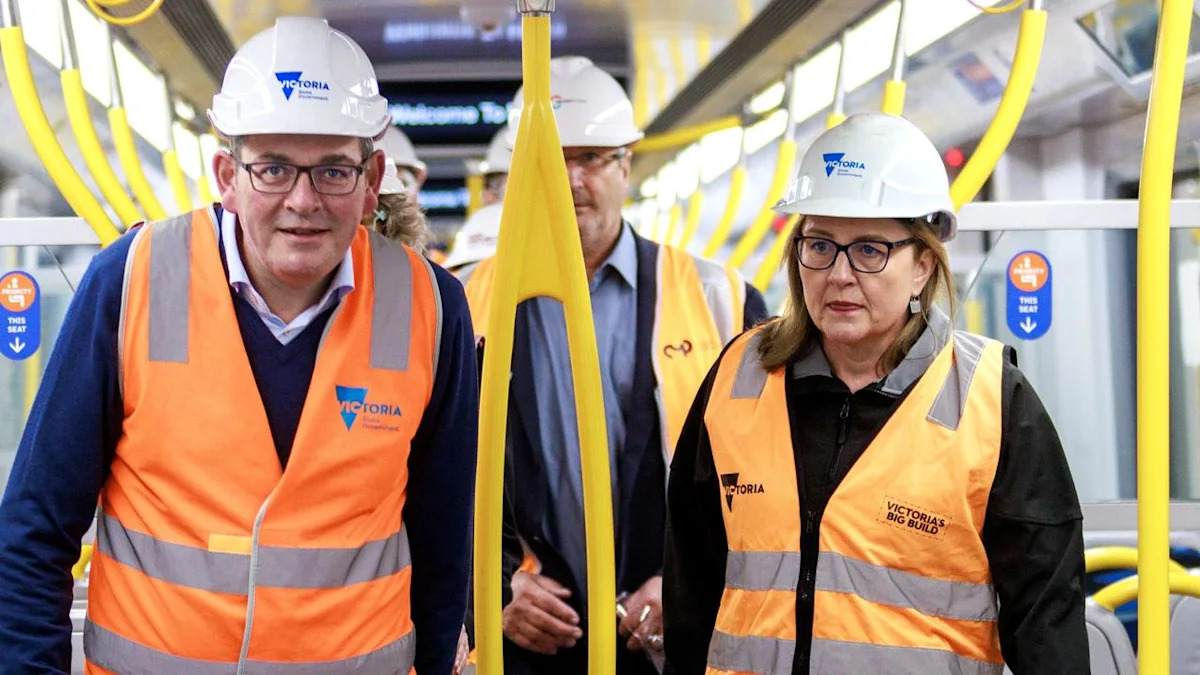
 Former Victorian premier Daniel Andrews and his successor Jacinta Allan have been blamed for dragging the state’s economy down. Picture: NewsWire / David Geraghty
Victoria’s unemployment rate is surging above the rest of the country, with the state’s “economic problems” showing up in official figures.
New data from the Australian Bureau of Statistics released on Thursday showed the national unemployment rate held steady at 4.4 per cent for the second month in a row.
However, Victoria lagged well behind with an unemployment rate of 5.1 per cent.
According to the ABS, nearly a third of the total unemployed people – 200,000 – now live in Victoria.
Independent economist Saul Eslake said the Victorian economy was continuing to drag on the national economy.
“Victoria has been underperforming the rest of the country for some time if you subtract from the impact that faster population growth has had in boosting headline growth,” he told Sky News.
“That is why over the last 20 years – predating the Andrews government but exaggerated by the Andrews and Allan government – Victoria has slipped from being one of Australia’s richest states to being the second or third poorest state depending on the measurement used.”
Economist Saul Eslake says the governments of recent Labor premier Daniel Andrews and Jacinta Allan have dragged the Victorian economy down. Picture: NewsWire / David Geraghty Economist Saul Eslake says Victoria has been lagging behind the rest of the nation for about 20 years. Picture: Chris Kidd
Mr Eslake said household disposable income per head in Victoria is now lower than Tasmania and is only ahead of South Australia.
He also noted the state is reliant on GST revenue to prop up its ailing economy.
Thursday’s unemployment figures has renewed pressure on Premier Jacinta Allan’s leadership just month’s from the Victorian state election on November 28.
Rumours are circulating that she could face a leadership challenge as early as next week when parliament returns.
More economic pain to hit Victoria
EQ Economics managing director Warren Hogan had another warning for Victorians, pointing out NSW and Victoria are the two most vulnerable states due to higher mortgage costs.
In a grim prediction for households, Mr Hogan said interest rates could be raised up to three more times – by a total of 75 basis points – returning the official cash rate above 5 per cent.
“Victoria already has a soft economy and it has a massively expanding government having an influence on everything, so the state will get hit hard if we have to see multiple rate hikes,”
Mr Hogan told Sky News’ Business Now program.
“The pressure relief valve around inflation could’ve been assisted if the governments of Australia pulled their spending a bit.
“But they all kept going and grew their spending around 3 per cent, when the economy’s potential is around 2 per cent.
“For the last two years, you’ve seen Victorian unemployment rise by almost two percentage points from around 3.25 per cent to now being over five per cent.”
VanEck senior portfolio manager Cameron McCormack agrees there could be more interest rate hikes, but is currently forecasting only one or two hikes by the end of the year.
“We believe there is at least one more rate hike coming this year, and a considerable chance that we will see two hikes,” he said shortly after the release of the data.
“Australia’s labour market is determined not to give the RBA the breathing room it needs.”
Mortgage holders are being warned of potentially multiple rate hikes. Picture: NewsWire / John Appleyard
Mr McCormack said the tight jobs market meant the economy was “close to full employment” for the second month in a row, firming the likelihood the Reserve Bank of Australia would increase interest rates to fight inflation.
“The RBA has greater freedom to focus squarely on inflation without a cooling in the labour market,” Mr McCormack said.
“The 4.75 per cent increase in minimum award wages – which took effect this month – introduces another source of upside inflation risk.
“Businesses in labour-intensive service industries are likely to face the greatest pressure to pass these higher costs on to consumers, and we are already seeing anecdotal evidence of this across areas such as restaurants and hospitality.”
He said the sharp rise in oil prices added another layer of inflationary pressure.
“If these pressures begin feeding more broadly into goods and headline inflation, the case for another rate hike could be brought forward,” he said.
More than 76,000 Australians found work in June, although 47,000 of these jobs were part time.
Meanwhile, 13,000 Aussies lost their jobs and the only reason unemployment didn’t fall is that the participation rate rose 0.3 per to 67 per cent.