
A pivotal medical training pathway launched at Bairnsdale Regional Health Service (BRHS) is set to bolster doctor retention in East Gippsland while ensuring clinical research directly reflects the needs of regional patients.
Developed by the Victorian Rural Generalist Program (VRGP) and the Australian College of Rural and Remote Medicine (ACRRM), the initiative allows doctors training in rural medicine to seamlessly combine frontline patient care with academic research, teaching, and medical education.
The pathway, co-funded by the VRGP and the federal Department of Health and Aged Care, aims to break the mold by proving that doctors do not need to relocate to metropolitan centres to build distinguished careers in research or academia.
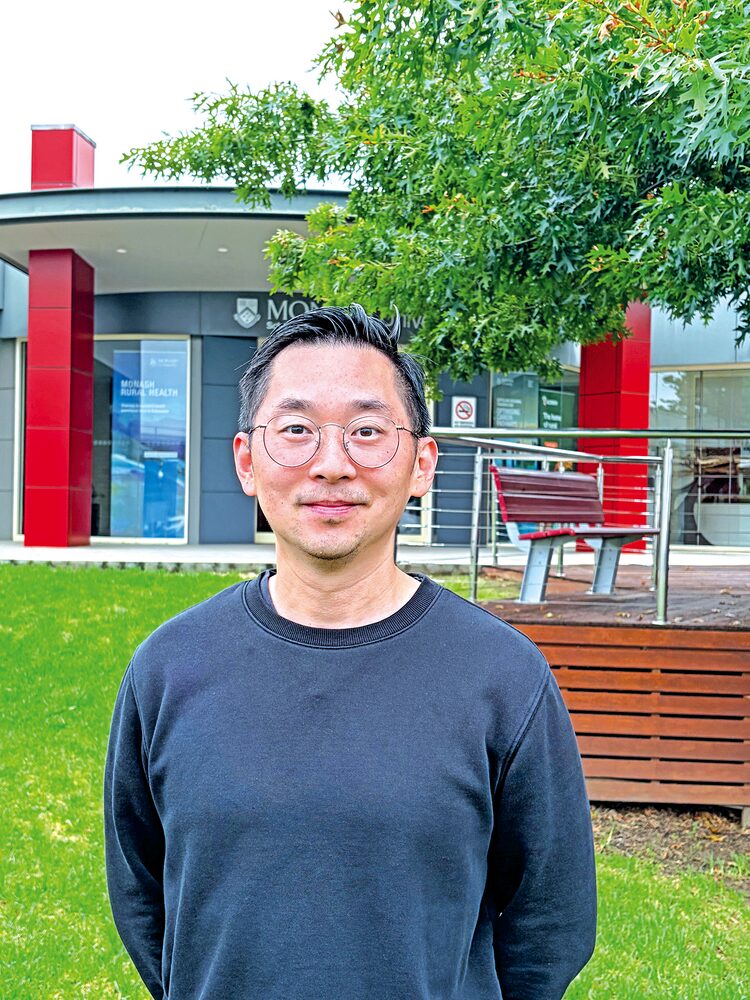
Dr Charlie Hsu has made history as the first doctor at BRHS to undertake the new pathway. He splits his time working as a community GP and a clinician in the BRHS Emergency Department, while simultaneously spearheading academic research focused entirely on regional healthcare challenges.
Dr Hsu, a final-year registrar completing his advanced training, noted that research conducted in major metropolitan hospitals often fails to align with the realities of regional medicine.
“Much of the health data we use comes from metropolitan health services and larger centres, and it is not always generalisable or applicable to rural areas,” Dr Hsu said.
“That is why we need rural health researchers finding data that is relevant to the communities they are working in.”
Attracted by the unique opportunity to train in rural medicine while living on the doorstep of East Gippsland’s iconic lakes, rivers, and coastline, Dr Hsu relocated to Bairnsdale in February 2024. Outside of the clinic, the keen windsurfer can be found kayaking, jogging, or cycling the East Gippsland Rail Trail.
As the program’s trailblazer, Dr Hsu hopes his framework will establish a clearer trajectory for future generations of regional clinicians.
“I hope being the first means I can help set up a good pathway for others to see that this is a viable and exciting opportunity,” he said.
BRHS chief executive Peter Abraham praised the initiative, stating that multi-dimensional training pathways are prime examples of how regional medicine can offer diverse, rewarding careers while actively strengthening local healthcare systems.
“By supporting rural doctors to undertake local research, the pathway has the potential to improve workforce sustainability and ensure future health services are shaped by evidence drawn from rural communities themselves,” Mr Abraham said.