
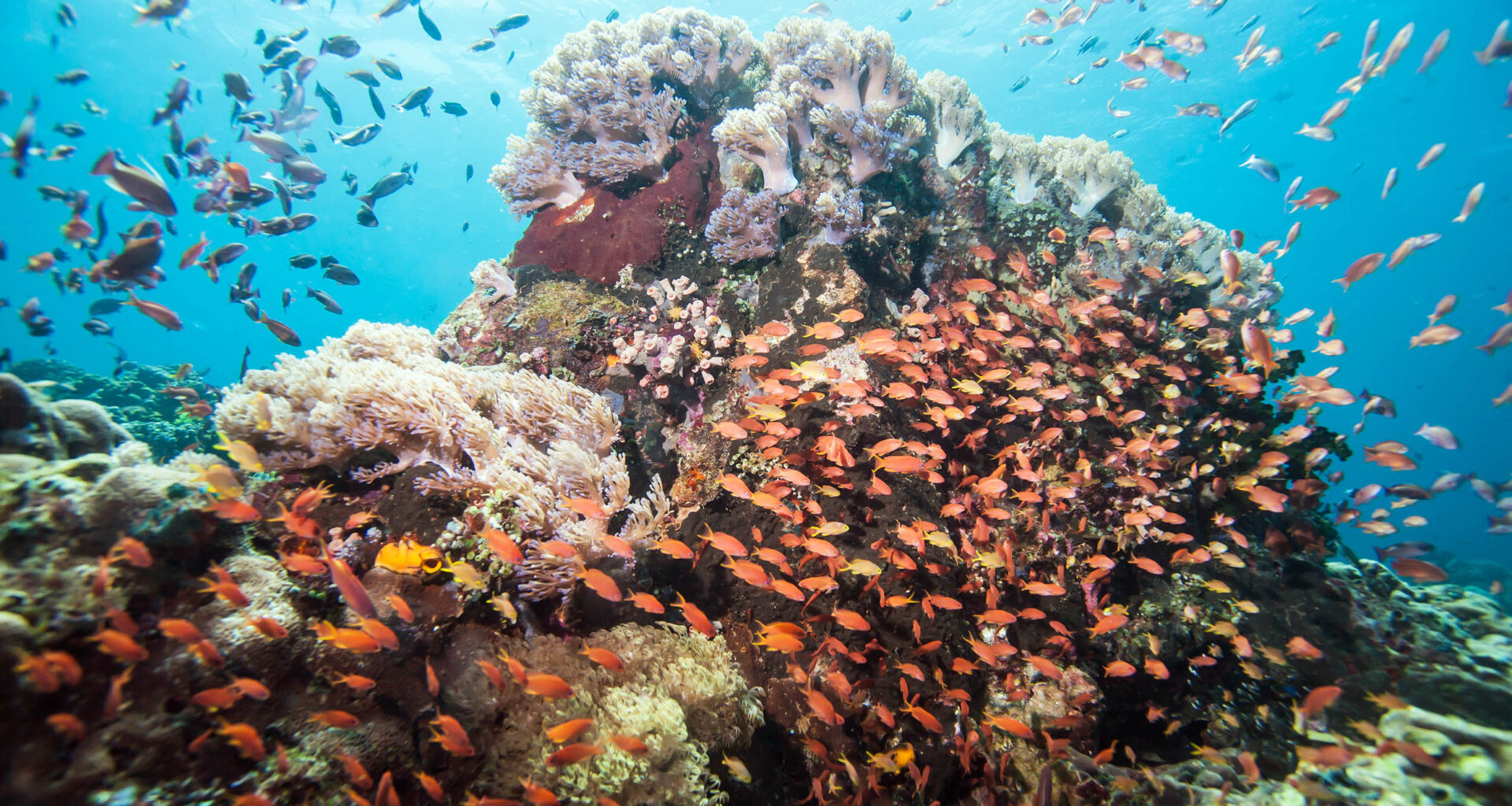
About a quart of seawater, dipped off the side of a boat above an Okinawan reef, holds enough shed coral DNA to confirm what species are growing on the bottom.
Researchers at the Okinawa Institute of Science and Technology (OIST) have now done that at 231 locations across the Ryukyu Islands of southern Japan.

All of it was released online for free on July 20. Click a dot on the map and you get the coral genera found there, ranked by share of DNA. The first release covers 12 islands, Okinawa south to Ishigaki.
Coral DNA drifts above the reef
Corals leak DNA all day. Mucus, sloughed tissue and cell debris come off a colony and float in the water directly overhead. Biologists call that loose genetic material environmental DNA (eDNA).
Adult corals cannot move, which makes them unusually cooperative subjects. DNA floating over a reef almost certainly came from that reef, not from something that swam past an hour earlier.
The sampling is dull work. Seawater goes through a fine filter on the boat, and at the lab a short stretch of mitochondrial DNA gets copied millions of times and sequenced. Each genus carries its own version, so the reads sort by name.
Building the reference library took years. Kanako Hisata and colleagues at OIST sequenced the mitochondrial genomes of 22 coral genera that had no usable record on file and re-sequenced 12 more.
They reported in Galaxea in May 2025 that the finished pipeline, Scl-eDNA-M, detects 83 of the 85 stony coral genera recorded in Japanese waters.
Divers and water samples mostly agree
Counting corals by eye is harder than it sounds. Identification leans on skeleton shape, and skeleton shape shifts with depth, light and wave exposure. Those 85 genera cover about 400 species. By the atlas team’s own estimate one dive survey turns up around 20 genera in 30 to 60 minutes of bottom time.
So the water had to be tested against people. For a 2023 paper in Proceedings of the Royal Society B, Koki Nishitsuji, Tomofumi Nagata and colleagues ran both approaches at 63 reef sites across about 155 miles (250 kilometers) near Okinawa Island. Snorkelers logged dominant genera while a boat crew filtered seawater overhead.
Of the 62 sites that gave up a sample, the lists matched strongly at 41 and moderately at 15, which the authors counted as agreement at better than 91 percent of locations. Four matched partially. Two shared nothing at all.
Dr. Takeshi Noda, a staff scientist in the OIST Marine Genomics Unit, told Earth.com the diver lists and the sequencing results showed good agreement across many sites.
“Although there are sometimes slight discrepancies in quantitative data between visual surveys and the eDNA method, our eDNA method offers higher detection sensitivity,” he explained.
Detailed taxonomic monitoring is slow going even for well-trained divers, Noda added, and the appeal of a jar of water is that “it enables objective and easy monitoring of coral reefs.” No dive clock, and no diver.
Seriatopora went missing from the shallows
Seriatopora, a fine-branched coral sometimes called bird’s nest coral, used to fill the shallow reefs of Okinawa Island.
Noda told Earth.com it was abundant there before 1998, the year a mass bleaching event tore through Pacific reefs, and that shallow-water populations around the island are now considered locally extinct.
The water says the same thing. “We rarely found Seriatopora eDNA in samples collected in the shallow reefs in Okinawa Island,” Noda said. The genus does turn up in samples from deeper water, where the sea stays cooler than it does at the surface.
Noda called Seriatopora a representative example of a coral that is weak to hot seawater, and said the atlas data reflect the decline of corals that cannot tolerate thermal stress. That is a pattern recorded in the field, not a mechanism anyone tested. Nobody heated a reef to watch what happened.
He also pushed back on an assumption about the reef photographs on the site, which the team does not use to measure change. “The coral photo collection plays a supplementary role on our site,” Noda said.
Researchers from the Okinawa Environmental Science Center and the survey firm Kaiyu shot the photos at 193 locations, from 2004 to 2024 around Okinawa Island and from 2001 to 2022 around Ishigaki, catching bleaching and crown-of-thorns starfish outbreaks as they happened.
Deeper reefs below the diving limit
Reefs do not stop where divers stop. Coral communities keep going down into mesophotic reefs, the dim band from about 100 to 490 feet (30 to 150 meters) that gets only a trickle of sunlight and almost none of the attention.
The atlas holds results from 57 mesophotic sites around Okinawa Island and the nearby Kerama Islands, sampled at roughly 100 to 200 feet (30 to 60 meters).
Getting down there took a small remote-controlled submarine. For a 2024 report in Royal Society Open Science, Nishitsuji’s team sent a mini-ROV to 24 sites around the Zamami Islands, drawing water a yard or two above the reef tops as deep as 260 feet (80 meters).
About a pint (half a liter) named the genera at every site but one. The telecom firm NTT Communications collaborated.
What came back was not a copy of the surface reef. Acropora, the fast-growing branching and tabletop coral that dominates shallow Okinawan reefs, accounted for less of the DNA as samples got deeper, while Porites, a slow mound-builder, accounted for more.
What coral eDNA cannot detect
Environmental DNA cannot measure how much of a reef is still alive. It reports which genera are present and in what share of the sequence reads, and Nishitsuji’s team wrote plainly that estimating coral cover is beyond the current method.
It also stops at genus. That matters, because Acropora alone contains dozens of species with very different tolerance for heat.
The published caveats go further. The approach assumes every coral sheds about the same amount of DNA per unit of surface, which the lab said it was still testing, and strong currents can import DNA from neighboring reefs, which is why the authors want at least two samples per site.
Because the primers target stony corals only, soft corals and the blue coral Heliopora stay invisible even where divers see them everywhere.
Bias runs both ways, too. Divers called Acropora more often than the DNA did, since tabletop colonies are easy to spot, while the DNA called Montipora more often, since many of those grow as easily missed crusts.
Acropora crowds the western shores
One result from the first survey round still has the team guessing. Noda told Earth.com that Acropora turned out to be the most dominant coral along the northwest shore of Okinawa Island, and that the same western bias showed up even more clearly around Ishigaki Island.
“The reason for such distributions is not yet clear, but it is an interesting finding that warrants further investigation,” Noda said.
The 2023 survey saw a version of the same thing, with Acropora heaviest on slopes facing the South China Sea and mixed communities more common on the Pacific side. Currents and coastal shape are the obvious suspects, and the authors left it there.
Faint read counts in that survey also put two genera at Okinawa Island that had never been formally recorded there, the kind of hint a snorkeler would be unlikely to spot.
Reference sequences for all of Japan
Scaling up is more a library problem than a boat problem now. Noda said reference sequences for every zooxanthellate stony coral in Japan are already prepared, so extending the atlas to the rest of the country is possible today.
“Our method is likely applicable to monitoring coral reefs in the North Pacific with slight modifications,” he said.
The Atlantic is harder. Noda explained that the Caribbean and Florida corals differ so much from Pacific ones in taxonomy that the system would need major modification before it could monitor those reefs.
The stakes are not abstract. Reefs cover about 0.2 percent of the ocean and shelter close to 30 percent of marine species, and in Okinawa they are payroll too, credited with about $1.5 billion in economic value in fiscal 2023.
Reef losses worldwide have continued climbing after the global bleaching event that NOAA’s Coral Reef Watch confirmed in April 2024, the fourth on record.
When the next hot summer arrives here, losses can be counted site by site against what the water already recorded.
The full study was published in Galaxea, Journal of Coral Reef Studies, released on J-STAGE.
Atlas: Ryukyu Islands Coral eDNA Atlas, OIST Marine Genomics Unit and Okinawa Environmental Science Center, released July 2026.
—–
Like what you read? Subscribe to our newsletter for engaging articles, exclusive content, and the latest updates.
Check us out on EarthSnap, a free app brought to you by Eric Ralls and Earth.com.
—–